Compare Smart Watches for Men: A Practical Guide
A data-driven guide to compare smart watches for men, focusing on battery life, comfort, OS compatibility, health tracking, and value to help you choose with confidence.


When you compare smart watches for men, prioritize battery life, wear comfort, and platform compatibility first. Look for a watch that fits your wrist, lasts through your typical day, and works smoothly with your phone’s ecosystem. This side-by-side guide helps you identify the best value based on real-world use and lasting performance.
Why compare smart watches for men matters
Choosing a smartwatch for men is not just about branding or the latest hardware. The right watch integrates with daily routines, fitness goals, and your smartphone ecosystem. A practical comparison assesses comfort, durability, and battery life, then weighs how software and app availability align with your needs. The Smartwatch Facts team emphasizes a methodical approach: start with your top three priorities, filter options that meet them, and validate claims with real-world usage tests. This section lays the groundwork for a structured evaluation you can apply to any future purchase, from gym workouts to office wear and travel. By grounding decisions in real-world scenarios—commuting, workouts, sleep tracking, and casual wear—you reduce the risk of buyer’s remorse and end up with a watch that truly fits your life.
Core criteria: durability, comfort, and fit
Durability begins with materials (stainless steel vs aluminum), screen protection (glass vs sapphire), and the watch’s overall bezel design. Comfort depends on weight, case size, and strap choice (silicone, fluoroelastomer, leather, or metal). For men with larger wrists, a compact case can feel clunky, while a bulky pro-grade design can hinder daily wear. A good rule: test the watch for a full workday, ensuring it sits securely without rotating excessively on the wrist. Consider lug-to-lug measurements and whether the strap system allows quick changes. Materials and finish influence not only aesthetics but sweat management and skin comfort over hours of wear. In a practical comparison, prioritize models offering multiple strap options and adjustable fits to accommodate different activities.
Screen technology and readability in sunlight
Display quality significantly affects usability. Look for high contrast, bright panels, and outdoor readability. OLED/AMOLED displays typically offer deep blacks and vibrant colors, which your eyes appreciate during workouts or navigation. Be mindful of glare in bright sun sessions—some screens have anti-reflective coatings or higher peak brightness to mitigate this issue. Always check viewing angles, touch responsiveness, and glove compatibility if you wear gloves during outdoor activities. A smartwatch that remains easy to read in daylight reduces the need to remove it for readability checks, improving daily usability and satisfaction.
Battery life reality and charging patterns
Battery life is one of the most cited differentiators. Real-world endurance depends on use: GPS-heavy workouts, always-on displays, heart-rate tracking, notifications, and mobile payments all affect longevity. When comparing, map your typical day: how often you check notifications, how many workouts you log, and whether you use features like continuous SpO2 monitoring. Some models offer fast charging or wireless charging, which can shorten “down” time when you’re in a busy schedule. Consider endurance in relation to charging cadence: a watch that lasts 2 days but takes 2 hours to recharge can be more convenient than a 5-day endurance but requires long pauses for charging.
Operating systems and app ecosystems for men
Compatibility is a practical gatekeeper. If you live in the iOS ecosystem, prefer watches with seamless iPhone integration, robust health apps, and quick access to notifications. Android users benefit from broader customization, Google/Android Wear features, and easier cross-device syncing. Some watches offer limited third-party app support, while premium models showcase expansive ecosystems. When comparing, note which health apps, music services, and payment integrations are supported, and whether there are any platform-specific limitations that would hinder daily usage. The goal is to select a watch that feels native to your phone and enhances routine interactions rather than adding friction.
Fitness and health tracking details
Modern men’s smartwatches bundle heart rate sensors, GPS, accelerometers, SpO2, and sometimes ECG. Consider which metrics matter most for your routine—distance tracking, sleep analysis, stress monitoring, or VO2 max. Sensor accuracy varies by price tier, but you should expect solid defaults across all models: consistent heart-rate readouts, reliable calorie estimates, and dependable GPS data during runs or cycles. Review features like automatic workout detection, running power, and recovery insights. Remember that more sensors often come with higher energy use, so balance the need for data with battery life expectations. A well-rounded device provides actionable insights without overwhelming you with data.
Design language and size considerations for different wrists
Men’s watches come in a wide array of designs—from sport-forward bezels to sleek, minimalist cases. The case size should feel proportional to your wrist circumference; a 42–44 mm range is common for medium wrists, while larger wrists may benefit from 46–50 mm cases. Weight matters for all-day wear; heavier watches can cause discomfort during long sessions, while lighter models may feel less substantial. Strap choice affects both comfort and style—silicone is ideal for workouts, leather for office wear, and metal for dressier outfits. Look for adjustable bands, quick-release pins, and a comfortable clasp system. A comfortable watch with a flattering look improves both daily wear and confidence in social settings.
Water resistance and durability for everyday wear
Daily wear includes exposure to rain, sweat, showers, and occasional immersion. Verify water resistance ratings (e.g., 5ATM or 50 meters) and ensure seals and crown protections are robust. While ratings provide a baseline, real-world durability also depends on build quality, gasket integrity, and strap attachment reliability. If you’re active outdoors, consider watches with reinforced cases, scratch-resistant glass, and secure strap systems to withstand vigorous activities. Your choice should strike a balance between ruggedness and comfort, avoiding overbuilt models that feel bulky for everyday use.
Price bands, value, and total cost of ownership
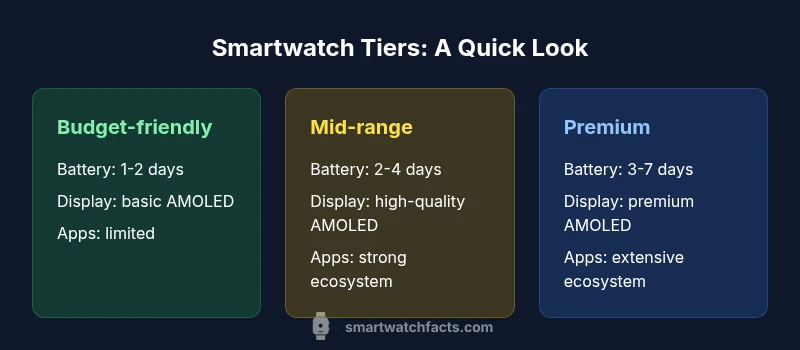
Smartwatches span multiple price bands. Budget models typically offer core health tracking, basic notifications, and decent battery life for casual wear. Mid-range devices add better displays, longer battery life, and broader app ecosystems. Premium or flagship models bring advanced sensors, faster processors, richer health features, more durable materials, and wider payment/app support. When evaluating price, consider the total cost of ownership: band replacements, extended warranties, and potential software subscriptions. A careful assessment helps you identify which tier delivers the best long-term value for your needs and how much you’re willing to invest in aesthetics, durability, and capabilities.
How to structure a side-by-side comparison
A disciplined approach helps readers see differences clearly. Start with a short summary of each option (e.g., Budget-friendly, Mid-range, Premium) and then align features by category: battery, display, OS, sensors, size, and price. Present a 3-column comparison table so readers can quickly scan. Then add a concise narrative for each option that highlights strengths and caveats. Finally, recommend a best-for scenario for each tier: best for budget constraints, best for feature-rich experience, and best for premium materials and expansive app ecosystems.
Testing and evaluating models before buying
Before purchasing, perform hands-on checks. Try wearing the watch for at least 20 minutes in common scenarios (standing, walking, typing, commuting) to assess comfort and readability. Test the strap’s adjustability, sensor responsiveness, and GPS accuracy outdoors. Check notification workflow and haptic feedback—these tactile cues matter in noisy environments. If possible, simulate typical activities you’d do daily: gym, office work, and quick errands. Finally, verify return policies and warranty terms so you have flexibility if the watch doesn’t meet your expectations.
Real-world usage scenarios: gym, office, outdoors
For gym use, prioritize a secure strap, comfortable weight, and precise heart-rate tracking. In office environments, a watch with strong notification handling, quick replies, and a discrete look can improve productivity. For outdoors and travel, GPS accuracy, reliable battery life, and robust case design matter most. When you compare smart watches for men with these scenarios in mind, you’ll identify devices that adapt to your routine rather than disrupt it. The end goal is a watch that feels like a natural extension of your daily life, not a gadget you rarely wear.
Feature Comparison
| Feature | Budget-friendly | Mid-range/Feature-rich | Premium/Flagship |
|---|---|---|---|
| Battery Life (real-world) | Budget-friendly: 1-2 days | Mid-range/Feature-rich: 2-4 days | Premium/Flagship: 3-7 days |
| Display & Build | Basic LCD or entry AMOLED, lighter build | High-quality AMOLED, better outdoor readability | Premium AMOLED, sapphire glass, rugged casing |
| OS & App Ecosystem | Limited third-party apps, solid basics | Broad app support, strong health suite | Extensive ecosystem, premium apps, more customization |
| Health Sensors | HR, step counting, basic sleep | Heart rate, SpO2, HRV, sleep stages | ECG, advanced SpO2, sleep, stress metrics |
| Price Range | $100-$200 | $200-$400 | $400-$800 |
| Best For | Budget-conscious users | Tech enthusiasts seeking balance of features and value | Users who want premium materials and the broadest app library |
Strengths
- Helps identify the best overall value by tier
- Clarifies ecosystem compatibility across devices
- Highlights comfort and durability for daily wear
- Reveals long-term costs like bands and warranties
Weaknesses
- Can overwhelm with choices and jargon
- Prices fluctuate with sales and promotions
- Some manufacturers overstate battery life or accuracy
A balanced mid-range option often delivers the best overall value.
Mid-range watches typically offer a strong mix of battery life, app support, and durable design. They provide practical features without the premium price tag. For many men, this tier hits the sweet spot between value and capability.
People Also Ask
What should I prioritize when comparing smart watches for men?
Start with battery life, comfort, and platform compatibility. Then assess sensors and app ecosystem to ensure ongoing value. Finally, factor in price and potential accessories or warranties.
Prioritize battery life, comfort, and OS compatibility first, then check sensors and apps before buying.
Do smartwatches work equally well with iPhone and Android?
Not all watches offer equal support across platforms. Some work best with iPhone due to tighter integration, while others provide broad compatibility with Android and cross-device features.
Some watches work best with iPhone, others with Android; check compatibility before buying.
Is GPS necessary for everyday wear?
GPS is essential if you run or hike regularly, but many daily users rely on phone GPS indirectly. If you want precise outdoor tracking, choose a model with reliable GPS.
If you run or hike often, pick GPS; otherwise you can rely on phone GPS for most days.
How accurate are health sensors on affordable models?
Entry-level and mid-range watches provide solid heart-rate and activity data, but precision can vary. For medical-grade insights, confirm ECG or clinical-grade options in higher tiers.
Health sensors on affordable models are good for general tracking, not medical-grade accuracy.
What wrist size should I consider?
Measure your wrist circumference and try models within the common 42–46 mm range for a balanced fit. Ensure adjustable bands or quick-release options to tailor the feel.
Know your wrist size and choose a case that fits 42–46 mm well with adjustable bands.
Are rugged or outdoor-focused smartwatches worth it for men?
If you’re outdoors often, rugged designs offer durability and reliability with features like reinforced cases and better water resistance. For casual wear, a slimmer design may be more comfortable.
Yes, rugged watches are good for outdoors, but choose based on how much you need durability vs style.
Key Points
- Focus on battery life and comfort first
- Match watch OS to your phone ecosystem
- Evaluate total ownership costs, not just price
- Test in real-world scenarios before buying
- Choose a tier that fits your daily routine