Are Smartwatch BP Readings Accurate? What Shoppers Should Know
Explore how blood pressure readings from smartwatches work, how accurate they are, and how to use cuff-based measurements alongside wearables for safer, smarter health tracking.


Are smart watch bp readings accurate? In general, wrist-based BP readings are not as precise as cuff-based monitors and should not be used for diagnosing or treating hypertension. Wearables often provide approximate values influenced by wrist position, movement, skin tone, calibration, and sensor quality. For medical decisions, rely on validated cuff-based devices and discuss any concerning results with a clinician.
How BP Readings from Smartwatches Work
Many readers ask, are smart watch bp readings accurate? The short answer is that most devices estimate blood pressure using cuffless methods rather than true cuff-based oscillometry. The core approach relies on photoplethysmography (PPG) to track how blood volume changes with each heartbeat and, in some cases, derives pulse transit time (PTT) or other surrogate signals. Those signals are then fed into an algorithm calibrated with baseline cuff measurements. The result is an estimated systolic and diastolic value that can be displayed on the watch screen or synced to a companion app.
The Smartwatch Facts team notes that accuracy is highly device-dependent. In controlled lab settings, some devices show reasonable correlation with cuff readings for healthy adults, yet the same models can diverge in real-world conditions. Factors such as wrist position, recent activity, ambient temperature, hydration, caffeine intake, and even skin tone can influence sensor readings. Because these estimates hinge on multiple, sometimes unstable variables, a single BP value from a watch should not be treated as diagnostic. Rather, observe trends over time and corroborate with a validated cuff device when there is a concern.
From a clinical perspective, cuff-based measurements remain the reference standard for diagnosing hypertension. Smartwatches offer a convenient, noninvasive way to monitor changes day to day, which can be useful for discovering patterns, flagging potential issues, and prompting timely conversations with a clinician. In other words, wearables are best used as a supplementary tool rather than a replacement for traditional BP monitoring.
The introduction of cuffless BP measurement in wearables represents a valuable consumer feature, but it carries limitations that both users and clinicians should recognize. The Smartwatch Facts analysis from 2026 emphasizes that the value lies in longitudinal trends and patient awareness, not in definitive clinical decision-making.
What the Numbers Mean in Everyday Use
For most people, blood pressure fluctuates throughout the day due to activity, stress, posture, and circadian rhythms. When a smartwatch reports a BP value, it is offering a point estimate anchored to its calibration and measurement model. Because readings can drift with small changes in how you wear the device or where you position your wrist, it is essential to interpret numbers as one data point among many. The practical takeaway is not to chase exact numbers, but to look for consistent patterns: Is your BP generally higher in the morning, or does it drift upward after a workout? Do you see a sudden spike that repeats across multiple readings? These patterns matter much more than any single value.
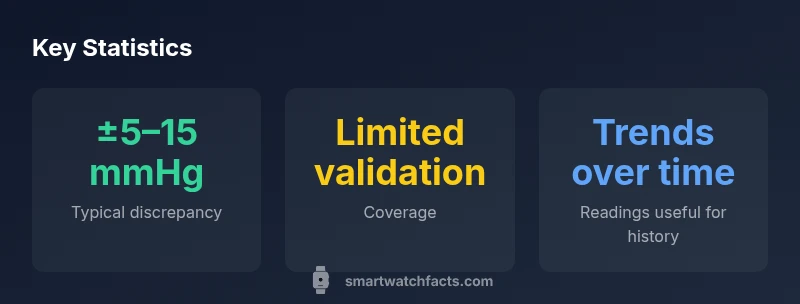
Keep expectations realistic. If you typically measure 120/80 with a cuff monitor, your smartwatch might occasionally report readings within a 10–15 mmHg range of that value under quiet, still conditions. In motion or during exertion, the gap may widen. For most healthy adults, occasional watch readings that deviate from their cuff standard do not automatically indicate hypertension. If readings show persistent elevated values, or if you experience symptoms such as headaches, dizziness, or chest discomfort, seek medical evaluation. The key is consistency over time rather than precision at every moment.
In sum, are smart watch bp readings accurate? They can reflect relative changes and daily trends, but they are not a substitute for cuff-based measurements. Treat watch results as informative cues and verify with a clinician when in doubt.
Validation and Standards You Can Trust
When evaluating BP readings from wearables, look for evidence of independent validation. Some manufacturers publish validation studies performed in laboratory settings, but the gold standard remains clinical validation under standardized protocols. Reputable sources emphasize that cuff-based monitors validated against recognized reference devices offer the most reliable measurements. In the absence of robust, device-specific validation, consider BP results from wearables as exploratory data rather than medical evidence. Smartwatch Facts’ 2026 analysis highlights that many popular wearables have not undergone large-scale, independent validation, even if they offer convenient BP monitoring features. If a device is not clearly validated, approach its numbers with heightened caution and prioritize cuff measurements for diagnosis and treatment decisions.
Clinicians often require that BP measurement devices demonstrate accuracy within a clinically acceptable error margin across diverse populations and use contexts. Until wearables consistently meet those standards, patients should use cuff-based readings for any clinical decisions and use smartwatches to observe trends or to prompt further testing.
Calibrating and Wearing Properly
First, calibrate if your device requires it. Calibration typically involves taking cuff readings with a validated cuff device and syncing the cuff and wearable data. Calibration can improve alignment between the smartwatch estimates and cuff measurements, but it does not guarantee universal accuracy across all scenarios. When wearing the device, keep the wrist at heart level and avoid flexing the wrist, talking, or moving dramatically during reading captures. Loose or overly tight wear can degrade signal quality; aim for a snug, stable position similar to how you would wear a watch for daily use.
Alerts about poor signal or inconsistent readings should be heeded. If the device indicates poor signal due to movement or low blood perfusion, pause activity, re-establish a stable posture, and retake the measurement. Routine calibration and careful wearing habits are the most reliable steps you can take to minimize random error and maximize the usefulness of cuffless BP readings for non-clinical tracking.
Interpreting Trends vs Single Readings
The most valuable aspect of BP data from wearables is its ability to reveal trends over time. Even if individual readings are imperfect, a consistent drift upward over days or weeks can signal a health concern worth discussing with a clinician. Conversely, a temporary spike associated with exercise or caffeine may not indicate a problem if subsequent readings return to baseline. Use wearable BP data to:
- Build a personal baseline through several days of measurements
- Observe how lifestyle changes (salt intake, activity, sleep) affect your BP trajectory
- Share trend data with your healthcare provider to contextualize cuff measurements
Remember: health is context-dependent. Your clinician will interpret BP values within your medical history, concomitant medications, comorbidities, and current symptoms. Wearables add a practical layer to ongoing monitoring but should not be the sole basis for treatment decisions.
Practical Tips for Consumers
If you decide to use BP readings from a smartwatch, consider the following best practices to improve usefulness:
- Calibrate and calibrate again if required by your device.
- Take multiple readings in a calm, seated position with your arm supported at heart level.
- Record readings at similar times each day to establish a reliable baseline.
- Note movement, stress, caffeine, and meals, which can bias readings.
- Compare watch trends with cuff-based measurements periodically, especially if values are high or notably low.
- Use the companion app to visualize graphs, not just individual numbers.
- Do not base medical decisions on a single reading—consult a clinician for persistent abnormalities.
These strategies help translate cuffless BP data into practical everyday use without overinterpreting the numbers.
When to Rely on cuff-Based Readings
For diagnostic or medication decisions, cuff-based measurements remain the standard of care. An automatic cuff or manual auscultatory method, performed correctly, yields a higher level of accuracy and reproducibility essential for clinical interpretation. Wearables can support ongoing monitoring and help identify patterns that warrant a clinic visit, but most guidelines still require cuff-based confirmation for diagnosis, treatment adjustments, or risk stratification. If you notice sustained elevations, schedule an in-person measurement with your healthcare provider and bring a log of smartwatch readings to discuss.
Real-World Scenarios and Myths Debunked
Myth: If a smartwatch shows a normal reading, I’m in perfect health. Reality: readings fluctuate, and one normal value does not guarantee an all-clear. Myth: All wearables are equally accurate. Reality: There is meaningful variation across brands and devices, with some models offering more robust validation than others. Myth: BP wearables can replace a doctor’s visit. Reality: They are supportive tools for trends, not stand-alone diagnostic devices. Smartwatch Facts emphasizes the importance of critical use and clinician consultation when readings deviate from your baseline or when symptoms arise.
Future Directions: What to Expect in BP Wearables
The wearable-tech landscape is evolving with new sensors, better calibration methods, and more rigorous validation studies. Advances in cuffless BP estimation aim to improve accuracy, reduce dependency on wrist position, and deliver clinically meaningful data. Researchers are exploring multi-sensor fusion, machine learning improvements, and personalized calibration frameworks. While progress is promising, patient safety will hinge on transparent validation, clear labeling, and appropriate clinical guidance. For now, expect better trend detection and more reliable consumer-focused indicators, not universal clinical-grade measurements.
Comparison of BP measurement methods for wearables and cuff-based devices
| Measurement Method | Pros | Cons |
|---|---|---|
| Cuff-based (arm cuff) | High accuracy, gold standard | Requires a cuff, can be inconvenient |
| Cuffless wrist-based (PPG) | Convenient, continuous tracking | Variable accuracy, sensitive to motion and positioning |
| Pulse Transit Time (PTT) | Research-focused, potential future accuracy | Limited consumer validation, complex setup |
People Also Ask
Are smartwatch BP readings accurate enough for medical decisions?
No. Wearable BP readings generally reflect estimates and trends, not definitive clinical measurements. They can vary by device and conditions. Rely on cuff-based readings for diagnosis and treatment, and use wearables to monitor patterns and alert you to potential issues.
Wearable BP readings are best for trends, not medical decisions. Always confirm with cuff measurements if readings are concerning.
Do all smartwatches measure BP?
No. Only some devices offer BP estimation, often based on cuffless sensors and calibration. Availability and accuracy vary by brand and model, and not all are independently validated.
Not every smartwatch measures BP, and those that do vary in quality and validation.
How should I take readings to improve accuracy?
Follow device instructions: stay still, wear the watch properly, calibrate if required, and take multiple readings over time rather than relying on a single value.
Stay calm, keep your wrist steady, and take several readings to spot trends.
Can movement affect BP readings on wearables?
Yes. Movement, temperature changes, and sensor contact quality can skew cuffless BP estimates. Minimize motion during measurement and recheck after resting.
Movement can throw off BP readings; rest and retake when things are calm.
What about BP monitoring during sleep?
Some wearables offer passive BP-related data overnight, but accuracy is often lower than daytime readings. Use it as a trend indicator and validate with cuff measurements if needed.
Sleep BP data can be interesting, but don’t base decisions on it without cuff validation.
How can I tell if a BP wearable is validated?
Check for independent validation studies published in medical literature or by recognized hypertension societies. Look for clear methodology and disclosures from the manufacturer.
Look for independent validation and published methods to trust a BP wearable.
“Wearable BP features can empower daily health awareness, but they should complement—not replace—clinically validated measurements.”
Key Points
- Treat smartwatch BP readings as informational, not diagnostic
- Use cuff-based measurements for medical decisions
- Look for independent validation claims for wearables
- Track trends over time, not single readings
- Calibrate and wear correctly to improve data quality