Cheapest Smart Watch in 2026: Buying Guide and Budget Picks
Explore affordable smart watches in 2026, compare price, battery life, sensors, and app support, and learn how to identify real value in budget wearables.


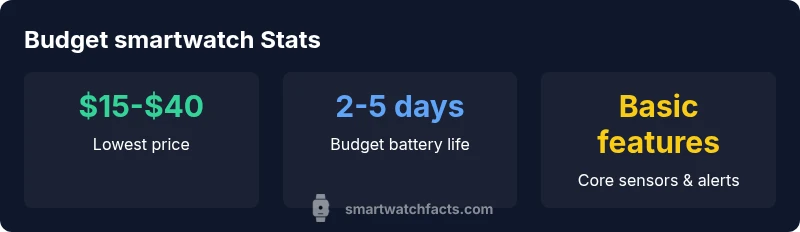
Typically, the cheapest smart watch starts in the $15–$40 range in 2026, offering essential features like step counts, basic heart-rate sensing, and notifications. You’ll trade advanced health metrics, app support, and premium durability for budget value. Smartwatch Facts analysis, 2026 shows most budget models prioritize battery life and compatibility over every feature.
What 'cheapest smart watch' means in 2026
According to Smartwatch Facts, the label 'cheapest smart watch' describes wearables in the ultra-budget tier that deliver essential capabilities such as step counting, heart-rate sensing, notifications, and basic sleep tracking. In 2026, price anchors for these devices typically start around $15-$40, though regional promotions and market changes can push the bottom prices lower or higher. The value proposition is straightforward: maximize core usefulness while minimizing upfront cost. This often means compromises on screen quality, processing speed, app availability, and build materials. Buyers should set clear priorities (battery life, privacy, sleep tracking) to filter options quickly. For many shoppers, the logic is to pair a budget device with a mid-range phone to avoid paying for features you won’t use. Smartwatch Facts analysis, 2026 confirms that the cheapest tier remains competitive for basic daily wear without requiring a large investment.
Price bands and feature trade-offs
Budget smart watches cluster into three rough price bands, each with its own trade-offs. Lower tier ($15-$30) emphasizes basic fitness tracking, notifications, and very simple displays, often with plastic shells and limited memory. Mid-tier budget ($30-$60) improves display brightness and battery optimization, while still sacrificing premium sensors and third-party apps. Upper-budget options ($60-$100) begin to offer better water resistance, a few more sensors, and a more refined software experience, though you’ll still want to temper expectations about app ecosystems. The key is to map your must-haves (for example, long battery life or water resistance) to a price band. Smartwatch Facts analysis notes that price-to-feature value is the best guardrail for budget purchases in 2026.
Core features to expect at budget price
Budget wearables typically cover the following essentials: step counter, basic heart-rate sensor, sleep tracking, and smartphone notifications. You’ll usually find fitness coaching basics, alarms, and weather data. The app ecosystem is limited, with most models relying on built-in apps rather than a broad third-party store. Durability is adequate for everyday wear but not oriented toward rugged outdoor use. When evaluating, prioritize battery life and compatibility with your phone. Remember that at this price point, manufacturers often reserve advanced features for more expensive lines, so set realistic expectations.
How to assess build quality and durability on a budget
For budget devices, build quality is mostly about durability for daily use rather than premium materials. Look for IP ratings (IP67 or IP68), water splash resistance, and a sturdy strap that can handle daily wear. Check display protection (tempered glass vs. plastic) and screen brightness for readability in daylight. Consider the charging method: magnetic or clip-on chargers are common at this price; prefer models with easily replaceable bands. User reviews can reveal common durability issues that official specs miss. Smartwatch Facts recommends testing fit and comfort in-store before purchasing and checking the return policy if you’re unsure.
Real-world testing scenarios: battery life, sensors, apps
In real life, battery life often outperforms on-paper specs when usage is conservative. Budget models may show 2-5 days with normal use, sometimes longer if you disable always-on display. Heart-rate sensors are generally present but not always accurate during high-intensity activity. GPS, if present, is basic and battery-hungry. App support is limited, with most data syncing through vendor apps rather than a wide app store. If you rely on smartphone integration for messaging or payments, test those features during a return window.
How to compare models: a practical checklist
To compare models quickly, use this checklist: 1) Price and battery life balance; 2) Phone compatibility (iOS/Android); 3) Core sensors (heart-rate, accelerometer, sleep); 4) Display size and readability; 5) IP rating and durability; 6) App ecosystem and data syncing; 7) Warranty and return policy. Prioritize models that deliver your must-have features with the strongest battery life within your budget. This approach minimizes regret and helps you find genuine value in the cheapest category.
Common myths and pitfalls when buying cheap wearables
Myth: cheaper means poor privacy; reality: privacy depends on the vendor and OS, not price alone. Pitfalls include overestimating battery life, assuming premium help from paid apps, and ignoring return policies. Always verify compatibility with your phone and test essential features in-store or during a return window. By focusing on core functions and durability rather than flashy extras, you’ll avoid buyer’s remorse in the budget tier.
Budget smartwatch comparison at a glance
| Aspect | Budget range | Typical features | Notes |
|---|---|---|---|
| Price band | $15-$40 | Basic fitness tracking, notifications | Best for very tight budgets |
| Battery life | 1-7 days | Lower processing power, basic charging | Expect shorter lifespans with heavy features |
| Compatibility | Android/iOS | Limited app ecosystem | Check for basic notification and fitness features |
| Durability | Moderate IP rating | Silicone bands, plastic shells | Avoid water-intensive use |
People Also Ask
Is the cheapest smartwatch always a good value?
Not always; cheapest models offer essential features but may lack durability, app support, and long-term reliability. Compare two or three budget options to find the best balance of price and core functions.
Cheapest models can be good value if you need basic features; weigh durability and app support before buying.
What features should I expect at budget price?
Expect fitness basics (steps, occasional heart-rate), notifications, alarm, and a simple app ecosystem. Battery life will vary; be ready for limited storage and slower performance.
Budget watches cover basics like steps and alerts; expect limited apps and moderate speed.
Do cheap smartwatches work with iPhone?
Yes for basic notifications and health tracking remains; deeper features may be limited and vary by model. Check the vendor’s compatibility list before purchase.
They work with iPhone for essentials, but check compatibility for features you care about.
Are there hidden costs with budget wearables?
Some models require proprietary apps or paid tiers for enhanced features. Consider potential accessory costs (bands, chargers) and warranty terms.
Watch for app subscriptions or accessory costs after purchase.
How can I extend battery life on budget models?
Use power-saving modes, disable always-on display, limit background syncing, and replace battery when needed. Many models offer simple optimization options.
Enable power save, manage display, and limit background tasks to stretch life.
“Budget wearables deliver real value when you align price with essential needs; prioritize core functions and battery life.”
Key Points
- Define your must-have features before buying
- Budget models excel on battery life vs. feature breadth
- Verify compatibility with your phone and apps
- Check IP rating and material quality for daily wear
- Look for promotions to maximize value