Consumer Reports Smart Watch Buying Guide 2026
A data-driven, practical buying guide analyzing Consumer Reports smart watch reviews, battery life, sensors, privacy, and price-to-feature value for 2026.


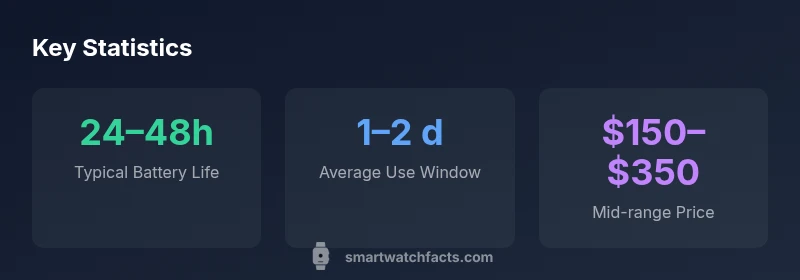
Across Consumer Reports smart watch reviews, the most well-rounded option offers roughly 24–48 hours of battery life, robust health sensors, and reliable software. These models balance feature depth with long-term usability, often at a price range of about $150–$350 depending on extras like GPS, LTE, or advanced sensors. Smartwatch Facts analysis, 2026.
How Consumer Reports evaluates smart watches
Consumer Reports' testing of smart watches combines laboratory measurements with real-world usage. They examine battery life under typical daily routines, screen readability in sunlight, heart-rate sensor accuracy during exercise, GPS performance during outdoor runs, and how well the watch handles notifications. They also consider durability under everyday wear, water resistance, and screen durability. The Smartwatch Facts team notes that the process emphasizes repeatability and transparency: tests are replicated across devices where possible, and results are reported with clear margins of error. They also evaluate software experience—app availability, ease of pairing with phones, update cadence, and privacy controls. In 2026, the emphasis has shifted toward ecosystem coherence: a watch is only as good as the apps and services it supports. The conclusion is not simply which model scores highest on a single metric, but which offers consistent performance across daily tasks, health monitoring, and smarthhome integration. When you read Consumer Reports' findings, compare models within the same ecosystem and account for region-specific availability.
Battery life and charging: what to expect
Battery life remains the most practical differentiator for most shoppers. Consumer Reports typically notes that mainstream smart watches deliver about 24–48 hours under mixed usage: notifications, heart-rate monitoring, and occasional GPS drain accelerate the clock. In power-saving modes or when GPS is off, many models stretch to the upper end of that range. Charging speed varies by charging method and adapter, with wireless charging offering convenience but not always speed. If you rely on GPS for workouts, expect shorter runtime, especially on models with bright always-on displays. The article also highlights that battery longevity depends on wear patterns: a snug strap reduces sensor variability, while frequent screen-on times or continuous HR monitoring can shorten cycles by hours. Smartwatch Facts analysis, 2026, recommends budgeting for a mid-cycle replacement if you heavily use health tracking or GPS features, and considering a model with a spare battery pack or a faster charger if you travel often.
Health sensors and accuracy
Health sensors underpin the core value of a smartwatch. Consumer Reports reviews show that heart-rate sensors are generally reliable for resting measurements and general workouts, but accuracy can vary with motion and skin tone. SpO2 sensors add valuable context, but are less precise for medical-grade readings; ECG features are available on select models and offer more robust data when supported by official apps. The Smartwatch Facts team reminds readers that sensor accuracy should be evaluated with fit and wear habits in mind. A snug, stable fit minimizes measurement noise; cleaning the sensor area prevents erroneous readings. In practice, you should test sensors across activities—resting, walking, running—to gauge consistency. The article also discusses privacy considerations around continuous health data collection, as some platforms consolidate data across devices and cloud services. When Consumer Reports discloses sensor performance, it’s essential to look at the range of accuracy across several users and conditions, rather than relying on single-test results. The upshot is: expect variability, but prioritize models with transparent data sharing and third-party validation where available.
Display quality, UI, and app ecosystem
Display quality matters for readability, especially outdoors. Consumer Reports compares brightness, contrast, and color accuracy across models, noting that high-contrast OLEDs yield legible screens in daylight. Responsiveness of the user interface is also tested, including watch faces, gesture controls, and app launch times. A strong app ecosystem matters as much as hardware; the best devices support a broad range of health and productivity apps, plus robust notifications. The Smartwatch Facts team emphasizes that software updates and developer support are critical for long-term value; a watch with a strong ecosystem tends to retain features over time. Consider compatibility with your phone; some watches offer tighter integration with iOS or Android, which can affect features like messaging, music control, and GPS mapping. In the end, the right balance is a display that is legible in all lighting conditions, a responsive interface, and an app ecosystem that aligns with your daily routines and privacy preferences.
Durability and water resistance
Durability ratings, including water resistance and screen protection, influence long-term satisfaction. Consumer Reports notes IP ratings provide a baseline for water and dust protection, but real-world exposure—like sweat, rain, or gym environments—tests resilience. Glass technology and strap materials affect scratch resistance and comfort. The Smartwatch Facts team suggests inspecting the transition between hardware components (case, crown, buttons) and how tightly sealed the ports feel. If you swim or exercise in wet conditions, verify water resistance ratings and the possibility of corrosion over time. Battery safety in extreme temperatures is also a consideration; high temperatures can degrade battery chemistry more quickly. In 2026, durability often pairs with modular bands or quick-release mechanisms, which can extend usable life if you like to swap looks or upgrade in the future.
Privacy, data ownership, and software updates
Privacy remains a common concern for smartwatch buyers. Consumer Reports touches on data collection, third-party permissions, and whether data can be deleted from devices and cloud services. Some platforms offer local storage options and stronger encryption, while others rely more heavily on cloud-based processing. The Smartwatch Facts team notes that software updates affect privacy controls; ongoing updates can add new permissions or features that affect data sharing. Look for granular controls to disable location sharing, activity tracking, and ad-targeting; check whether data can be exported in common formats. It's also wise to assess update cadence and longevity guarantees: watch platforms with longer planned support provide better long-term value. Finally consider whether the device supports family safety features or enterprise management if you use wearables in a shared workplace.
Practical buying guide: value vs features
To maximize value, start with your use case. If you need GPS, health monitoring, and smartphone notifications on the go, aim for models at the mid-to-premium range with robust app ecosystems. If you only need basic timekeeping and occasional notifications, simpler watches may offer better price-to-feature value. Always compare total cost of ownership, including bands, chargers, and potential subscription services. Look for devices that receive regular software updates and have accessible repair options. Reading Consumer Reports' cut-and-dried ratings can highlight which watches perform consistently, but pair that with hands-on testing where possible. Smartwatch Facts recommends building a short wish list of features you actually use and testing watches for comfort, screen readability, and ease of use before committing to a purchase.
How to use the findings in real shopping
Use the findings as a framework during in-store trials and online shopping. Bring your phone and test pairing, notifications, and app installation. Check comfort by wearing for at least 20 minutes; examine screen readability in bright light; verify that key health sensors respond when you move. Compare devices within the same ecosystem to ensure you get consistent software updates and a unified experience. Finally, consult the latest reports from Consumer Reports and Smartwatch Facts to refresh your context before making a purchase.
Comparison of Consumer Reports insights vs Smartwatch Facts insights on key smartwatch metrics
| Aspect | Consumer Reports Insight | Smartwatch Facts Insight |
|---|---|---|
| Battery life | Typically 1–2 days for mainstream models; 2–3 days in power-saving modes | Most mainstream models offer 1–2 days; some premium variants reach 2–3 days with GPS off |
| Sensor breadth | HR, SpO2, ECG on select models; accuracy varies by fit | Broad sensor coverage including SpO2/ECG on premium models; accuracy improves with snug wear |
| Software support | Updates vary by brand; long-term support is not guaranteed | Major ecosystems emphasize regular updates and developer support |
People Also Ask
What is the most important metric when judging smartwatch value?
Battery life, sensor accuracy, and software support are the core drivers of long-term value. Look for models that perform consistently across daily tasks, workouts, and app availability.
The most important metrics are battery life, sensor accuracy, and software support, which together determine long-term value.
How often are software updates released for smartwatches?
Update cadence varies by brand and platform, but major OS updates tend to occur yearly or biannually, with smaller security and feature updates more frequently. Check official support pages for your chosen device.
Brands vary, but expect yearly or biannual major updates and more frequent security fixes.
Are there differences between iPhone and Android smartwatch experiences?
Yes. Some watches offer tighter integration with a particular ecosystem, affecting features like messaging, music control, and GPS. In general, core health features work on both, but app availability and notifications may vary.
There are ecosystem differences; choose a watch that aligns with your phone for best notifications and app support.
Can Consumer Reports testing be trusted for privacy and data handling?
Consumer Reports emphasizes transparency and tests privacy controls, but data handling varies by platform. Always review permitted data sharing and export options for your chosen model.
CR highlights privacy controls, but always verify data sharing options for your device.
What should a value-focused buyer look for beyond the price tag?
Look for a healthy balance of battery life, sensor suite, ecosystem quality, and ongoing support. Factoring in accessory costs and potential subscriptions helps gauge true value.
Balance battery life, sensors, ecosystem quality, and ongoing support to get real value.
Is there a recommended process to test a smartwatch before buying?
Yes. In-store, test pairing with your phone, check notification responsiveness, try sport-tracking modes, and wear the watch for at least 15–20 minutes to assess comfort and readability.
Test pairing, notifications, and comfort for 15–20 minutes in-store before buying.
“"The best buying decisions come from weighing hardware power, sensor trust, and software longevity together, not in isolation."”
Key Points
- Prioritize battery life for GPS-heavy use cases
- Assess sensor availability and wear fit for accuracy
- Value a strong app ecosystem and regular software updates
- Consider privacy controls when choosing a platform
- Compare total ownership costs, not just sticker price