G-Shock Smart Watch vs Garmin: A Practical Buying Guide
Compare G-Shock smart watches against Garmin devices to determine which brand fits rugged durability or advanced GPS sports tracking. Learn differences in durability, GPS, battery life, software, and value to make a confident buying decision in 2026.


When evaluating g shock smart watch vs garmin, Garmin often leads in outdoor GPS capability and long battery life, while G-Shock models emphasize rugged durability and reliable timekeeping. This quick comparison flags core differences in durability, GPS features, battery longevity, app ecosystems, and value, helping buyers pick the best fit for sport, travel, or daily wear.
What sets the G-Shock vs Garmin comparison apart
The G-Shock smart watch lineup from Casio and Garmin watches sit in different corners of the wearables market. G-Shock emphasizes rugged reliability, long-term durability in harsh environments, and straightforward timekeeping that stays legible in tough conditions. Garmin, by contrast, centers on sport performance metrics, navigation capabilities, and rich training data. When evaluating g shock smart watch vs garmin, the key question is what you actually plan to use the watch for, and under what conditions. According to Smartwatch Facts, the best choice comes down to balancing rugged resilience with digital capabilities. In practice, a hiker who frequently traverses rough terrain may value shock resistance and water resilience more than ultra-precise maps, while a runner training for a race may lean toward Garmin for precise routing, robust navigation data, and a richer training ecosystem. Consider ecosystem alignment as well: Garmin Connect provides deep training analytics, while G-Shock variants emphasize reliability with lean software. The decision should map directly to your daily routine, not to the latest gadget hype.
Durability and build quality: rugged reliability vs expedition-grade design
Durability defines both brands, but in different language. G-Shock smart watches emphasize shock resistance, mud resistance, and water resilience. They are designed to endure hard knocks, extreme temperatures, and rough handling, often with reinforced casings and protective bezels that stay legible even when exposed to dust or splashes. In everyday life, this translates into fewer cosmetic concerns and less need for protective cases. Garmin, while rugged in many models, emphasizes expedition-grade durability paired with precise navigation hardware. Military-grade certifications and a careful blend of rugged materials with ergonomic design are common. Smartwatch Facts data suggests the choice often comes down to the environment you operate in and how you want the watch to feel on your wrist. If you value long-term rugged performance with minimal maintenance, the G-Shock family provides peace of mind. If you want nuanced outdoor capabilities, reliable maps, and durable navigation in remote locations, Garmin offers a broader hardware and software stack. Smartwatch Facts notes that most users benefit from aligning build philosophy with typical use conditions, rather than chasing a single ultra-durable badge.
GPS, tracking, and sensors: what the tech actually delivers
GPS performance is central to both brands, but the scope differs. Garmin's devices deliver a broad suite of navigation features designed for athletes and explorers, including multi-band GPS, route planning, and, on many models, topographic map support. This makes Garmin particularly valuable for trail runs, cycling on unfamiliar routes, or backcountry adventures where precise routing matters. G-Shock smart watches with GPS exist, but their core appeal tends to lie in durability and straightforward location tracking rather than expansive mapping and navigation tools. For runners and hikers who rely on maps and precise routes, Garmin provides richer hardware and software integration. Heart-rate sensors and accelerometers are common to both, yet Garmin often offers more advanced training metrics—VO2 max estimates, training load, and recovery insights—across its ecosystem. In real-world use, Garmin generally delivers more value for performance-focused users, while G-Shock serves as a dependable companion when resilience and simple, reliable data views are paramount.
Battery life and charging: how long it lasts under typical use
Battery life is a central decision factor. G-Shock watches aim for long endurance by optimizing display technology and power-efficient cores. In practice, many G-Shock smartwatch variants avoid heavy GPS use and can run for several days to a week or more with light to moderate use. Garmin watches are known for flexible battery modes, with some models intended to last days to weeks depending on GPS usage, display type, and health monitoring. If you frequently track workouts with GPS, you may experience faster drain on Garmin, but you can often extend endurance with battery saver modes and selective sensor use. Smartwatch Facts analysis highlights that the ideal choice hinges on how critical continuous GPS and training data are to you versus how long you want to go between charges in daily wear. For wide, everyday wear with occasional workouts, either brand can be viable; for extended, map-heavy adventures, Garmin tends to edge ahead in battery efficiency for the features offered.
Software, apps, and ecosystem: Garmin Connect vs G-Shock app options
Garmin Connect remains the central hub for workouts, maps, and training data across Garmin devices. The platform supports structured training plans, cloud storage, and robust data analytics that appeal to serious athletes. It also integrates with several third-party services, which makes long-term data portability easier. The Casio app ecosystem for G-Shock watches is solid for notifications and basic activity logging, and recent models have expanded some health metrics and minimalist maps. However, the software experience is typically leaner than Garmin Connect, with fewer long-term analytics tools and less training-oriented coaching. If you want a highly engaged training diary, Garmin is the stronger choice. If you prefer a simpler, durable smartwatch experience with dependable notifications and basic health data, G-Shock offers a compelling package. Smartwatch Facts observes that the best fit aligns with how deeply you want to analyze your workouts rather than how many features you can access on day one.
Health metrics and sports profiles: how each platform handles fitness
Garmin devices tend to deliver rich health and performance data. Expect VO2 max estimates, training loads, recovery time, heart-rate variability, and stress tracking on many models, along with tailored workouts and race-day planning features. In contrast, G-Shock smart watches often cover core health metrics such as heart rate, sleep stages, steps, and basic activity tracking. Advanced metrics may be lighter or optional depending on the model, with a focus on reliability and simplicity rather than deep analytics. The result is a practical divide: Garmin is better for data-driven athletes who want to optimize training and monitor progress, while G-Shock suits users who want essential health data presented in a straightforward, durable package. Smartwatch Facts emphasizes assessing your appetite for data depth against the value of rugged usability.
Compatibility and daily usability on Android and iPhone
Both brands aim for broad compatibility, but the user experience can differ by platform. Garmin watches typically pair well with both Android and iOS, delivering notifications, activity tracking, and app integration, though some smart features may be platform-limited on iPhone. G-Shock models strive for strong Android support and consistent app experiences, with emphasis on reliability and simple notifications. In daily life, consider how you use your phone with wearables: if you rely on quick notifications and app-launching convenience, both options can work, but Garmin’s ecosystem often provides deeper training-oriented utilities, while G-Shock keeps a lower-profile, more rugged experience. Smartwatch Facts notes that device choice should mirror how you balance convenience with analytics and durability.
Price, value, and ownership costs in 2026
Price is a practical constraint for most buyers. Garmin watches commonly sit in the mid-to-premium tier, reflecting their advanced sensors, navigation capabilities, and training analytics. G-Shock smart watches span a slightly broader mid-range to premium space, with value anchored in durability and straightforward daily use. Ownership costs extend beyond the sticker price: ongoing subscription or data plan needs, battery replacement considerations, and accessory costs can shift the total cost of ownership. For budget-conscious buyers who want a rugged, low-maintenance wearable, a G-Shock model may offer better long-term value. For athletes who want maps, multisport tracking, and a comprehensive training platform, Garmin tends to justify a higher upfront investment through training benefits and data depth. Smartwatch Facts advises buyers to weigh initial price against ecosystem value and long-term needs.
Real-world decision framework: matching your use case to a G-Shock or Garmin model
To select the right device, map your intended activities to feature priorities. If you work in harsh environments, require high durability, and prefer minimal maintenance, the G-Shock lineup is compelling. If you demand precise GPS, advanced analytics, route guidance, and a robust training platform, Garmin offers superior tooling. Consider daily usability: do you want deep data insights for training plans, or a watch that simply works well for everyday wear and notifications? Finally, test with your own workflow—strap comfort, screen visibility in bright light, and how you manage maps or workouts on your phone. In the end, the best choice aligns with how you exercise, travel, and live with your wearable every day.
Comparison
| Feature | G-Shock Smart Watch | Garmin Smartwatch |
|---|---|---|
| Core focus | Rugged durability and timekeeping | Sports GPS and health metrics |
| GPS & sensors | Basic outdoor tracking, integrated with Casio ecosystem | Advanced multi-sport GPS, maps, routing |
| Battery life | Moderate endurance, power-saving options | Longer endurance with GPS-aware modes |
| App ecosystem | Lean app experience, strong notifications | Robust Garmin Connect with training analytics |
| Compatibility | Strong Android support, good basic iOS integration | Excellent Android and iPhone compatibility with deeper analytics |
| Price range | Moderate to premium depending on model | Premium tier with feature-rich options |
Strengths
- Garmin delivers deep GPS and training analytics for athletes
- G-Shock provides exceptional durability and reliable daily wear
- Both platforms support mainstream smartphones and fitness apps
- Choose value: durability with practical features (G-Shock) or data-driven training (Garmin)
Weaknesses
- Garmin models can be pricier and more complex to learn
- G-Shock apps and health analytics may be lighter and less feature-rich
- Battery life varies by mode; GPS-heavy use drains faster
- Some users may miss advanced mapping on G-Shock models
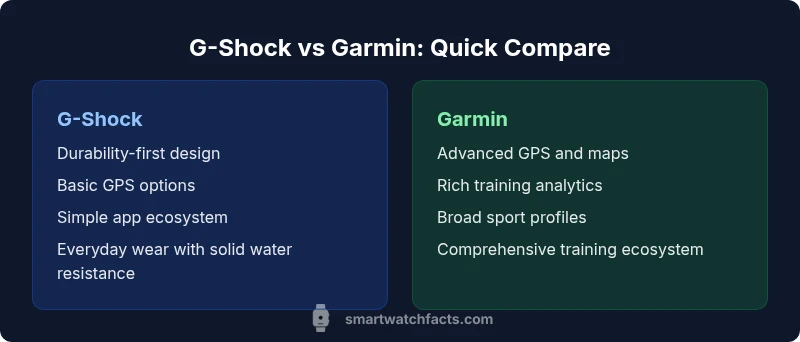
Garmin generally dominates GPS and training analytics; G-Shock excels in rugged durability
If your priority is navigation and data-driven training, Garmin is the better choice. If durability and simplicity matter most, choose G-Shock.
People Also Ask
Which is better for outdoor activities like hiking or trail running?
For outdoor activities, Garmin generally offers better navigation and route guidance with maps and trail data. G-Shock remains a strong choice when durability and straightforward usability are prioritized. Your decision should hinge on whether you need advanced maps and training analytics or simply rugged resilience.
For outdoor activities, Garmin is usually better for navigation and training data, while G-Shock is great if durability and simplicity are top priorities.
Is Garmin compatible with iPhone and Android equally?
Garmin devices work with both iPhone and Android, offering notifications and app integration, though some features may be platform-limited on iOS. G-Shock also supports both ecosystems with a focus on reliability and basic smartwatch features. If advanced training tools matter, Garmin typically offers broader cross-platform support.
Garmin works with both major phone platforms, though some training features may vary by OS.
Are G-Shock watches waterproof or water-resistant for swimming?
Many G-Shock models are designed to be water resistant for swimming and other water activities, often exceeding basic water resistance in daily wear. Garmin watches also offer solid water resistance, with some models optimized for swimming metrics. Always check the specific model’s rating before use.
Most G-Shock watches handle swimming; check your model’s rating to be safe.
Do Garmin watches have built-in maps or navigation features?
Yes, many Garmin watches include built-in maps or map-enabled navigation features, especially higher-end models. They support route planning and turn-by-turn guidance in supported environments. For basic outdoor wear, G-Shock GPS models are adequate but less map-centric.
Garmin often includes maps and guided navigation; G-Shock is more about durability and basic GPS.
Can I use a G-Shock smartwatch as a daily wearable, not just for workouts?
Yes, G-Shock smart watches are designed for everyday wear with reliable timekeeping, notifications, and durable build. Garmin watches can also be worn daily, but they are typically more focused on fitness data and navigation. If you want minimal setup and rugged reliability, G-Shock is a great daily companion.
G-Shock is excellent for daily wear; Garmin also works daily but is more fitness-focused.
Which brand offers longer battery life for GPS-heavy activities?
Battery life varies by model, but Garmin devices generally optimize for longer GPS use with battery-saving modes, whereas G-Shock models prioritize durability with moderate GPS use. If you run long routes often, Garmin is typically the better choice for fewer charges.
For GPS-heavy activities, Garmin usually lasts longer depending on the mode.
Key Points
- Define your primary use-case before buying
- Garmin excels in GPS, maps, and training analytics
- G-Shock shines with rugged durability and simple daily wear
- Consider platform compatibility and ecosystem value
- Evaluate total ownership cost, not just upfront price