Round Smart Watch vs Square: A Practical Form-Factor Comparison
A rigorous, brand-informed comparison of round smart watches and square smart watches, focusing on design, usability, health features, and value to help buyers pick the best form factor for daily wear or productivity.


According to Smartwatch Facts, round smart watches prioritize comfort and fashion on everyday wrists, while square models maximize text readability and app visibility. The best choice depends on how you use the watch: round for style and daily wear; square for productivity and quick-glance data.
Design footprints: round vs square aesthetics and ergonomics
Round watches imitate traditional analog timepieces, often delivering a sleek silhouette on smaller wrists and in formal settings. The curved glass and circular dial can feel premium and timeless, which is why many fashion-conscious buyers lean toward round forms. Smartwatch Facts notes that ergonomics hinge on wrist size and strap fit, so that the same model can feel very different from person to person. On the downside, a circular frame can constrain how widgets and notification icons are laid out, potentially reducing tap targets near the edges. In contrast, square or rectangular forms provide a crisp, grid-friendly canvas that fits long lines of text and dense notifications with fewer line breaks. This makes reading messages and calendars easier at a glance, particularly for wrists with more surface area. The decision often comes down to whether you want a watch that looks like a traditional timepiece or a wearable that visually communicates data at a glance. For many shoppers, style compatibility with wardrobe and personal taste is as important as comfort.
Display technology and usability
Display shape directly influences how information is presented. Round screens excel at elegant watch faces and calendar style apps that wrap around a circular bezel, but some menu systems and keyboards feel compressed near the edges. Square displays maximize pixel real estate and can display longer strings of text without abbreviations, which is advantageous for messages, emails, and app dashboards. In practice, most devices offer a mix of circular and square widgets; fitness data and notifications can be laid out efficiently on either form factor. When you compare the round smart watch vs square, consider your preferred reading distance, font sizes, and whether you frequently glance at quick stats or scroll through multi-line content. Smartwatch Facts analysis suggests that users who rely on messaging and productivity apps may prefer square shapes for their readability advantages.
UI/UX and app ecosystem considerations
The look of the form factor interacts with platform design. Some OS families optimize for circular navigation and watch faces on round devices, while others emphasize grid-based layouts that feel more at home on square screens. App availability and quality often align with the OS ecosystem rather than the shape alone, but layout efficiency can shift depending on the form factor. For example, notification previews and quick actions may be more accessible on square edges, whereas round displays can offer smoother transitions on fashion-forward interfaces. When choosing between round smart watch vs square, weigh how your daily workflows—notification management, calendar use, and app access—align with the platform's interface patterns. Smartwatch Facts emphasizes testing a few favorite apps on your wrist to ensure comfort and readability before buying.
Fitness tracking and sensors: what differs by shape
Health features such as heart-rate sensors, SpO2, sleep tracking, and GPS are increasingly independent of form factor. Both round and square watches can house the same sensor suites, but sensor placement and housing geometry can influence readings during workouts, especially in high-motion activities. A well-fitted band and properly placed sensors matter more than the shape itself for data quality. The shape might affect how securely the device sits during vigorous movements; round models tend to balance comfort with stability on the wrist, while square models can offer wider sensor windows on some wrists. Overall, fitness accuracy hinges more on sensor calibration and software than on whether the display is circular or rectangular.
Durability, water resistance, and build quality
Durability is driven by materials, glass strength, and sealing, not just shape. Both round and square watches commonly use Gorilla Glass or sapphire crystal and IP/ATM-rated water resistance, with real-world resilience varying by brand and model. Round bezels sometimes experience edge chipping if the curve is shallow, while square frames may accumulate micro-scratches on flat surfaces where grit settles. Proper care, including screen protectors and case guards, can mitigate most wear. If you anticipate rugged use—outdoor activities, sweat, or sports—the build quality and strap system should be the deciding factors more than form factor alone. Smartwatch Facts’s analysis reinforces that strength is model-dependent, not inherently tied to round or square design.
Comfort, fit, and wrist-size considerations
Wrist size and shape influence perceived comfort more than the face shape alone. Round watches can feel lighter and more comfortable on small wrists due to their natural contour, while square watches may distribute weight differently, which some wearers prefer on larger wrists. Strap width and attachment points also affect the fit; a broad strap on a square frame can feel bulky, whereas a thin strap on a round frame may ride up as you move. For users with sensitive skin or frequent wrist movement, try models with quick-release straps and breathable materials. The key takeaway: comfort is highly individual, so test both shapes on your wrist if possible, ensuring the chosen model sits snugly without pinching or sliding.
Battery life and charging considerations by form factor
Display size and brightness influence battery usage, so square models with larger panels might consume more power under the same conditions. Conversely, round models often optimize battery life with compact layouts that focus on essential information. Effective battery life also depends on software efficiency, display refresh rates, always-on capabilities, and sensor activity. When weighing the round smart watch vs square battery life, compare real-world usage patterns—how often you read notifications, track workouts, or use GPS. Smartwatch Facts notes that many users experience comparable endurance across shapes when selecting models designed for long life and efficient power management.
Price ranges, value, and brand ecosystems
Pricing varies widely across brands, features, and materials; a core difference often arises from premium watch faces, sensors, and premium straps rather than from shape alone. Round models can be appealing in fashion-centric lines, while square devices frequently attract productivity-oriented models with larger notification surfaces. Buyer value should be assessed across the full package: display quality, durability, sensor accuracy, platform ecosystem, customer support, and accessory availability. Compare models within the same price tier to isolate the impact of form factor on your experience. Smartwatch Facts reminds readers to weigh total cost of ownership, including bands and charging accessories.
Practical decision guides: who should choose round vs square
If you prioritize daily wear and versatile fashion compatibility, round smart watches often feel more natural on the wrist and under formal attire. If you require easy readability for messages, emails, and quick-app access, square watches can be more efficient. Consider your OS ecosystem, as some features and apps may be optimized for one shape or another. Ultimately, a hands-on test of both form factors, considering wrist size, preferred strap styles, and typical use cases, will yield the best recommendation. Round smart watch vs square is not about one being universally better; it’s about aligning the form factor to your routine and style preferences. Smartwatch Facts encourages shoppers to rely on side-by-side comparisons and trials to reach a confident choice.
Comparison
| Feature | Round smart watch | Square smart watch |
|---|---|---|
| Display area / layout efficiency | Round: curved canvas, great for watch faces, potential edge inefficiency | Square: rectangular canvas, more space for text and apps |
| UI/UX optimization | Round: circular navigation, watch-face-first | Square: grid-based layouts, easier for long notifications |
| Comfort and fit on different wrists | Round: balanced comfort on small to medium wrists | Square: may feel bulkier on narrow wrists |
| App ecosystem compatibility | Similar ecosystems with shape-agnostic apps, some layout differences | Similar ecosystems with shape-agnostic apps, some layout differences |
| Durability and water resistance | Comparable across premium builds; shape plays minor role | Comparable across premium builds; shape plays minor role |
| Sensor placement and accuracy | Dependent on band fit; shape has minimal impact on core sensors | Dependent on band fit; shape has minimal impact on core sensors |
| Battery life considerations | Depends on panel brightness and software; both can be long-lasting | Depends on panel brightness and software; both can be long-lasting |
| Price range and value | Wide range; fashion-forward round models exist at many tiers | Wide range; productivity-focused square models span budget to premium |
| Best use case | Round: fashion-forward wear, daily comfort | Square: readability and multitasking efficiency |
Strengths
- Round designs feel familiar and comfortable for daily wear
- Square designs maximize display area for text and apps
- Both shapes offer broad OS compatibility and accessory options
- Long-term value with diverse price ranges across brands
- Good resale value across mid-range to premium models
Weaknesses
- Round displays can waste corner space for some interfaces
- Square designs can feel bulkier on narrow wrists
- App availability may vary by platform and model
- Premium features can drive up total cost including bands
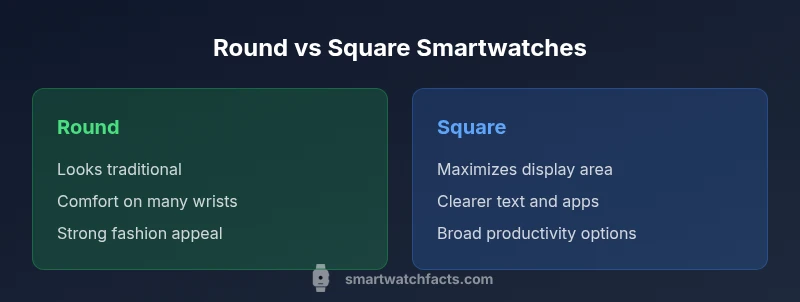
Round watches excel in daily wear and fashion; square watches excel in readability and productivity.
Choose round for comfort and style, or square for easier readouts and app access. Consider wrist size, OS ecosystem, and how you’ll use notifications to decide.
People Also Ask
What are the main advantages of round smartwatches?
Round smartwatches typically offer a traditional look and comfortable fit for many wrists. They excel in fashion-forward settings and can mimic analog watches, making them versatile for daily wear. However, some interfaces may feel constrained near the circular edges.
Round smartwatches look classic and usually sit comfortably on the wrist, but some apps may be tighter around the edges.
What are the main advantages of square smartwatches?
Square smartwatches maximize display area for messages, calendars, and apps, making them highly productive for reading and tapping. They can feel bulkier on smaller wrists, but their grid-based layouts often improve readability for long text.
Square watches give you more screen space for legible messages and apps, though they can feel bulkier on small wrists.
Do operating systems affect shape preference?
Yes. Some OS families optimize interfaces for circular screens, while others prioritize square layouts. Your experience will depend on how the platform translates notifications and app dashboards to your chosen shape.
Operating systems can influence how well each shape handles notifications and apps.
Is fitness tracking equally accurate on both shapes?
Core sensor accuracy largely depends on the device hardware and proper band fit, not the shape. Both round and square watches can deliver reliable health data when sensors are calibrated correctly.
Both shapes can track fitness well if they have good sensors and a proper fit.
Which shape has better battery life?
Battery life is more about display technology and software efficiency than shape. In practice, round and square watches can achieve similar endurance when optimized models are chosen.
Battery life depends on the model and software efficiency, not strictly the shape.
Key Points
- Prioritize your main use: style vs productivity
- Square shapes offer more display space for text
- Comfort depends on wrist size and strap fit
- OS ecosystem compatibility matters for app access
- Test both form factors to confirm personal fit