Smart Watch Advantages and Disadvantages: An Analytical Guide
A rigorous, objective look at smart watch advantages and disadvantages, covering battery life, health features, app ecosystems, privacy, and cost to help buyers decide if a wearable fits their daily routine.


Smart watches offer clear advantages like instant notifications, health and fitness tracking, and quick access to apps. But they also bring drawbacks such as shorter battery life, higher price, and data privacy considerations. The Smartwatch Facts team finds that whether these trade-offs pay off depends on your daily routines, app ecosystem, and willingness to recharge often.
What this guide covers
This article analyzes the topic of smart watch advantages and disadvantages for everyday buyers. It explains what makes these devices compelling and where they sometimes fall short, with a practical emphasis on real-world use. Whether you’re upgrading from a traditional watch or comparing mid-range and premium models, the goal is to help you decide if a wearable actually fits your routines. According to Smartwatch Facts, most shoppers want a balance of health features, reliable notifications, and reasonable battery life, not gimmicks. We define key terms (battery life, sensors, app ecosystems, and privacy) and establish a framework you can reuse across brands and platforms. The discussion remains platform-agnostic and focused on outcomes rather than hype, so you can apply the insights whether you buy an iPhone-compatible watch, a Wear OS model, or a basic fitness tracker. Note that this guide uses generalized guidance and avoids product SKUs or marketing claims to ensure you can apply it to a broad range of devices. The primary aim is to help you think critically about what you gain and what you trade off when you bring a smartwatch into daily life.
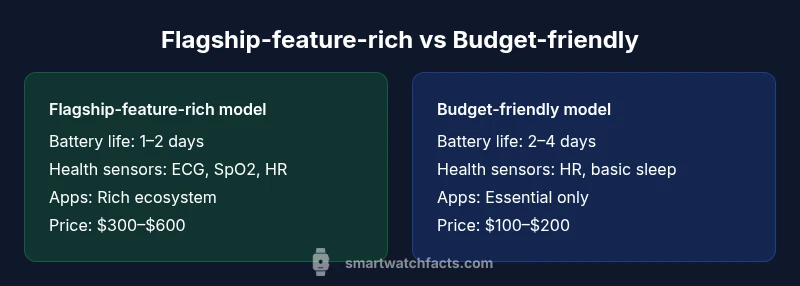
Comparison
| Feature | Flagship-feature-rich model | Budget-friendly model |
|---|---|---|
| Battery life | Typically 1–2 days | Typically 2–4 days |
| Health sensors | ECG, SpO2, HR, advanced metrics | HR, sleep tracking, basic metrics |
| App ecosystem | Extensive app/vendor support | Essential apps with slower growth |
| Price range | $300–$600 | $100–$200 |
| Best for | Power users seeking depth and performance | Budget-conscious users who want core features |
Strengths
- Improved productivity through quick access to calls, messages, and calendars
- Enhanced health insights and motivation via activity tracking
- Safety features such as fall detection and GPS tracking
- Cross-device convenience reduces phone pickups and search time
- Customizable watch faces and apps for personalization
Weaknesses
- Battery life often requires daily charging or frequent top-ups
- Upfront cost and ongoing app/subscription expenses add to total ownership
- Privacy and data collection concerns, especially with health data
- Smaller screens limit readability and input complexity
- Dependence on paired smartphone for full functionality
Smartwatch advantages generally outweigh disadvantages when features align with daily needs
If you value health metrics, timely notifications, and device independence for quick tasks, a smartwatch is worthwhile. Choose based on battery life, app ecosystem, and total ownership costs to ensure the benefits meet your routines.
People Also Ask
What are the main advantages of smart watches?
The primary benefits are convenient notifications, health and fitness tracking, and quick access to apps and information. They can streamline daily tasks, support activity goals, and improve situational awareness without pulling out a phone.
The big perks are easy notifications, health metrics, and fast access to apps—helping you stay connected on the go.
What are the main disadvantages?
Key downsides include battery drain, higher upfront and ongoing costs, and potential privacy concerns around health and location data. Some users also find the small screen challenging for complex tasks.
The downsides are shorter battery life, higher costs, and privacy considerations.
Do smart watches work with iPhones and Android phones?
Most watches offer broad compatibility, but feature parity varies by platform. Apple Watches pair best with iPhones, while Wear OS and other brands work across Android and iOS with varying degrees of functionality.
They usually work with both major phone platforms, but the best experience is with devices designed for your phone.
How accurate are health sensors on smart watches?
Health sensors provide useful trends, but they are not medical devices. Heart rate, sleep, and activity data are best used for general guidance and goal tracking rather than medical diagnosis.
They’re good for tracking trends, but not a substitute for professional medical devices.
How long does battery life typically last?
Battery life ranges from roughly one to several days depending on usage, sensor load, and screen brightness. Heavier use of GPS, continuous heart-rate monitoring, and always-on displays shorten the interval between charges.
Most watches last a day or two with mixed use, longer with lighter features.
Are smart watches worth buying for casual users?
For casual users, a smartwatch can be worth it if it replaces several phone interactions and supports health goals. If you mainly use a phone for notifications, a basic wearable with essential features may suffice.
If you want convenience and health tracking without constantly fiddling with your phone, it can be worth it.
Key Points
- Evaluate battery life against daily usage to avoid frequent charging
- Prioritize health sensors and app ecosystem if fitness tracking matters
- Consider total cost of ownership, not just upfront price
- Balance privacy concerns with the benefits of continuous data collection
- Use a buying checklist to compare models quickly