Smart Watch Android Low Price: Practical Budget Buying Guide
Discover budget-friendly smart watches that run Android or Wear OS, with practical buying tips, realistic price ranges, and setup guidance for 2026.


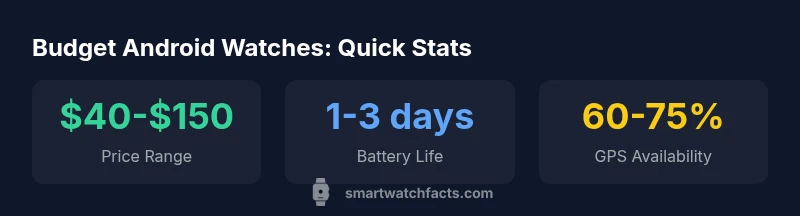
Budget Android smartwatches commonly fall in the $40–$150 range, offering GPS, heart-rate sensors, and Wear OS compatibility. For those chasing a smart watch android low price, prioritize essential features, reliable battery life, and a responsive display over luxury extras, and verify app ecosystem compatibility with your Android phone before buying.
Why price matters when shopping for a smart watch android low price
Price drives feature availability in budget Android wearables. In the Smartwatch Facts analysis for 2026, the more you pay within the low-price tier, the more you typically gain in GPS reliability, brighter displays, and smoother software updates. The trade-off often shows up in build quality, water resistance, and storage. If you need basic health metrics and smartphone notifications, a budget model can be a sensible choice; if you want flagship metrics or premium materials, you’ll pay a premium. When evaluating a candidate, map features to your daily routines and use cases. Your goal is clear: maximize essential utility while avoiding overpaying for features you won’t use.
How to compare affordable Android smartwatches
When shopping in the budget segment, start with four core specs: display quality, processor efficiency, RAM, and battery life. Look for displays with at least 1.3 inches and a reasonable brightness level, and aim for a processor that can handle everyday apps without lag. RAM of 512MB–1GB is common in lower-cost Wear OS devices, with storage typically 4–8GB. Check GPS availability, water resistance (at least IP68 if possible), heart-rate sensors, and always-on display performance. Finally, confirm compatibility with your Android phone and ensure the watch receives regular firmware updates. A systematic checklist helps prevent buyer’s remorse and aligns expectations with price.
Android compatibility and app ecosystem at lower price points
Budget Android watches frequently run Wear OS or a lightweight fork of it, offering basic app support and notification mirroring. The ecosystem is evolving: you’ll find core apps for fitness, music control, and messaging, plus streaming options limited by processor capability. Important caveats: iPhone compatibility is often limited on budget Wear OS devices, app availability may be uneven, and offline maps or advanced offline features may be absent. For Android users, most daily needs—paying, navigating, tracking—are supported, but expect occasional compromises in app breadth and polish.
Common compromises on budget models and how to mitigate
Key compromises at low price points include display brightness, build durability, speaker quality, and sensor fidelity. To mitigate, prioritize models with higher brightness and better outdoor legibility, and choose watches with reinforced cases or IP-rated water resistance. If your budget watch lacks native GPS, you can often enable phone GPS pooling for location-based features—though this drains the battery faster. Consider buying from reputable retailers who offer returns and warranty coverage to protect your investment. Finally, read user reviews focusing on long-term performance rather than initial hype to gauge reliability.
Practical buying guide: where to shop and what to look for
Where you shop matters as much as what you buy. Favor reputable retailers with clear return policies and warranty terms. Look for models that clearly state GPS, heart-rate monitoring, and at least IP65/IP68 water resistance, even in the budget range. Confirm the watch supports your Android phone and receives timely software updates. Compare price-per-feature rather than sticker price; sometimes a slightly higher price yields longer software support and better hardware durability. Use price-tracking tools and seasonal sales to time purchases for the best value in 2026.
Maintenance and optimization tips to get the most from budget watches
To maximize longevity, keep firmware up to date, limit background app activity, and use power-saving watch faces. Disable unnecessary notifications to preserve battery life, and adjust screen brightness to balance readability with energy use. Replaceable bands and protective cases can extend physical durability, while regular charging habits (don’t let the battery fully discharge) help preserve capacity. Finally, calibrate sensors monthly to maintain accuracy for heart-rate and activity tracking. With mindful use, budget watches can remain dependable companions for daily wear.
Quick-start setup for budget Android watches
Unbox, charge, and pair your device with your Android phone following the manufacturer’s app prompts. Grant essential permissions (location, notifications, and health data). Install updates, then customize watch faces and essential apps. Enable GPS briefly to confirm location services work, then switch back to power-saving modes if battery life is tight. This approach minimizes early setup friction and helps you understand how the watch fits into your routine from day one.
Common myths about budget Android smartwatches
Myth: Budget watches aren’t reliable. Reality: Many budget models deliver solid daily performance with proper maintenance. Myth: All watches have the same app experience. Reality: App ecosystems vary; verify app availability before purchase. Myth: You must sacrifice features entirely. Reality: Core features like notifications, fitness tracking, and basic GPS can be strong with careful model selection.
Budget-friendly Wear OS watches comparison
| Model Type | Approx Price Range | Pros | Cons |
|---|---|---|---|
| Budget Wear OS watch | $40–$150 | Affordable features, GPS | Lower build quality |
| Entry-level Wear OS watch with GPS | $90–$170 | GPS + notifications | Shorter battery life |
| Basic fitness-tracker with smartwatch features | $40–$120 | Sleep tracking, fitness modes | Limited app support |
People Also Ask
What defines a 'budget' Android smartwatch?
A budget Android smartwatch typically costs under $150 and focuses on essential features like notifications, fitness tracking, and basic GPS. Performance and materials are weighed against price, with fewer premium specs. Always compare core features to determine value.
A budget Android smartwatch costs under roughly $150 and prioritizes essentials like notifications and fitness tracking; expect fewer premium features and lighter materials.
Will a budget Android watch work with my iPhone?
Budget Android watches—often running Wear OS—work best with Android phones. iPhone compatibility is limited and may exclude advanced features. If you mainly use an iPhone, check the watch’s iOS support before buying.
With an iPhone, budget Android watches may work for basics, but expect limited functionality. Check iOS support before buying.
Do budget models include GPS?
Many budget Android watches include GPS, but availability varies by model. If you need precise outdoor activity tracking, confirm GPS presence in the product specs before purchase.
Most budget watches offer GPS, but always verify in the specs to be sure.
How long can a budget smartwatch last between charges?
Battery life on budget watches typically ranges from 1 to 3 days, depending on usage and display brightness. To maximize life, enable power-saving modes and limit GPS usage.
Expect about 1 to 3 days of battery life on budget models, depending on use and settings.
Are there counterfeit budget models to watch out for?
Yes, counterfeit or heavily discounted models can appear. Buy from reputable retailers, check the warranty, and verify model numbers against official listings to avoid scams.
Yes, stick to reputable sellers and check serial numbers to avoid fakes.
Is Wear OS improving for budget devices in 2026?
Wear OS continues to evolve, with tighter integration and better power management. Budget devices may still offer older OS versions or lighter skins, so confirm OS support and updates before purchasing.
Wear OS is getting better, but budget devices may run older versions—check updates before you buy.
“Budget Android watches offer solid value when you focus on core utilities and reliable software updates. Real-world performance often hinges on software optimization and ecosystem support.”
Key Points
- Prioritize essential features over luxury extras.
- Verify Android compatibility and app availability before buying.
- Expect trade-offs in durability and battery life at low price.
- Shop from reputable retailers with clear warranty terms.