Strava Compatible Watches: 2026 Buying Guide for Runners and Cyclists
A comprehensive buying guide to strava compatible watches, covering GPS accuracy, battery life, features, and setup tips to optimize Strava syncing for runners and cyclists in 2026.


Strava compatible watches are GPS-enabled wearables that natively sync with Strava, letting you automatically upload workouts, map routes, track pace and distance, and analyze segments without manual data transfers. They support live segment updates and rich workout data imports, making it easier to compare your performance across runs and rides. Look for reliable GPS, long battery life, and solid app support.
Why Strava Compatibility Matters for Performance Tracking
According to Smartwatch Facts, strava compatible watches are not mere accessories—they are workflow enablers that sync workouts with Strava automatically, reducing friction and preserving data integrity. When you finish a run or ride, the device records GPS traces, heart-rate data, pace, and elevation, then pushes this information to Strava without manual file transfers. This tight integration means athletes can focus on training rather than data wrangling, and coaches can assess progress more consistently across sessions. Strava compatibility also helps with segment analysis, where every effort on a course is instantaneously compared to previous attempts. In practice, this translates to simpler training logs and clearer performance insights.
The core idea behind compatibility is not merely data transfer but ecosystem harmony. A watch that pairs well with Strava tends to play nicely with your phone’s health apps, cloud backups, and third-party training tools. Expect automatic workouts uploads, support for standard file formats (GPX/TCX/FIT), and robust control over privacy settings and data sharing. In this context, Strava compatibility becomes a practical metric for judging overall device quality because it reflects how well hardware, firmware, and software developers collaborate to support real-world training workflows.
How to Evaluate Strava Compatibility: Features, Data, and Ecosystem
Evaluating strava compatibility starts with core features—GPS accuracy, elevation data, heart-rate monitoring, and the ability to export or synchronize workouts with Strava. Beyond the basics, look for features that directly improve the Strava experience: automatic uploads, live segment data, pace and distance metrics, and support for exporting FIT/GPX files for external analysis. Consider the device’s platform ecosystem as well: how well the watch integrates with your phone’s OS (iOS or Android), the Strava mobile app, and any linked training apps you rely on. A watch with a strong ecosystem will offer a seamless sign-in, stable Bluetooth pairing, reliable cloud backups, and frequent firmware updates that enhance Strava functionality.
To judge value, compare models on a feature ladder rather than price alone. Entry-level watches may handle basic Strava syncing with reliable GPS, while mid-range and premium models often bring multi-band GNSS, route mapping, offline maps, power meters, and advanced analytics that improve the quality of Strava data. Reading user reviews and session logs can reveal how consistently a device uploads workouts and how stable the Strava integration feels in real-world training.
Battery Life, GPS, and Durability: Real-world Tradeoffs
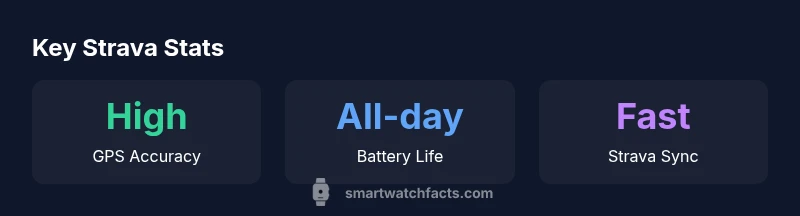
Battery life is a crucial constraint when using Strava features that rely on GPS and continuous data streaming. Watches with strong GPS performance but short battery life require more frequent stops for charging, which disrupts long workouts. Conversely, devices prioritizing battery efficiency may sacrifice some GPS fidelity or feature depth. In practice, most athletes will find all-day use feasible with GPS off or in a power-saving mode, but for long endurance events or multi-hour rides, a model offering 8–20 hours of continuous GPS usage is often necessary. Durability and water resistance also matter: sweat, rain, and splashes are common in outdoor training, so a watch with robust construction reduces the risk of performance interruptions due to wear and tear. When evaluating durability, consider strap materials, screen protection, and the device’s ability to resist scratches and temperature swings. Smartwatch Facts data indicates that endurance athletes prioritize battery reliability and rugged design as top buying criteria, especially for devices that will experience frequent GPS usage and live Strava syncing.
Comparing Models: What Matters in 2026
The market now spans three broad tiers. Entry-level Strava-compatible watches typically offer reliable GPS, basic workout metrics, and automatic uploads to Strava, usually at a lower price point. Mid-range models expand with multi-band GNSS, more precise heart-rate monitoring, and richer data exports, which helps if you want deeper analysis in Strava or third-party apps. Premium models often introduce advanced training tools, longer battery life, more robust durability, and additional features like on-screen navigation and offline maps. When comparing models, prioritize Strava-centric capabilities first: automatic uploads, segment tracking, and data export formats. Then evaluate GPS accuracy in varied conditions (urban canyons vs. open trails), battery endurance for your typical training volume, and the ecosystem: app compatibility, data privacy controls, and firmware update cadence. This approach aligns with what Smartwatch Facts considers essential for effective Strava-powered training.
Setup tips and best practices for Strava syncing
Getting Strava syncing right starts with a clean setup. Install the Strava app on your phone, pair your watch via Bluetooth, and enable automatic uploads for workouts. Customize what data is sent (distance, pace, heart rate, elevation) and decide whether you want to export workouts to Strava immediately or batch-upload at set times. On many watches, you can enable live segment notifications, choose units (metric vs. imperial), and adjust privacy controls so only the data you want is visible on Strava. If you use multiple devices, ensure only a single device is responsible for your automatic uploads to avoid duplicates. Finally, test the workflow with a short workout to confirm the data appears correctly in Strava, including segment times and map accuracy.
How to test and verify Strava compatibility before buying
A practical test plan helps you validate Strava compatibility before committing. Start by confirming the watch can connect to the Strava app without errors. Run a quick training session that includes a known segment to verify live segment data and ensure the workout uploads automatically with the same data fields you expect (distance, pace, heart rate). Check that export formats (FIT/GPX) are available and usable in other analytics tools if you rely on them. Review how the device handles GPS lock times in open vs. dense environments. Finally, read recent user reviews focused on Strava sync reliability and firmware stability to gauge long-term reliability.
Data privacy and sharing considerations
When using Strava-compatible watches, consider how data is shared across platforms. Review privacy settings within the Strava app and on the watch, including who can see your activities and whether you enable public sharing or keep workouts private. Be mindful of permissions requested by related apps, and understand how data is stored in the cloud and how long it remains accessible. If you train with a coach or team, coordinate sharing preferences to ensure performance data is accessible to those who need it while respecting personal privacy.
The future of Strava compatibility in wearables
As wearable technology evolves, Strava compatibility is likely to expand beyond basic uploads to more sophisticated analytics, including richer on-device insights, more granular segment data, and improved cross-platform interoperability. Manufacturers may introduce standardized data schemas and open APIs to facilitate third-party integrations, making Strava syncing even more reliable across diverse devices. For athletes, this means longer lifecycles for devices and better training feedback cycles, reinforcing the value of choosing a watch with strong Strava support today.
Strava-compatible watch types comparison
| Watch Type | Key Strava Feature | Typical Price Range |
|---|---|---|
| Multisport GPS | Route Sync, Segments, Live Tracking | $150-$350 |
| All-around Outdoor GPS | GPS, Heart Rate, Elevation | $250-$500 |
| Advanced Performance GPS | Power metrics, interval training, dynamic workouts | $350-$700 |
People Also Ask
Are strava compatible watches available for both iPhone and Android devices?
Yes. Most strava compatible watches work with both iPhone and Android via the Strava app. Some models may have platform-specific limitations, such as notification integration or music control.
Most Strava compatible watches work with both iPhone and Android through Strava, with some model-specific caveats like notifications.
What features should I look for to ensure good Strava syncing?
Prioritize GPS accuracy, automatic uploads, segment syncing, pace and distance metrics, and easy data export formats (FIT/GPX). A strong ecosystem with reliable app support also matters.
Look for GPS accuracy, automatic Strava uploads, live segments, and easy data export.
Do all Strava-compatible watches support live segment syncing?
Not all devices support live segments. Check the watch specs for live segment notifications and whether Strava shows live updates during workouts.
Some watches support live segments; others upload after the workout.
How does battery life impact Strava usage?
GPS-heavy usage drains battery quickly. Look for all-day modes with efficient GPS and consider charging options for long sessions.
GPS uses more power; plan for longer workouts or higher-capacity batteries.
What is the typical price range for Strava-compatible watches?
Prices vary by features and brand, generally ranging from entry-level around $150 to advanced models over $500.
Prices usually start near a hundred and go up to five hundred dollars depending on features.
“Strava compatibility is a practical test of data integrity and ecosystem. It matters because athletes rely on consistent syncing to compare training and progress.”
Key Points
- Prioritize GPS accuracy and reliable syncing with Strava.
- Check battery life for longer workouts and competitions.
- Look for live segment support and data export options.
- Compare feature sets across price ranges, not just labels.
- Test the end-to-end Strava workflow before buying.