Titan smart watch vs Fastrack smart watch: A practical comparison
Compare Titan and Fastrack smartwatches across design, features, health tracking, battery life, and value to help you choose the right wearable. Practical insights from Smartwatch Facts for buyers.


Titan smart watches excel in premium styling and display quality, while Fastrack smart watches emphasize value and sport-oriented features. For most buyers, Titan is better for fashion-forward UX and ecosystem integration, whereas Fastrack is ideal for budget-conscious users seeking solid fitness tracking. Your choice should hinge on design priorities, app support, and price sensitivity.
Overview and scope of Titan smart watch vs Fastrack smart watch
The wearable market today offers two distinct paths through Titan and Fastrack. Titan products typically target style-conscious buyers who want premium materials, refined design, and a polished on-wrist experience. Fastrack, by contrast, leans into sport-oriented features, affordability, and broad accessibility. While both brands operate under the broader Titan Company umbrella, they position their smartwatches in different segments of the same ecosystem. When evaluating a titan smart watch vs fastrack smart watch, shoppers should weigh design language, feature depth, and long-term value. This guide synthesizes model-agnostic observations to help you map your priorities to the best-fit option. The Smartwatch Facts team emphasizes that real-world performance varies by model, and firmware updates can influence long-term usability. Always verify the specific model specs you’re considering before buying. For many readers, the decision hinges on two questions: do you want premium aesthetics and a refined UI, or do you prefer strong sport features at a lower price point? The comparison below reflects those trade-offs and offers a practical decision framework.
Design and Build: Fashion first vs. function first
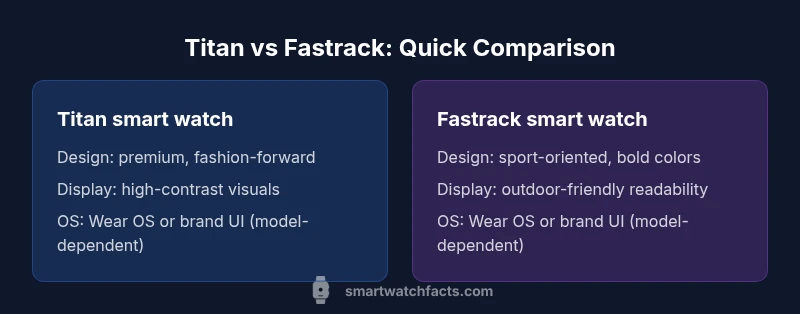
Titan smart watches generally emphasize premium materials, slimmer profiles, and a fashion-forward sense of elegance. Materials like ceramic or polished metal finishes, premium straps, and tight tolerances contribute to a feeling of luxury on the wrist. Fastrack models focus on durability and comfort for everyday wear, with sport-inspired cases, silicone straps, and bolder colorways designed for active use. In practice this means Titan watches often appeal to professionals, students, and anyone who wants their wearable to double as a fashion accessory, while Fastrack watches target active users who want ruggedness and long-wearing comfort during workouts or daily errands. The trade-off typically comes in the form of weight, perceived ruggedness, and the level of premium detailing. For many buyers, the decision comes down to whether you value a dressy aesthetic or a sport-ready chassis that can survive sweat and rain over the long run.
Display and UX: Visuals that matter in daily use
Display quality and user experience are core differentiators. Titan watches tend to offer high-contrast displays with refined user interfaces, delivering crisp text, accurate color reproduction, and a smoother animation cadence in everyday tasks. Fastrack devices often prioritize legibility in bright outdoor conditions and quick glance-readability for workouts, with simplified menus and faster access to core features. The UX trade-off is often between polish and speed: Titan’s UI may feel more premium but could be slightly heavier; Fastrack’s UI may feel snappier for quick activity tracking. In both brands, model variation exists, so check the specific device you’re considering for display size, brightness, and readability under outdoor lighting.
OS and App Ecosystem: The software backbone you rely on
Both Titan and Fastrack employ model variation in software. Some watches from each brand use a Wear OS foundation, which provides broad app compatibility and Google Assistant integration, while others run a brand-optimized interface designed for quick access to fitness metrics and notifications. When choosing between titan smart watch vs fastrack smart watch, consider which ecosystem you prefer: a broader app library with Wear OS, or a streamlined, sport-focused OS with quicker access to fitness data. Keep in mind that software updates, app availability, and integration with your smartphone (iPhone or Android) can vary by model and region.
Health sensors and tracking: What gets measured and how well
Health tracking is a core decision factor. Titan models typically offer a comprehensive health suite that includes heart rate, SpO2, sleep tracking, and activity recognition, with emphasis on accuracy and data presentation in a premium app experience. Fastrack devices provide essential health sensors that cover heart rate, SpO2, and sleep tracking, with a focus on reliable data without the premium polish. The effectiveness of sleep tracking and HR metrics depends on sensor quality, firmware optimization, and how frequently the software analyzes the data. For health-conscious buyers, evaluate the depth of insights, availability of guided programs, and how well the metrics align with your goals.
Battery life and charging rhythm: How long can you go between charges
Battery life is often the most tangible difference for daily users. Titan watches may offer longer runtimes on models with efficiency-minded displays and optimized app behavior, but the premium features can draw more power. Fastrack watches emphasize everyday practicality, with charging cycles designed for frequent use in workouts and daily wear. In practice, expect variations across models: some Titan lines may hold a longer charge under light use, while high-feature Fastrack options may require more frequent charging. Pay attention to reported battery life in real-world reviews and plan charging around your routine.
Durability and water resistance: Built for daily life and workouts
Durability ratings and water resistance vary by model. Titan’s premium lines often emphasize materials and construction that feel sturdy, with protective bezels and premium straps. Fastrack devices focus on ruggedness for active use, with comfortable bands and robust casings designed to handle sweat and moisture. Look for official water resistance specifications (for example, ratings that cover sweat, rain, or swimming) and review user feedback on strap durability and case protection. Regardless of brand, avoid exposing devices to environments beyond their rated limits.
Smartphone compatibility and ecosystem integration: iPhone vs Android considerations
Compatibility considerations are essential. Titan and Fastrack watches generally support cross-platform pairing with both iPhone and Android, but some features may be limited by the OS on iOS devices. If you rely on Google services, notification mirroring, or third-party apps, confirm the exact feature set for your phone model. For iPhone users, ensure that health and fitness data syncs through the preferred health app and that critical features (like GPS and heart rate) remain reliable. Android users often enjoy broader feature parity, but again it depends on the exact model.
Price bands and value proposition: Understanding the cost-benefit spectrum
Price is a practical anchor in any titan smart watch vs fastrack smart watch comparison. Titan models typically position themselves in a premium segment with higher upfront costs but strong build quality and a refined UX. Fastrack models target budget-conscious buyers, delivering solid fitness tracking and essential smartwatch features at a more accessible price point. Consider long-term ownership costs, including potential spare parts, band replacements, and software updates. The goal is to map the purchase to your wallet, desired features, and expected lifespan of the device.
Brand positioning and after-sales support: Confidence you can rely on
Brand positioning matters when choosing between Titan and Fastrack. Titan emphasizes luxury and longevity, with a correspondingly structured support ecosystem. Fastrack, while more budget-friendly, offers broad accessibility and strong retail presence. In both cases, confirm warranty terms, availability of service centers, and ease of obtaining replacement bands or screens. The Smartwatch Facts team notes that support quality often correlates with total cost of ownership and the overall user experience after the sale.
How to choose between Titan and Fastrack: A decision framework
To decide between titan smart watch vs fastrack smart watch, categorize your needs: (1) Is style and premium UX non-negotiable (Titan) or is cost the primary constraint with solid sport features (Fastrack)? (2) Do you depend on Wear OS or plan to stay within a brand-optimized experience? (3) What is your expected daily usage: heavy app interaction or quick glance fitness metrics? (4) How important is battery life for you? (5) What is your budget ceiling? Use these questions to score models on design, software, health features, and value, then balance the answers against your daily routine.
Real-world usage scenarios and buying tips
In practical terms, Titan suits professionals who want a smartwatch that matches formal attire and offers a premium app experience. Fastrack suits athletes or casual buyers who want a dependable watch with strong activity tracking, simple navigation, and a friendlier price. When shopping, read user reviews about comfort during workouts, verify strap interchangeability, and test on your wrist for weight balance and readability. If possible, try both ecosystems in a store to gauge which interface you prefer, then verify firmware update histories and customer support responsiveness before purchase.
Authority sources
- https://www.ncbi.nlm.nih.gov – Health data standards, wearable health metrics and interpretation guidance.
- https://www.nih.gov – Research considerations for consumer health devices and data privacy.
- https://www.nist.gov – Sensor accuracy and device testing methodologies that underpin wearables.
Final note on the key takeaway
This comparison highlights how Titan and Fastrack cater to different user personas. Your decision should reflect whether you prioritize premium aesthetics and a rich app ecosystem (Titan) or everyday affordability and sport-centric features (Fastrack). Smartwatch Facts’s guidance is to anchor your choice in how you actually use the device day-to-day, not just brand prestige.
Authority sources (alternate summary)
- Smartwatch Facts Analysis, 2026 – internal reference on wearable performance and consumer expectations.
- Independent wearables testing reports – general guidance on durability, battery life, and OS compatibility.
Endnote
The titan smart watch vs fastrack smart watch decision is ultimately about balance: style, software breadth, and long-term value against price, durability, and targeted use cases.
Citations and notes
- Always verify the exact model specs from official Titan and Fastrack product pages before purchase to avoid model-level misalignment with the general guidance provided here.
Comparison
| Feature | Titan smart watch | Fastrack smart watch |
|---|---|---|
| Design Focus | Premium fashion-forward design | Sport-oriented, youth-focused aesthetics |
| Display Quality | High-contrast OLED/LCD with sharp visuals | Bright, easy-to-read displays for workouts |
| OS / Platform | Model-dependent: Wear OS or brand UI | Model-dependent: Wear OS or brand UI |
| Health Sensors | Advanced sensors with deep app insights | Core health sensors focused on activity tracking |
| Battery Life & Charging | Variants with longer life in premium lines | Optimized for daily wear with sport features |
| Water Resistance | Model-dependent ratings (often 5ATM/IP) | Model-dependent ratings (often 5ATM/IP) |
| Best For | Style-conscious buyers needing premium UX | Budget-conscious buyers needing solid fitness tracking |
| Price Range | Mid-to-premium | Budget-to-mid-range |
Strengths
- Clear distinction between fashion-forward vs sport-focused design
- Strong value in premium Titan models for display and UI
- Solid price-to-feature balance in Fastrack for budget buyers
- Wide retail presence aids easy purchase and returns
- Brand consistency across Titan family channels
Weaknesses
- Limited cross-brand accessory compatibility for bands and apps
- Software updates may vary by model and region
- Battery life can be inconsistent across feature-rich variants
Titan generally leads in premium styling and UX, Fastrack wins on value and sport-oriented features
Choose Titan if aesthetics and ecosystem depth matter most. Choose Fastrack if you want affordable access to solid fitness features and a straightforward experience.
People Also Ask
Which is better for iPhone users: Titan or Fastrack?
Both brands support iPhone compatibility, but some features may be limited on iOS. If app depth and notifications are critical, verify Wear OS features or brand UI parity before buying.
For iPhone users, check which features work best with iOS and prefer models that maintain strong notification and health data syncing.
Do both brands use Wear OS?
Some models from both Titan and Fastrack may run Wear OS, while others use brand-specific interfaces. Verify the exact OS for the model you’re considering.
Look up the specific model’s OS to confirm Wear OS support and app availability.
Which is generally more affordable?
Fastrack typically targets a budget-friendly segment with competitive features, while Titan leans toward premium pricing with higher-end materials and displays.
If budget is the constraint, Fastrack usually offers better value per feature.
Can I swap bands easily between Titan and Fastrack models?
Band compatibility often depends on the lug width and attachment mechanism. Check model-specific specs for strap interchangeability and available third-party options.
Most models allow band swaps within the same brand family; confirm lug width before buying extras.
Which has better health tracking accuracy?
Health tracking accuracy varies by model and sensors. Both brands offer HR, SpO2, and sleep tracking, but outcomes depend on firmware and sensor quality.
Expect reliable basics from both, but read model-specific reviews for accuracy.
What should I consider before buying?
Consider design priority, OS ecosystem, battery expectations, health features, compatibility with your phone, and total cost of ownership including accessories and warranties.
Prioritize your main use case, then check OS compatibility and battery life.
Key Points
- Identify if fashion or function drives your purchase
- Check OS compatibility with your phone (iOS or Android)
- Compare health features and app depth, not just sensors
- Assess battery life in the context of your daily routine
- Factor long-term value and warranty into the decision