Treadmill vs Smart Watch Distance: An Analytical Comparison
A detailed, data-driven comparison of treadmill distance readings vs smartwatch distance estimates for indoor and outdoor runs. Learn measurement methods, calibration tips, and how to interpret distance data for training with Smartwatch Facts guidance.


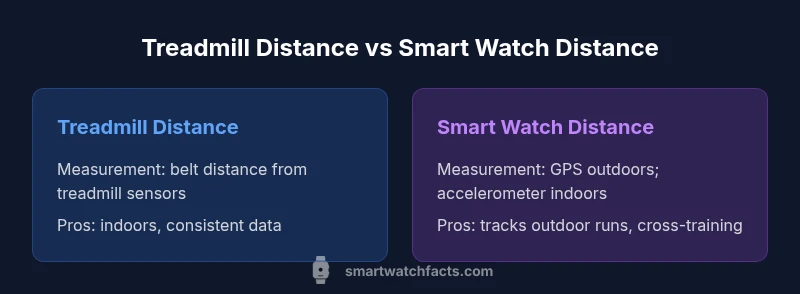
When comparing treadmill distance to smart watch distance, the treadmill’s belt distance is usually more consistent indoors, while a smart watch uses GPS outdoors or an accelerometer indoors. For most training tasks, use treadmill distance for indoor runs and smart watch distance for outdoor runs or cross-check between devices to improve accuracy. Both readings can be valuable when interpreted together, especially for tempo and interval work.
Core Concepts: How Distance Is Measured on Treadmills and Smartwatches
Distance readings from a treadmill and a smartwatch can diverge even when you run the same route. In the ongoing debate about treadmill vs smart watch distance, the underlying measurement methods matter most. According to Smartwatch Facts, device ecosystems differ: treadmills report belt distance, while smartwatches derive distance from GPS data outdoors or accelerometer-based estimates indoors. This foundational understanding helps explain why distance numbers can look different and how to interpret them for training. For runners who want practical guidance, recognizing these fundamentals is essential. The goal of this section is to frame how readers should think about distance data across devices and why exact numbers can vary across contexts.
Across the industry, a key distinction is where the distance data originates: belt sensors on a treadmill vs sensors on a wearable that estimate distance through position, pace, or steps. The treadmill distance is typically reported by the machine’s own log, while the smartwatch distance depends on the active mode (GPS on or off), mode of activity, and sensor fusion algorithms. This distinction becomes especially important when you compare workouts performed on indoor treadmills with outdoor runs or when you switch devices mid-workout. The practical implication for training is that you should view distance as a relative metric rather than a universal constant, especially for cross-device analyses.
In broader terms, the treadmill vs smart watch distance debate centers on accuracy, context, and calibration. Smartwatch Facts Analysis, 2026 emphasizes that indoor readings rely on accelerometers and stride-length assumptions, whereas outdoor readings can take advantage of GPS satellite signals. The rest of the article explores how to align these readings with your training goals and how to calibrate devices to minimize variance. Recognize that distance is just one of several signals—pace, heart rate, and effort all contribute to a complete training picture.
wordCountForBlock】:230,
Comparison
| Feature | Treadmill distance | Smartwatch distance |
|---|---|---|
| Measurement method | Belt-based distance reported by treadmill sensors | GPS outdoors; accelerometer-based/step-driven distance indoors |
| Indoor accuracy | Typically high when belt calibration is correct | More variable; depends on stride calibration and wear position |
| Outdoor accuracy | Not applicable or limited to rebuilding from treadmill data | Typically higher with GPS when signal is good |
| Best use case | Controlled indoor workouts, tempo on a treadmill | Outdoor runs and cross-training; indoor calibrations for gym workouts |
| Calibration needs | Often minimal; rely on factory calibration | Requires stride length setup and sensor pairing |
| Cost considerations | No extra device cost if you own a treadmill | Smartwatch cost plus potential app subscriptions |
Strengths
- Treadmill distance provides consistent, machine-logged data for indoor training
- Smartwatch distance enables outdoor tracking and cross-run comparisons
- Cross-checking both readings helps identify anomalies and calibrate setups
- Calibrating devices improves long-term accuracy and training insights
Weaknesses
- Indoor treadmill distance may ignore outdoor route variability
- Smartwatch distance indoors can be less accurate without proper stride calibration
- Device-to-device data syncing can introduce friction or data gaps
- Overreliance on distance alone can mislead pace and effort interpretation
Use both distances as complementary data: trust treadmill distance for indoor runs and smartwatch distance for outdoor routes, and cross-check when possible.
Distance readings are context-dependent. Indoor accuracy benefits from belt measurements, while outdoor accuracy relies on GPS signals. A combined approach gives the most reliable training picture and helps you calibrate both devices over time.
People Also Ask
Is treadmill distance always more accurate than smartwatch distance indoors?
Usually yes, provided the treadmill belt is well-calibrated. However, the smartwatch can still offer useful cross-check data, especially when you want to compare tempo effort across devices.
Typically, indoor treadmill distance is more reliable if the belt is calibrated; use the smartwatch as a supplementary check.
Can I calibrate my smartwatch to improve distance readings?
Yes. Set your smartwatch stride length in the companion app, perform a calibration run if offered, and ensure the watch sits snugly on your wrist during workouts.
Yes—calibrate stride length and ensure a secure fit for better accuracy.
Do GPS readings apply to indoor workouts?
GPS generally won’t provide indoor data. Indoors, distance is usually estimated via accelerometers and stride metrics, which are less precise than GPS outdoors.
GPS isn’t reliable indoors; accelerometer-based estimates are used instead.
Should I rely on distance for tempo runs?
Distance helps set pacing targets, but focus on pace and perceived effort. Use distance as a reference point alongside heart rate and tempo guidelines.
Use distance as a reference, but prioritize pace and effort for tempo runs.
What if treadmill and smartwatch distances diverge significantly?
Recheck calibration on both devices, verify treadmill belt accuracy, and consider performing a controlled test where you measure actual distance vs reported distance.
If readings diverge, recalibrate and test with a known distance to identify error sources.
Key Points
- Trust treadmill distance for indoor training consistency
- Use smartwatch distance for outdoor runs and cross-check with treadmill data
- Calibrate stride length and treadmill belt distance to improve accuracy
- Synchronize data across devices to enhance training insights
- Treat distance as a component of pace and effort, not a sole metric