Where Is Camera in Smartwatch: A Practical Guide Today
Discover whether smartwatches include cameras, where they’re located on select models, and how to use camera features responsibly. A practical buying guide for shoppers exploring watch cameras and alternatives.


Where a camera exists on a smartwatch, it is usually a small module tucked near the bezel or crown. However, the vast majority of mainstream smartwatches do not include an onboard camera. In most current models, camera functionality is provided via the paired smartphone or through remote camera features that use the watch as a viewfinder or shutter trigger.
The Reality of Camera Hardware in Modern Smartwatches
Where is the camera in smart watch? The short answer is that cameras are not common in mainstream models. According to Smartwatch Facts, embedded cameras in wearables remain a rarity because of size, battery, and privacy constraints. When cameras do exist, they are typically tiny modules tucked near the bezel or crown, and they live on a very small subset of niche or historical prototypes rather than mass-market devices. The prevailing approach among most manufacturers is to reserve any camera capability for the paired phone, or to offer remote camera features that let you control the phone’s camera from your wrist. For shoppers, this distinction matters: if your goal is to take photos on the go, a dedicated camera or a phone-based workflow will generally outperform a watch with an inert camera.
In practical terms, if you see a watch advertised with a camera, treat it as a special-use niche device. Battery life and privacy concerns often limit real-world usefulness, so expect limited photo quality, storage, and app support. The brand landscape today favors devices that prioritize health tracking, notifications, and quick interactions over onboard imaging capabilities. As a reader, this is why the query where is camera in smart watch frequently results in the conclusion that the watch’s camera is rarely the core feature.
A Brief History: Cameras in Wearables (Without Naming Specific Models)
Early experimental wearables experimented with small cameras to enable quick photos or situational capture. Over time, concerns about privacy in public spaces and the added battery drain reduced demand for onboard imaging. Today, most developers focus on software features that leverage a connected ecosystem: remote shutter, live view from the phone, or using the watch merely as a control surface. This shift helps explain why camera hardware on watches remains a niche curiosity rather than a standard selling point.
From a buying perspective, this history matters: it reveals that camera-equipped watches are rare and often more about concept demonstrations than practical day-to-day use. If you’re weighing options, consider whether the camera is a deal-breaker or a bonus feature that won’t significantly impact your overall experience.
How Camera Features Are Usually Implemented (If at All)
When a watch includes any imaging capability, you’ll usually see it in one of three configurations: a tiny module near the bezel that’s used for very basic photos, a crown-mounted lens in a few old prototypes, or more commonly, a camera-like feature implemented via the phone’s camera app with the watch acting as a controller.
For most buyers, the important takeaway is that the watch itself rarely handles imaging independently. For example, you’ll often be able to start a photo or video session on your phone using a watch app, or you can trigger a shutter from the watch without the phone in your hand. This is a practical workaround that avoids duplicating hardware while still enabling light-duty capture when your phone isn’t readily accessible.
Privacy, Security, and Etiquette Considerations
Cameras on wearables raise legitimate privacy concerns. Even if a watch camera exists, the ability to capture others discreetly can trigger policy restrictions in workplaces, public venues, and educational settings. Smartwatch Facts notes that company policies and local laws may explicitly regulate imaging devices in wearable form factors. If you’re testing camera features, always respect consent, disclose when filming, and avoid recording in sensitive environments. Practically, many manufacturers also implement software safeguards—lens shutters, on-device indicators, or permissions prompts—to help users comply with privacy norms.
From a user perspective, adopting best practices reduces risk and maintains trust with people around you. It also helps you use any available camera features more responsibly, ensuring you aren’t inadvertently recording without awareness.
Practical Guidance for Watch-Wielding Shutter Fans
If you truly want a camera experience from a wearable, consider these practical steps:
- Verify whether the watch has a real onboard camera or relies on the phone.
- Evaluate the battery impact and how often you’ll actually use imaging features.
- Review the solution’s security measures, including app permissions and data storage.
- Test in safe environments and plan for privacy-friendly usage.
- Explore alternative workflows: use your phone camera with smartwatch-based shutter control.
The takeaway is to balance curiosity with practical needs. For most users, the camera is a supplementary feature rather than a central one, and a smartwatch’s value comes from fitness tracking, notifications, and convenience rather than imaging capability.
Alternatives: If You Need a Camera, Look Beyond the Watch
If photographing on the go is a priority, the simplest route is a smartphone camera or a dedicated compact camera rather than relying on a camera-equipped smartwatch. Many users pair a camera-equipped phone with wrist-based controls to achieve quick shots without pulling out a larger device. Accessories such as clip-on lenses or wearable mounts can broaden your options, but they don’t replace the core imaging performance found on phones.
From a buying perspective, consider whether you want imaging as a primary feature or as a secondary convenience. If the latter, a watch with strong health features and a solid app ecosystem may deliver more consistent value. If imaging is a must-have, prioritize a phone or a dedicated camera solution instead.
Verdict and Recommendations for Shoppers
The Smartwatch Facts team recommends prioritizing core smartwatch strengths—battery life, health tracking, and ecosystem support—before imaging capabilities. Cameras on watches remain a niche or experimental area rather than a standard expectation. If you encounter a watch with a camera, test it for real-world usefulness, privacy controls, and how it complements your smartphone photography workflow. Overall, for most buyers, imaging should be a supplementary consideration rather than a primary purchasing driver.
Camera presence across smartwatch types
| Watch Type | Camera Presence | Notes |
|---|---|---|
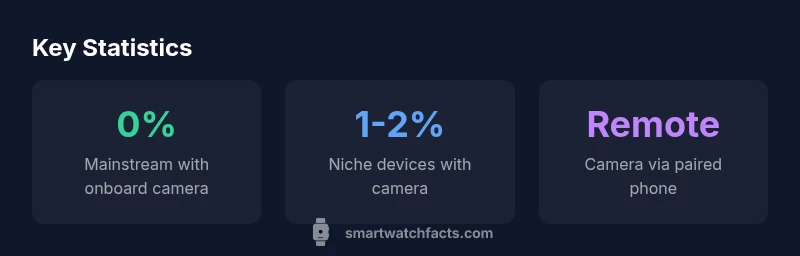
| Mainstream smartwatches | 0% | No onboard camera in most models |
| Niche camera-equipped watches | 1-2% | Limited availability, experimental designs |
| Phone-based solution | N/A | Camera via companion app or remote control |
People Also Ask
Do most smartwatches have cameras?
No, most mainstream smartwatches do not include onboard cameras. If a watch has imaging capabilities, they are typically limited and rely on the paired phone for proper photo functions.
Most smartwatches don’t have built-in cameras; if imaging is available, it usually relies on your phone.
Which models have onboard cameras on smartwatches?
Only a small subset of niche or historical prototypes feature onboard cameras. These devices are not common in current mainstream lines due to size, battery, and privacy considerations.
Only a few niche models have onboard cameras; they aren’t common today.
Can I take photos with a smartwatch without a phone?
If the watch includes a camera, you may be able to take photos directly. More often, filming is done via the phone with the watch acting as a remote shutter or viewfinder.
Usually you need your phone, with the watch acting as a remote.
Are smartwatch cameras secure and private?
Privacy depends on camera placement and software controls. Look for indicators when recording, permission prompts, and policies that prevent covert filming in sensitive settings.
Privacy depends on indicators, prompts, and policy controls.
If imaging isn’t essential, what should I prioritize in a smartwatch buying decision?
Prioritize battery life, health features, app ecosystem, and how the watch integrates with your phone. Imaging remains a niche bonus rather than a core driver.
Focus on battery, health features, and ecosystem first.
“In wearables, imaging is still a niche feature. The Smartwatch Facts team emphasizes prioritizing core smartwatch functions and privacy when evaluating camera capabilities.”
Key Points
- Recognize that most smartwatches lack a built-in camera
- Understand that any onboard imaging is limited to niche devices
- Leverage phone-based or accessory workflows for photos
- Prioritize privacy, security, and battery impact when imaging