Xiaomi smart watch vs band: A practical buying guide
An objective, data-backed comparison of Xiaomi's smartwatch and Xiaomi Band, covering display, sensors, battery life, compatibility, price, and ecosystem to help you choose the right wearable.


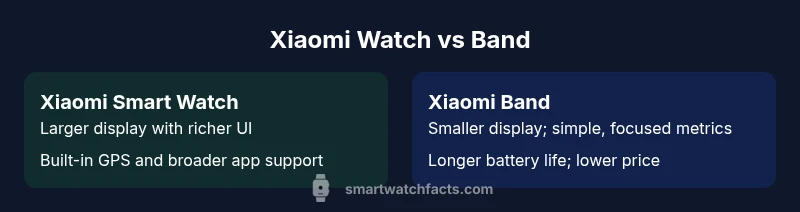
In the Xiaomi smart watch vs band decision, the watch delivers a richer feature set, larger display, built-in GPS, and broader app support, while the Band emphasizes simplicity, longer battery life, and a lower upfront cost. If you want apps, notifications, and location tracking, choose the watch; if you prioritize affordability and pure activity tracking, choose the Band. This guide helps you compare the essentials side by side.
Key differences at a glance
When you weigh the choice between a Xiaomi smart watch vs band, you’re balancing feature breadth against simplicity and price. The smartwatch variant typically offers a larger display, a fuller app ecosystem, and more advanced sensors. The Band focuses on essential health metrics, comfortable wear, and extended battery life. For most buyers, this contrast boils down to two questions: Do you need on-device apps, GPS, and notifications, or is basic tracking and long battery life enough for your daily routine? This section maps the core deltas to help you decide quickly within everyday contexts.
Display and design: screen size, materials, and interaction
Display size and interface shape your daily experience. The Xiaomi smart watch usually features a larger screen with higher resolution and more capacitive inputs, enabling fluid swipes, more on-screen information, and easier text entry. The Band relies on a more compact display that prioritizes glanceability and comfort. Material choices, strap ergonomics, and overall weight also influence wearability for all-day use. If you spend long days reading notifications or using on-watch apps, the larger display and more tactile controls of the watch become a clear advantage. If you prefer a lightweight, discreet form factor, the Band minimizes bulk while still offering essential health readouts.
Health sensors and tracking capabilities
Both devices track core metrics such as heart rate and sleep, but the smartwatch generally supports a broader suite of sensors for health enthusiasts and athletes. Expect more advanced features on the watch, such as higher-frequency heart-rate sampling, richer sleep staging, and sometimes additional metrics like VO2 max or SpO2 variability depending on the model. The Band, by contrast, covers baseline health tracking with reliable heart rate and sleep insights suitable for casual monitoring. For users who rely on medical-grade data or exercise analytics, the smartwatch path often provides more depth and customization options. Always verify the exact sensor set for your specific model before purchase.
GPS, connectivity, and app ecosystems
GPS capability is a common differentiator: Xiaomi smart watches frequently include built-in GPS, enabling independent route tracking and distance metrics without carrying a phone. The Band (depending on the model) may rely on connected GPS via a paired phone, which limits live tracking when the phone is not nearby. App ecosystems also diverge: watches typically support third-party apps, widgets, and more diverse notification options. Bands usually prioritize core health data, quick replies, and basic notifications. If you need standalone navigation or app-driven workflows, the watch is the stronger choice; if you value simplicity and a lightweight companion, the Band suffices.
Battery life and charging behavior
Battery life varies by usage pattern, but the Band generally lasts longer on a single charge due to a smaller display and fewer features. The smartwatch consumes more power for the larger touchscreen, continuous sensors, and on-device processing. Expect shorter cycles on the watch with active GPS and frequent app interactions, whereas the Band can often go several days between charges with normal activity. Charging methods are similar (wireless or magnetic docks depending on model), but charging cadence strongly influences day-to-day convenience. If you hate frequent recharging, the Band is typically the better fit.
Software experience and app support
Software experience shapes how intuitive daily use feels. Xiaomi smart watches offer richer on-device menus, more customization options, and broader app support that can extend to fitness dashboards, music control, and location services. The Band emphasizes a clean, straightforward interface focused on core health data and notifications. App store availability varies by region and model, so verify local options before purchase. If you want a device that doubles as a mini smartphone assistant, the watch is the better option; for a simple, low-friction companion, the Band shines.
Durability, water resistance, and daily wear comfort
Durability and water resistance matter for all-day wear. Both devices typically meet standard water resistance ratings suitable for sweat and rain, with watches often offering stronger shielding and more robust casings. The Band’s smaller form factor can win on comfort for all-day wear and during sleep-tracking sessions, while the watch’s larger profile may feel more noticeable during workouts. Consider your daily activities and whether you need extra ruggedness or superior screen protection. A well-fitted strap and breathable wrist feel also contribute significantly to long-term comfort.
Price, value, and regional availability
Price remains a primary concern in the Xiaomi smart watch vs band decision. In general, the Band carries a lower upfront cost, reflecting its simplified feature set and smaller display. The smartwatch, while more expensive, offers broader capabilities and a more complete app ecosystem. Regional promotions, model variants, and bundled accessories can shift value considerably. If you’re budgeting strictly, the Band presents immediate savings; if you want future-proofing with apps and GPS, the watch offers long-term versatility that can justify the premium.
Use-case scenarios: who should buy which
If your daily routine centers on quick activity tracking, sleep insights, and a lightweight wearable, the Band is often the pragmatic choice. For runners, travelers, or power users who want on-device apps, music control, GPS routes, and more nuanced health metrics, the smartwatch is typically the better fit. Real-world decision-making should weigh three axes: feature needs, daily wear comfort, and total cost of ownership over time. This framing helps you align your choice with your actual usage patterns rather than a feature wishlist.
Setup, pairing, and daily usage tips
Setting up either Xiaomi device is usually straightforward: install the companion app, pair via Bluetooth, and tailor notification and health-tracking preferences. For best results, ensure firmware is up to date, calibrate sensors after first wear, and customize watch faces or band patterns to suit your activities. Regular hygiene—clean straps and screens, plus periodic re-pairing—keeps data syncing accurate. If you encounter compatibility quirks with iOS or Android, consult the official support channels and verify that you’re on a supported app version for your device.
Common myths and troubleshooting basics
A common misconception is that a bigger screen automatically means a better wearable experience. In truth, software optimization, battery management, and sensor quality often matter more. If you notice lag, inaccurate readings, or rapid battery drain, start with a soft reset, update the firmware, and review permissions for sensors and notifications. For those unsure about GPS reliability, confirm whether the device supports standalone GPS or relies on a phone. Clear expectations about model capabilities help you avoid post-purchase regret.
Quick decision framework and checklist
To finalize your choice, run through a simple checklist: (1) Do you need built-in GPS and on-device apps? (2) Is a larger display and richer interface important for you? (3) Is battery life a priority, or do you want the most features irrespective of charge cycles? (4) What is your budget and willingness to upgrade later? Use these questions to anchor your decision in concrete usage rather than marketing claims.
Comparison
| Feature | Xiaomi Smart Watch | Xiaomi Band |
|---|---|---|
| Display and design | Larger display with richer UI | Compact display with streamlined UI |
| GPS and connectivity | Built-in GPS; independent navigation | Typically relies on paired phone GPS |
| Health sensors | Richer sensor suite; advanced metrics | Core health metrics; reliable basics |
| App ecosystem | Third-party apps and widgets | Limited app flexibility |
| Battery life | Moderate to shorter cycles with active use | Longer cycles under typical activity |
| Water resistance | Standard wearable water resistance | Enjoyable for daily wear and workouts |
| Price range | Higher upfront cost | Lower upfront cost |
| Best for | Power users needing apps and GPS | Budget-conscious, simple tracking |
Strengths
- Clear distinction between feature-rich watch and budget-friendly band
- Helps tailor buying to usage: fitness-focused vs smart features
- Useful framework to compare value and long-term costs
- Highlights ecosystem and compatibility considerations
Weaknesses
- Overlap in capabilities can still create confusion for new buyers
- Regional model variations may affect availability and price
- Assumes typical usage; individual needs may differ
Watch for features and GPS; Band for affordability and simplicity
If you want on-device apps, GPS, and a larger display, choose the Xiaomi Smart Watch. If you prioritize low cost, longer battery life, and essential tracking, the Xiaomi Band is the smarter pick. Your decision should align with how you plan to use the wearable daily.
People Also Ask
What is the main difference between Xiaomi smart watch and Xiaomi Band?
The smartwatch offers a larger display, built-in GPS, and broader app support, while the Band focuses on essential health tracking and affordability. The decision hinges on whether you need extensive features or a simple, long-lasting wearable.
The watch is feature-rich with GPS and apps; the Band is simpler and cheaper, great for basic tracking.
Which should I choose for heart rate and sleep tracking?
Both devices track heart rate and sleep, but the smartwatch typically provides deeper analytics and more sensor options. If your goal is basic monitoring, the Band covers core metrics well.
For basic tracking, the Band is enough; for deeper insights, the watch is better.
Are Xiaomi devices compatible with iPhone and Android?
Yes, both Xiaomi devices work with iOS and Android, but some features may be limited on iPhone. Android users generally enjoy broader functionality and smoother pairing.
Yes, they work with both platforms, though features can vary by OS.
Do either device have built-in GPS?
Most variants of the smartwatch include built-in GPS, enabling independent route tracking. The Band often relies on a connected phone for GPS data.
Watch usually has GPS; Band often relies on your phone for GPS.
Can I swap bands or straps easily?
Yes, both devices support interchangeable straps in many models, but compatibility depends on the specific band width and attachment system.
Yes, you can swap bands in most models; check model-specific compatibility.
What is the general price range?
Prices vary by region and model, but the Band generally starts lower with a simple feature set, while the smartwatch carries a higher price for more capabilities.
Band is cheaper; smartwatch costs more for extra features.
Key Points
- Assess feature needs versus budget before buying
- Choose the watch for apps, GPS, and a bigger display
- Choose the Band for price, comfort, and long battery life
- Check compatibility with your phone and ecosystem
- Consider future-proofing with ecosystem support