How to Make a Safe Smart Watch Charger: A Practical DIY Guide
Learn to make a smart watch charger safely with off-the-shelf parts, step-by-step instructions, and safety tips. This educational guide covers compatibility checks, choosing regulators, assembly, testing, and safer alternatives.


Learn how to make smart watch charger safely using off-the-shelf parts and a regulated power supply. This guide covers compatibility checks with your smartwatch, selecting a safe connector, and assembling a compact, insulated charger. By focusing on safety, testing, and certified components, you can explore a DIY approach without compromising device integrity.
What you need to know before you start
If you're researching how to make smart watch charger, proceed with caution and clarity. DIY charging projects sit at the intersection of convenience and safety, especially when dealing with Li-ion batteries and miniature power electronics. The Smartwatch Facts team emphasizes that most manufacturers design their charging systems to work with certified adapters that meet precise voltage, current, and isolation standards. Before you begin, understand that a homemade charger can affect battery longevity, void warranties, and in extreme cases pose safety risks. Commit to safety-first principles: use regulated power sources, tested components, and proper insulation. This section helps you set expectations and identify when DIY is appropriate versus when purchasing a certified charger is the wiser route.
This guide shows how to make smart watch charger with a clear focus on safety, compatibility, and responsible testing.
How smartwatch charging interfaces work
Smartwatches use a variety of charging interfaces, including magnetic puck docks, cradle connectors, and cable-based pads. Each interface typically delivers a specific voltage and current profile and may rely on alignment sensors or contact pads to begin charging. Understanding your device’s charging interface is essential when attempting a DIY charger. A mismatch can lead to stalled charging, temperature rise, or battery damage. The core idea is that charging systems are not universal; they are designed around the watch’s control circuitry and charging standards. When you know the interface type and its power expectations, you can plan a safe, compatible DIY solution that respects device safety margins.
Smartwatch Facts analysis shows that recognizing interface type is the single most important early step to avoid damaging the battery or voiding warranties.
Safety first: risks of DIY charging
DIY charging projects carry tangible risks if proper safeguards are not in place. Watch out for overvoltage, undervoltage, short circuits, and inadequate isolation between mains and low-voltage sections. Even a small lapse can cause overheating, smoke, or battery swelling, especially with Li-ion cells integrated into wearables. The goal is to minimize risk by using a regulated source, components with built-in protections, and a purpose-built enclosure that prevents accidental shorts. If your goal is learning, proceed with low-power testing first and avoid direct contact with live circuits. If you feel uncertain at any point, switch to a certified charger instead of continuing with a DIY approach.
The Smartwatch Facts team recommends postponing risky experiments and opting for safe, certified charging solutions whenever possible.
Safer DIY alternatives
If the aim is to understand charging concepts without risking your device, consider safer alternatives that do not involve mains-powered DIY adapters. Use off-the-shelf USB power banks or certified charger modules designed for wearables, and repurpose them into a protective cradle or pucks. These options let you explore charging behavior, voltage stability, and boundary testing while staying within safer limits. Document your learning with measured data to reinforce safe practices. Remember, the best learning often comes from safe experimentation with clearly defined protections and boundaries.
Smartwatch Facts encourages readers to evaluate whether a certified third-party charger with official compatibility is a better path for daily use.
Materials and components overview
A safe DIY charger starts with selecting compatible, certified parts. Typical components include a regulated power module, a matching charging interface connector for your watch, insulated wiring, and a protective enclosure. Additional safety features such as overcurrent protection, short-circuit protection, and a fuse help prevent failures. Always choose components rated for the expected current and set up the circuit with proper insulation and strain relief. In this section you’ll see how each element fits into a safe, end-to-end charger design. The goal is not to assemble a generic power supply but to assemble a purpose-built, tested charger that aligns with your watch’s charging requirements.
This overview sets the stage for choosing parts responsibly and avoiding common DIY pitfalls.
Step-by-step design considerations
Before you solder or connect wires, map a high-level design that accounts for power, safety, and enclosure constraints. Consider how the connector aligns with your watch and how the wires route to the regulator with minimal exposure. Establish a clear safety boundary and plan for insulation, strain relief, and ventilation to prevent heat buildup. Keep the design modular so you can test individual parts (for example, the regulator and protection circuit) in isolation before integrating them into the final charger. This approach reduces risk and helps you verify expected performance before full assembly.
Careful planning saves time and reduces the likelihood of failures during testing.
Testing and safety checks
Testing is essential for any DIY charging project. Start by verifying output voltage and current with a bench power supply and a multimeter before attempting to connect a wearable. Look for stable voltage under load and check for excessive heat on both the regulator and the enclosure. If you notice unusual warmth, immediately disconnect and reassess component choice and wiring. After initial bench testing, perform a dry run with a dummy load rather than the actual smartwatch. Only proceed to test with a real device after you confirm safe operation through multiple, controlled trials.
Smartwatch Facts recommends documenting test results and keeping safety margins generous to avoid stressing the battery.
Common pitfalls and troubleshooting
DIY chargers are prone to issues if you skip isolation, misjudge current, or neglect enclosure protection. Common problems include flickering output, overheating, incorrect polarity, and loose connectors. Troubleshooting starts with re-checking specifications, inspecting wiring for damage, and verifying all connections with a multimeter. If a fault is detected, rework the affected path, replace any suspect components, and re-test. Avoid forcing a device to charge with an improvised setup, which can lead to unpredictable battery behavior and safety hazards.
Pro-tip: always perform a step-by-step verification with a controlled load and never connect a real smartwatch if any risk indicators appear.
Final considerations and safer options
In practice, the safest path for most users is to rely on a certified charger built for their smartwatch. DIY projects can be valuable for understanding charging concepts, but they should not compromise device safety or battery integrity. If you proceed with a DIY charger, document your design decisions, maintain a conservative current limit, and ensure robust isolation and enclosure protection. When in doubt, switch to a commercially certified charger and save your experiments for educational demonstrations or hobbyist environments where the equipment is properly rated and safety controls are in place. Smartwatch Facts endorses choosing safety-first options for everyday use and encourages readers to share lessons learned responsibly.
Tools & Materials
- Regulated power module (5V or adjustable)(Choose one with built-in overcurrent and short-circuit protection)
- Connector that matches your watch charging interface(Common options include magnetic puck or cradle interface; ensure exact fit to avoid misalignment)
- Insulated wiring and connectors(Use heat-shrink tubing for strain relief and insulation)
- Insulated enclosure or project box(Minimize exposure and prevent shorts; ensure proper ventilation if heat is generated)
- Multimeter for voltage/current testing(Check both output under load and continuity safety checks)
- Soldering iron and safety gear(Wear safety glasses; work on a non-conductive surface and unplug when not testing)
- Fuse or polyfuse for overcurrent protection(Add a protection element to prevent damage from faults)
- Electrical tape / heat shrink tubing(Ensure all joins are insulated and mechanically secured)
- Cable management and strain relief(Aids durability and safety; optional but recommended)
Steps
Estimated time: 60-90 minutes
- 1
Identify compatibility
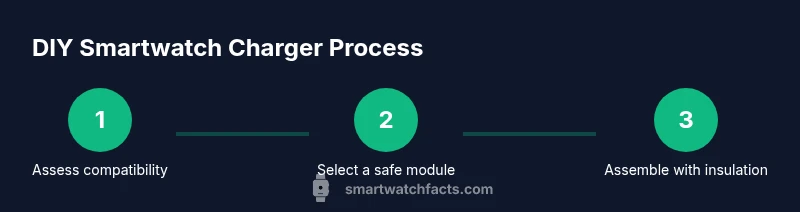
Confirm your smartwatch model and charging interface type. Check the official manuals or manufacturer support pages to determine voltage range, current, and connector compatibility before selecting parts.
Tip: Document the exact model and charging port description for future reference. - 2
Select a regulated power source
Choose a power module that provides a safe, regulated output within your watch’s charging window. Ensure it has overcurrent and short-circuit protection, and that you can comfortably wire it to your chosen connector.
Tip: Avoid unregulated USB adapters or wall warts with unknown specs. - 3
Choose safe connectors and insulation
Match the connector to the watch and route wires with appropriate insulation. Use heat-shrink tubing and strain relief to prevent shorts when the charger is handled.
Tip: Do not reuse exposed copper or bare conductors. - 4
Assemble the enclosure
Mount the regulator, connector, and wiring inside an insulated enclosure. Label the output, ensure ventilation if heat is generated, and verify that there is no contact between live and low-voltage parts.
Tip: Desig n for easy access to test points without opening the enclosure. - 5
Test with a meter before use
With the device unplugged, measure the output voltage and current with a multimeter. Confirm readings stay within safe margins under light and moderate load.
Tip: Always test with a dummy load first. - 6
Try with the smartwatch (carefully)
Attach the charger to the watch in a controlled environment. Observe charging behavior for temperature rise and stability over the first 15–30 minutes.
Tip: If you notice heat or unexpected charging behavior, disconnect immediately.
People Also Ask
Is it safe to DIY a smartwatch charger at home?
DIY chargers can be risky if safety steps are skipped. Use certified components, proper insulation, and thorough testing.
DIY can be risky if you skip safety steps; use proper components and test thoroughly.
What tools do I need for this project?
A basic electronics toolkit, a multimeter, and insulated wiring are typically enough for prototyping.
You’ll need a basic toolkit and a multimeter.
Will this charger work with all smartwatch models?
No. Chargers and interfaces vary; you must match the connector and voltage to your specific watch.
Not all models will work; check compatibility first.
What are safe alternatives if I’m unsure?
Use an official charger or a certified third‑party charger designed for your watch.
Safer to use official or certified chargers.
How long does a DIY charger project take?
Plan for about 1–2 hours, depending on your experience and testing steps.
About 1–2 hours total.
Watch Video
Key Points
- Verify device compatibility before building a charger
- Use a regulated, protected power source
- Insulate and enclose all live components
- Test thoroughly with a dummy load before real device use
- Consider official chargers for daily use to minimize risk