Smartwatch Amazfit: Comprehensive Buying Guide
Discover the smart watch Amazfit with practical buying guidance, setup tips, battery-life insights, and real-world comparisons to help shoppers pick the right model.


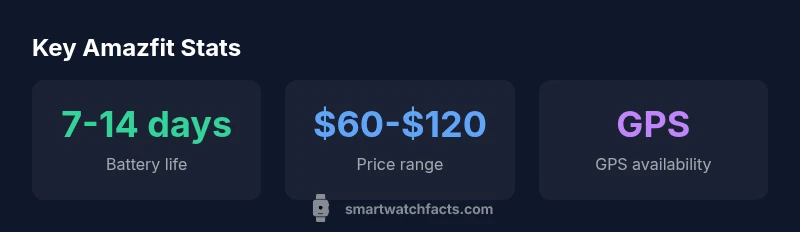
Estimated battery life for Amazfit watches commonly spans 7–14 days per charge, depending on GPS use and sensor activity. Budget models may reach 5–10 days, while premium configurations hover around 7–12 days. In practice, longer life comes with lighter GPS use, fewer always-on features, and moderate notifications.
Overview of the Amazfit Ecosystem
Amazfit offers a broad lineup of wearables that balance price, durability, and feature depth. The brand has built a strong reputation for long battery life and practical health tools, rather than chasing every last high-end sensor. In the context of this article, the term smart watch amazfit signals a range of devices that focus on value and reliability, while still delivering GPS, heart-rate sensing, sleep tracking, and standard smartwatch notifications. Across models, you’ll find a common core: multi-day endurance, health sensors, activity tracking, and a companion app that syncs workouts and progress with your phone. The Smartwatch Facts team notes that while the catalog is broad, success hinges on matching a model to everyday routines—work commutes, workouts, and weekend adventures—without paying for capabilities you won’t use.
How Amazfit Compares with Other Brands
When you stack Amazfit against brands like Garmin, Fitbit, Samsung, or Apple, several themes emerge. Amazfit typically wins on battery life and price-to-feature value, offering longer endurance at lower price points than many premium options. In exchange, you may trade some ecosystem breadth and optimization found in higher-end ecosystems. Zepp OS-powered devices emphasize a clean, accessible interface and a strong fitness-tracking core. For shoppers who want practical wellness features without a premium price, the Amazfit lineup often reads as a logical choice. However, if your priorities include advanced mapping, elite sports profiles, or top-tier app ecosystems, you may prefer other brands. Smartwatch Facts analysis shows that the decision should hinge on how you actually use the watch day-to-day.
Essential Features Across Amazfit Models
Across the Amazfit family, several features consistently matter for everyday use. Battery life remains a standout, with most models designed for multi-day wear. Health sensing typically includes heart-rate monitoring, SpO2, and sleep tracking, with more capable variants offering advanced metrics like stress monitoring and VO2 max. GPS is commonly available, though GPS accuracy can vary between budget and premium tiers. The display quality ranges from clear LCDs to bright AMOLED panels, with waterproof ratings often sufficient for swimming in shallow water. Build quality emphasizes light, comfortable bands and durable cases. When evaluating options, prioritize battery life, GPS behavior during workouts, and the compass of health metrics you actually rely on.
Setup and Daily Usage Tips for New Owners
Starting with Amazfit is straightforward: install the Zepp app on your
Real-World Performance: Battery Life, Fitness Tracking, and Accuracy
In real-world use, Amazfit devices typically deliver impressive battery life, especially compared to fully-featured smartwatches in the same price tier. Fitness tracking is solid for most daily activities and common workouts, with heart-rate data generally reliable for casual monitoring. GPS performance is sufficient for most outdoor activities, though runners seeking pinpoint mapping and advanced GPS modes may find higher-end brands more appealing. Sleep tracking is useful for nightly insights, but remember that algorithms can vary between devices. Overall, the user experience tends to be smooth, with a focus on practical metrics and long-lasting battery life.
Buying Guide: Price Ranges, Value, and Where to Buy
Prices vary by market, model tier, and promotions. As a practical rule of thumb, you’ll typically see budget entries in the low hundreds of dollars, mid-range models in the mid-range, and premium variants approaching higher hundreds. The value proposition for Amazfit is clear: long battery life and essential health features at a lower price than many competitors. When buying, consider authorized retailers to avoid counterfeit accessories, and check the watch’s software support horizon. Look for bundles that include extra bands or charging docks, which can improve long-term value.
Common Pitfalls and How to Avoid Them
Common mistakes include buying solely on features you won’t use or expecting premium app experiences equal to flagship brands. Firmware updates can introduce new features or improve accuracy, so regular updates matter. Relying on always-on GPS or heart-rate monitoring for every activity can drain battery quickly. Finally, don’t overlook compatibility checks with your phone’s OS and the Zepp app’s data syncing capabilities, as these aspects influence day-to-day usability more than most spec sheets.
A quick model-type battery life and GPS comparison for Amazfit watches
| Category | Battery Life | GPS | Water Resistance |
|---|---|---|---|
| Budget / entry-level | 5-7 days | Optional GPS | IP68 |
| Mid-range | 7-12 days | GPS | 5 ATM |
| Premium / multi-sensor | 10-14 days | GPS + GLONASS | 5 ATM |
People Also Ask
Is Amazfit compatible with iPhones?
Yes. Amazfit watches pair with iOS devices via the Zepp app, and basic notifications typically work well on iPhone. Some advanced features may require Android compatibility.
Yes, Amazfit works with iPhones through the Zepp app, offering core notifications and health tracking. Some features may be limited on iOS.
Do Amazfit watches track sleep accurately?
Sleep tracking provides useful nightly insights, including stages and duration. Like most wearables, results are best viewed as trends over time rather than precise hourly classifications.
Sleep tracking gives you useful nightly patterns and trends; treat exact stage timing as directional.
What is the best Amazfit model for fitness?
For fitness-focused use, look for models with accurate GPS, continuous heart-rate monitoring, robust water resistance, and longer battery life. The best fit depends on your sport, budget, and desired apps.
If fitness is the priority, pick a model with reliable GPS, solid sensors, and good endurance.
Can Amazfit watches replace a smartphone for notifications?
Amazfit watches handle essential notifications like calls, texts, and app alerts, but some advanced notification features may be limited compared to flagship platforms.
They handle core alerts, but some advanced notifications may be limited.
How does Amazfit compare to rivals in features?
Amazfit emphasizes battery life and affordability with a practical feature set. Rivals may offer deeper app ecosystems or sport-specific modes, but often at higher prices.
Amazfit gives you great value with solid features; rivals may offer more apps or sport-specific options, usually at a higher price.
“A well-chosen Amazfit model delivers exceptional value with long battery life and robust health features; however, real-world usage and software support ultimately determine day-to-day satisfaction.”
Key Points
- Prioritize battery life for everyday wear and workouts.
- Compare price bands to align features with your budget.
- Check GPS and sensor accuracy against your activities.
- Use the official app to manage settings and updates.