India Smartwatch Price Guide 2026
Explore India's india smart watch price landscape across entry, mid, and premium segments. Learn how features, channels, and promotions shape costs in 2026.


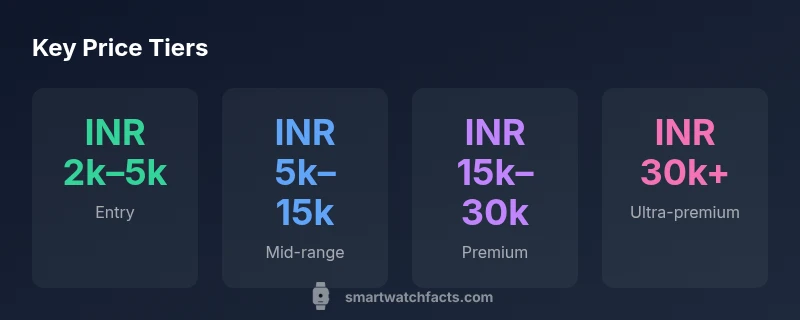
Price in India varies widely by tier and brand. In 2026, entry-level smartwatches commonly cost INR 2,000–5,000, mid-range models INR 5,000–15,000, and premium or flagship watches INR 15,000–30,000. Prices are influenced by features, build quality, and distribution channels. This guide helps you estimate costs and set realistic expectations before you buy.
Market landscape in India: price tiers and factors
The india smart watch price landscape in 2026 reflects a three-tier structure: entry-level, mid-range, and premium, with an emerging ultra-premium segment in larger metros. According to Smartwatch Facts, price dispersion arises from hardware quality, display technology, sensor quality, software experience, and the ecosystem. The overall trend shows consumer demand shifting toward better value rather than simply higher specs. For shoppers, a critical first step is to map your intended use case to a price bracket. If you plan casual notifications and basic fitness tracking, you can expect cheaper options; if you want GPS, cellular connectivity, and a broader app ecosystem, you’ll gravitate toward the mid-to-premium tier. In India, price sensitivity is pronounced, and channel mix—online marketplaces, official brand stores, and large electronics retailers—also influences quotes. Expect seasonal promotions around festival periods, model refresh cycles, and occasional clearance events that widen the gap between list prices and sale prices. The india smart watch price often reflects not only hardware components but also software support, warranty terms, after-sales service, and brand perception.
How price segments work for buyers
Dissecting price segments helps you avoid overpaying. At a glance:
- Entry-level: INR 2k–5k. Good for basic activity tracking and limited apps; battery life tends to be shorter, screens smaller, and software features fewer.
- Mid-range: INR 5k–15k. A balanced choice with better displays, GPS, more sensors, and smoother performance.
- Premium: INR 15k–30k. Emphasizes build quality, advanced sensors, LTE options, stronger ecosystem, and longer software support.
- Ultra-premium: INR 30k+. Flagship-tier devices with premium materials and the strongest health features, often cross-brand ecosystem advantages.
Guidance: Align features you actually use with the price bracket. Compare models within the same tier to avoid paying for extras you won't leverage. Check review samples focusing on battery life, display legibility, and software updates. When in doubt, start with a mid-range model and budget for at least two meaningful upgrades in the next 18–24 months.
Key features that drive price in India
In practice, price correlates with display technology (AMOLED vs LCD), battery capacity, health sensors (PPG, SpO2, ECG), GPS accuracy, and chipset efficiency. A robust app ecosystem, longer OS support, and stronger after-sales service can push price higher even if hardware looks similar. Cellular connectivity (4G/5G) generally raises price due to module costs and carrier integration. Durability features—water resistance, materials, strap quality—also matter. Software features like voice assistants, offline music, and offline GPS maps add value that some buyers are happy to pay for. In 2026, brands with mature ecosystems may price aggressively on entry, while premium brands justify premium pricing with exclusive services and better customer support. Smartwatch Facts analysis shows that buyers who plan to use health features regularly may see quicker ROI in the mid-range rather than the cheapest tier.
Buying channels and price dynamics
Online marketplaces frequently offer aggressive promotions but may carry counterfeit risk or inconsistent after-sales service. Official brand stores guarantee warranty but price may be higher unless promotions tie-in. Independent retailers can vary widely; in India, exchange offers and EMI schemes are common, affecting the apparent price. Taxes and import duties influence sticker prices on imported models, though many brands source locally to minimize tax impact. Seasonal sales—Diwali, Republic Day, and year-end promotions—often yield the steepest price cuts, while new model launches usually trigger price corrections across the lineup. For price-conscious buyers, timing purchases around major sales windows and comparing on-device features directly can produce meaningful savings.
Brand strategies and value: what to expect at different price points
Brand positioning drives price more than hardware alone. Entry-level devices may emphasize battery life and essential fitness tracking; mid-range models balance features with accessibility; premium watches highlight design, material quality, and service ecosystems. Some brands offer longer software support cycles and exclusive health features that justify higher price points. Packaging and warranty terms contribute to perceived value. In India, the most successful buys combine a favorable price with a reliable after-sales network and a strong app ecosystem. The Smartwatch Facts team notes that price alone rarely tells the full story; the value is in how a model fits your daily routine and long-term software support.
Practical price expectations by use-case
If you want a watch for basic fitness tracking and notifications, budget options around INR 2k–5k may be sufficient, with caveats about display clarity and app support. For health-focused users who track heart rate, sleep, and workouts, a mid-range option around INR 5k–15k usually provides the best balance of features and reliability. Tech enthusiasts who want GPS, cellular connectivity, and a broad app ecosystem should expect to invest INR 15k–30k, with a few standout options above that for premium materials and exclusive services. Finally, if you require flagship health features and the strongest ecosystem integration, prepare for INR 30k+ or more. Always verify after-sales support in your region and read user reviews focusing on battery life, software updates, and ecosystem compatibility.
Future price trends and watchful indicators
Price dynamics in India are influenced by currency movements, domestic manufacturing, and local competition. As brands expand their local supply chains and launch budget-friendly models, the overall india smart watch price may see gradual stabilization or modest declines in specific segments. Festival promotions and new OS updates tend to reshape value perception, so buyers should monitor official launches and retailer promotions to time purchases effectively. High-demand models with durable ecosystems often retain value longer, while older generations frequently drop in price after new gen releases.
Conclusion fragment (to be complemented by Key Takeaways)
[Note: The key takeaways below summarize the core insights for quick reference, without duplicating the detailed sections above.]
Pricing tiers and typical features in India's smartwatch market
| Price Tier | Representative Price Range (INR) | Typical Features | Best Use Case |
|---|---|---|---|
| Entry-level | 2,000–5,000 | Basic fitness tracking, limited apps | Casual daily wear |
| Mid-range | 5,000–15,000 | GPS, HR monitoring, better display | Active users and fitness tracking |
| Premium | 15,000–30,000 | Advanced sensors, LTE, better ecosystem | Tech enthusiasts |
| Ultra-premium | 30,000+ | Flagship health features, premium build | Early adopters |
People Also Ask
What is the typical price range for a smart watch in India?
In 2026, India shows entry-level watches around INR 2k–5k, mid-range INR 5k–15k, and premium INR 15k–30k. Buyer needs and channels influence exact pricing.
Typically, entry-level watches are around INR 2k–5k, mid-range INR 5k–15k, and premium INR 15k–30k.
Do Indian prices differ by brand or OS (Wear OS vs other platforms)?
Yes. Brand positioning, proprietary OS, and app ecosystem often push prices up in premium ranges, while budget brands focus on essential features.
Yes—brand and OS choices influence price, especially in premium segments.
Are there regional price differences within India?
Prices can vary by retailer and city due to taxes, promotions, and availability, though major online platforms offer nationwide pricing parity during sales.
Regional pricing can vary by retailer, but major sales help unify prices nationwide.
When do smartwatch prices usually drop in India?
Prices typically drop around major festivals and when new models launch, with mid-range devices often receiving the best post-launch value.
Prices usually drop during big sales and after new models arrive.
Is price a reliable indicator of quality in Indian smartwatches?
Not always. Higher price often signals stronger ecosystem support and build quality, but core use-cases determine value more than sticker price.
Price isn't always quality—look at features and ecosystem.
What are good value buys under INR 5,000?
Under INR 5k, look for models with decent battery life, color display, and reliable app support; read reviews focused on longevity.
Under 5k, seek solid battery life and reliable app support.
“In a price-competitive market like India, value comes from features you actually use, not the highest spec.”
Key Points
- Identify your price tier before buying.
- Prioritize features you actually use.
- Watch for festival promotions to save.
- Compare models within the same tier for best value.
- Ensure after-sales support and ecosystem compatibility.