Smart Watch and Ring Combo: A 2026 Comparison Guide
Explore a practical comparison of smart watch and ring combo options, focusing on sensor coverage, compatibility, battery life, and value for health tracking in 2026.


With a smart watch and ring combo, you gain broader health sensing, discreet wear, and smoother daily tracking compared with a watch alone. The Smartwatch Facts team notes that this setup can improve data continuity across workouts, sleep, and recovery, while keeping jewelry minimal. It shines when ecosystems support seamless pairing and long-term comfort.
The Concept: What is a smart watch and ring combo?
A smart watch and ring combo refers to a coordinated wearables setup that pairs a smartwatch with a smart ring to broaden sensing capabilities and interaction methods. In practice, the watch provides core metrics like heart rate, pace, GPS, and on-face notifications, while the ring adds supplementary sensors for continuous data even when the wrist is idle. According to Smartwatch Facts, this combination can deliver more complete health context across daily activity, workouts, and sleep. The result is a tighter data loop: the watch collects situational data (location, pace, screen interactions), and the ring reinforces physiological signals (heart rate variability, skin temperature, and sleep patterns). For shoppers, the key is to evaluate whether the two devices integrate into one coherent ecosystem and whether the extra hardware actually translates into meaningful improvements for your goals, whether that means better wellness insights, more convenient wear, or both.
In 2026, the concept of pairing a watch with a ring has moved from experimental to practical for many users. The Smartwatch Facts team notes that you will often see better day-to-day data continuity with a two-device setup, especially if you want near-continuous metrics without wearing bulky bracelets or relying on a single sensor source. The choice hinges on comfort, ecosystem compatibility, and willingness to manage two devices rather than one.
As you evaluate options, consider not just sensor count but also data interpretation. A two-device approach can complicate data normalization in your health app; ensure the software you rely on presents harmonized trends rather than conflicting readings. A well-designed pairing experience typically yields a smoother user journey from setup to daily use.
How a ring complements a smartwatch
A smart ring extends health sensing and interaction in several ways. Physically smaller than a wristband, a ring can stay on continuously during sleep and daily activities, often delivering stable HR, SpO2, and sometimes temperature data without the variability caused by wrist movement. The ring can also offer hands-free gestures and quick confirmations that don’t require tapping the screen—useful during workouts or when your hands are occupied. From a software perspective, ring data can fill gaps left by a watch’s sensors, creating a fuller picture of circadian rhythms and recovery. The combination is especially compelling for users who want unobtrusive wear in everyday life but still crave robust health metrics. However, the usefulness depends on how well the two devices sync, how regularly the ring’s data is sampled, and whether the wearable apps translate that data into actionable insights. Smartwatch Facts analysis shows that the most satisfying ring and watch pairings balance accuracy, comfort, and a frictionless app experience. Comfort is key: a ring must fit well without causing irritation during extended wear. If you prioritize fashion alongside function, the two-device approach can be a practical asset.
From a user-experience perspective, expect smooth wake/idle states, consistent heart-rate data through the day, and better sleep staging. Some wearers notice improved recovery metrics when ring readings supplement wrist sensors. Yet, you should also be mindful of potential issues, such as sensor overlap, increased charging frequency, and the need to manage two charging routines. In short, a ring can complement a smartwatch by expanding data scope and enabling subtler wear, but the total experience hinges on ecosystem integration and personal comfort.
For many shoppers, the ring’s non-intrusive form factor is a strong selling point. A well-structured pairing approach reduces the friction of data gathering, especially for people who prefer not to wear accessories that resemble medical devices. If you place a premium on discretion and continuous data gathering, a smart watch and ring combo is worth serious consideration. The decision becomes easier when you test the two devices together and assess how your health metrics look across activities, sleep, and recovery.
Key features to look for in a smart watch and ring combo
When evaluating a smart watch and ring combo, use a structured checklist to compare options. Here are the core features to weigh:
- Sensor synergy: Look for complementary sensors that maximize data continuity without duplicating readings. A ring can provide steady HR, SpO2, sleep stages, and skin temperature data that enrich a watch’s activity metrics.
- Comfort and fit: The ring should fit securely without pinching or feeling loose, and the watch should remain comfortable for all-day wear. Review sizing guides and return policies, as comfort is subjective and two devices can affect daily wear stability.
- App ecosystem and software integration: Confirm that both devices sync to a common health app or platform with a coherent UI. Check if you can view combined metrics, trends, and personalized insights in one place.
- Battery life and charging: Compare typical usage patterns and the charging burden. A two-device setup often requires separate charging, and the ring may need a dedicated charger or magnetic dock.
- Water resistance and durability: Ensure both devices have an appropriate IP rating for your activities and environment. Durability matters for workouts, travel, and daily routines.
- Data privacy and control: Review data sharing settings, permission prompts, and how the app handles sensitive health data. Two devices increase the attack surface, so strong privacy controls are essential.
- Price and total cost of ownership: A two-device system usually costs more upfront and across accessories or chargers. Consider long-term value in relation to your health goals and the ecosystem’s longevity.
- Look for comfort-driven design details: Subtle materials, ring sizing that accommodates knuckles, and touchscreen ease of use can materially affect daily satisfaction.
In practice, you’ll want to test a few combinations and compare real-world experiences. The best choice balances accurate readings, seamless syncing, practical charging routines, and a comfortable wearing experience across day and night. A well-chosen set should feel natural enough to forget you’re wearing it—until you see the insights that matter.
Compatibility and ecosystems
Ecosystem compatibility is central to the success of a smart watch and ring combo. First, confirm OS support for the ring: some rings are designed to pair exclusively with specific watch brands or OS ecosystems; others offer broader compatibility via cross-platform apps. If you are deeply invested in iPhone and Apple Health, for example, ensure the ring’s data transfers cleanly into Apple Health and can be used by watch-based apps without forcing a vendor lock. Conversely, Android users often face a wider array of ring options, but pairing reliability can vary by brand.
Second, examine data normalization. The same health metric can be reported by different sensors in separate devices; you need a unified view rather than two separate data streams. Look for apps that merge readings into a single timeline, with consistent timestamps and unit measurements. The ability to configure which metrics are prioritized and how alerts are generated is another important factor for daily use.
Third, consider the apps and developer support. A robust app ecosystem typically yields richer insights, more third-party integrations, and better long-term value. If you rely on third-party fitness apps, check compatibility lists and API access.
Brand-synchronization matters too. If you are already entrenched in a particular brand’s ecosystem, verify that the ring you choose will work without forcing you into a separate app suite. On balance, a well-matched duo will deliver more coherent health data with less friction in day-to-day operation. Smartwatch Facts analysis shows that buyers who optimize ecosystem alignment report the most satisfying experiences.
Use cases and real-world scenarios
Different user profiles benefit from a smart watch and ring combo in distinct ways. Athletes may prefer continuous data streams that cover sessions, workouts, and recovery. The ring’s steady signals during intense training can fill in gaps, while the watch provides GPS, pace, and route details. For casual wearers, the ring offers discreet, always-on heart rate, sleep tracking, and occasional health prompts without drawing attention to their wrists. Professionals who rely on long hours of standing or walking can gain appreciative insights into stress and recovery cycles.
In sleep-focused scenarios, rings often deliver stable sleep stage data that complements watch-based wake metrics and movement tracking. The ring’s data can improve overall night-time insights if the ring is comfortable enough to wear through the night. In daily life, notification management, gesture controls, and on-wrist gestures can be enhanced by a paired ring, enabling quick confirmations or silent interactions during meetings or workouts.
Businesses and researchers looking at health metrics in groups may find this combo appealing if the ecosystem supports data export and privacy-first sharing. However, for heavy app users who rely on specific features, ensure the chosen devices allow sufficient app support and cross-service compatibility. The blend of daily usability and health data depth makes the watch+ring combination compelling for many, but success hinges on practical wearability and dependable syncing.
Battery life and charging considerations
Battery life is a practical constraint in any wearable strategy, and adding a ring alongside a watch multiplies charging responsibilities. In many setups, the watch will be the primary battery consumer, especially if you use GPS, continuous HR monitoring, or always-on display features. The ring may extend usable hours because its sensors often draw less power, but this varies by model and usage pattern. When evaluating, look for devices with fast charging or magnetic docks that support quick top-ups, minimizing downtime between activities. Real-world testing typically reveals that charging routines matter more than nominal battery ratings. If you travel frequently or prefer minimal charging interruptions, the best combination balances longer watch battery life with a ring that can realistically be charged during the day or overnight.
Also consider charging ergonomics. A ring charger should be compact and easy to use without removing jewelry or interfering with sleep. Some rings charge via clip-on bases or magnetic pads, while watches rely on cradle-style docks. Planning charging around your daily routine helps prevent gaps in data collection. Finally, beware energy-hungry features such as continuous GPS, loud notifications, and frequent data syncing, which can shorten both devices’ useful life between charges.
Price, availability, and buying tips
Price and availability for smart watch and ring combos vary by brand, region, and feature set. In general, expect the combined system to sit in the mid-to-upper range compared with single-device wearables, reflecting the added sensors, software integration, and potential durability improvements. When shopping, consider total cost of ownership: initial price, charging accessories, and warranty coverage. If you are budget-conscious, look for bundles or seasonal promotions that reduce the upfront cost. For long-term value, evaluate how often you will use the extra ring capabilities and whether the ecosystem provides meaningful software updates and health insights over time. Availability can be influenced by supply chain conditions and regional support for both devices, so verify compatibility and service levels before purchasing.
From Smartwatch Facts perspective, the most satisfying purchases align with users who value data depth, practical wear comfort, and ecosystem reliability rather than chasing every latest sensor spec. Read product reviews that focus on real-world comfort, ergonomics, and the consistency of data across different activities. When in doubt, buy from retailers with clear return policies and trial periods so you can test the two devices together and confirm they meet your expectations.
Authority sources
For credible health and wearable technology context, refer to established sources:
- https://www.nih.gov
- https://www.mayoclinic.org
- https://www.who.int
Best practices for setup and maintenance
A successful smart watch and ring combo starts with a thoughtful setup. Start by calibrating both devices together so readings align on a single health dashboard. Enable sleep tracking and daily activity goals on both devices, then review a full week of data to identify any discrepancies. If readings diverge, check for fit, battery levels, and any firmware updates that affect sensor accuracy. Maintain your devices by cleaning the ring and watch surfaces regularly to prevent sweat buildup, ensuring sensors remain accurate. Keep a single primary health app to avoid fragmentation, and review privacy settings to control how your data is shared. Finally, schedule periodic reassessments of your setup, because software updates and new ring/watch models can shift the balance of benefits. Smartwatch Facts recommends testing at least one full sleep cycle and several workouts before deciding whether to keep the combo as your primary wellness gear.
Authority sources
For credible health and wearable technology context, refer to established sources:
- https://www.nih.gov
- https://www.mayoclinic.org
- https://www.who.int
Comparison
| Feature | smart watch + ring combo | smart watch only |
|---|---|---|
| Sensor coverage | Expanded health metrics with ring sensors | Limited to watch sensors |
| Discretion | High discretion due to ring wear | Watch is more noticeable on the wrist |
| Interaction design | Ring-based gestures + watch controls | Watch controls primarily on-device |
| Battery life (watch) | Similar or variable depending on usage | Typically similar to watch-only |
| Best for | Health-focused users seeking depth and subtle wear | General users prioritizing simplicity and app ecosystem |
| Price range | Mid-to-high total cost (two devices) | Mid-range for a single device |
Strengths
- Broader sensor coverage without bulky hardware
- Discreet wear with ring form factor
- Potentially more accurate health context across day and night
- Enhanced user comfort when combined with a lightweight ring
- Improved hand-free interactions in busy activities
Weaknesses
- Higher upfront cost due to two devices
- Increased charging and maintenance effort
- Potential syncing or data normalization challenges
- App ecosystem limitations if devices are from different brands
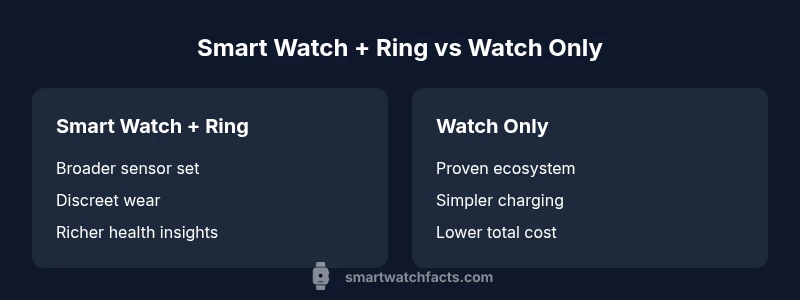
Two-device wearables win on data depth and discretion, but cost and setup complexity rise.
Choose a smart watch + ring combo if you value richer health insights and a discreet form factor. Opt for watch-only if you prioritize simplicity, lower cost, and a broader app ecosystem. The best choice depends on your health goals, budget, and how much you value seamless ecosystem integration.
People Also Ask
Do smart rings work with all smart watches?
Not universally. Ring compatibility depends on the brand and its ecosystem. Some rings work best with specific watch models or OS environments, while others offer broader cross-platform support. Always verify device-to-app compatibility before purchasing.
Not all rings work with every watch. Check the brand’s compatibility list and test with your watch to avoid surprises.
Can I replace a watch with a ring for health tracking?
A ring can supplement health tracking, especially for sleep and resting metrics, but most users still rely on a watch for GPS, notifications, and some fitness features. A ring alone usually cannot replace the core smartwatch experience.
A ring alone won’t usually replace a smartwatch, but it can complement it for deeper health data.
Do smart ring sensors track sleep accurately?
Sleep tracking on rings can be reliable for certain metrics, but accuracy varies by model and how the ring is worn. Pairing with a watch often helps create a fuller sleep profile with cross-verified data.
Sleep data from rings can be good, but pairing with a watch often yields a fuller picture.
Are smart watch and ring combos waterproof or water-resistant?
Most devices in this category offer water resistance at common IP or ATM ratings. Check the specific product specs for swimming or shower use, and follow manufacturer guidance to maintain sensor integrity.
Water resistance varies by model—always confirm the rating before exposing devices to water.
How should I charge two devices efficiently?
Use official chargers or a compatibility dock that supports both devices. Establish a routine (e.g., charge ring overnight, watch before bed) to minimize downtime and ensure data continuity.
Charge each device as part of a nightly routine to keep data flowing without interruptions.
Does the combination improve overall health insights?
In many cases, yes. Shared data streams from watch and ring often provide richer insights into activity, sleep, and recovery. The actual benefit depends on software, sensor quality, and how you interpret the data.
Yes, when data from both devices is merged well, you get a richer health picture.
Key Points
- Prioritize sensor depth and ecosystem coherence when choosing a combo
- Expect higher upfront cost and more complex charging routines
- Test comfort for extended wear and verify data accuracy across devices
- Check OS compatibility and app support before buying
- Consider a trial or return policy to evaluate real-world usefulness