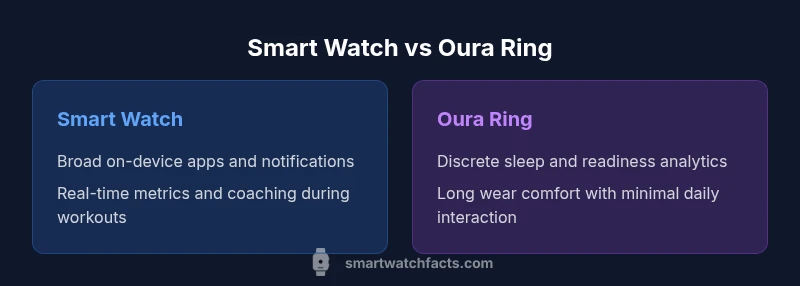
Smart Watch vs Oura Ring: A Comprehensive Comparison
Compare smart watches and the Oura Ring for health tracking, battery life, and daily use. Learn which wearable fits your goals—discreet sleep data or on-wrist versatility.


TL;DR: Smart watches provide broad, real-time health metrics, notifications, and app ecosystems, while the Oura Ring emphasizes discreet, long-term sleep and recovery data with a strong focus on comfort. If you want a versatile, on-wrist device that doubles as a phone companion, choose a smartwatch. If your priority is sleep insight and low-profile wear, the Oura Ring is the stronger choice. Your daily routine and wellness goals determine the winner.
Overview: Why the smart watch vs Oura Ring discussion matters
In the crowded world of wearables, the choice often boils down to how you plan to wear the device and what you expect to gain from it. The Smartwatch Facts team emphasizes that the decision isn’t merely about feature lists—it's about daily UX, comfort, and how much you want data to shape your routines. A smartwatch offers a broad platform: a bright display, touch controls, notifications, and access to a growing app ecosystem, which makes it a practical daily companion for work, travel, and fitness. The Oura Ring, by contrast, is designed for continuous wear with a small footprint: it sits on a finger and emphasizes sleep, recovery, and long-term trends. The result is two distinct user profiles: those who want immersive on-wrist utilities and those who want continuous wellness signals with minimal disruption. This article dives into the nuances, providing practical guidance for shopping, setup, and daily use.
Note: Throughout this piece, you’ll see how Smartwatch Facts frames the comparison and how real users balance breadth vs. depth in wearable data.
Design, Comfort, and Daily Wearability
The physical form factor drives almost every practical choice in wearables. Smart watches are outward-facing devices: they feature a colored display, tactile controls, and interchangeable bands. They excel when you need glanceable data, on-device apps, and easy access to messages or music during workouts. That visibility comes with trade-offs: some models are heavier, screens can be distracting at night, and charging schedules can complicate sleep routines. The Oura Ring adopts a minimalist approach. It is small, light, and designed to disappear under most daily activities, including sleep. For many users, the ring is more comfortable to wear to bed and during long meetings, but sizing matters—an ill-fitting ring may distort readings or feel uncomfortable after hours of wear. Smart watches win on convenience and screen-based interactivity; the Oura Ring wins on subtlety and long-term comfort. Both devices suit different personalities and workflows, so your decision should reflect when and where you want to interact with data.
Health Metrics and Data Depth
Smart watches provide broad health metrics: continuous heart rate, occasional ECG on select models, blood oxygen, animated activity rings, GPS-enabled workout tracking, and sometimes stress or skin temperature. The breadth is valuable for people who want a single device capturing many aspects of daily health. Oura Focuses primarily on sleep, HR, HRV, body temperature trends, and readiness scores based on overnight data. The data you get from Oura tends to emphasize longitudinal insights—how your sleep and recovery trend over weeks and months—rather than rapid, moment-to-moment vitals. In practice, many users use both devices to balance breadth and depth: a watch for real-time metrics and notifications, and the ring for deep sleep analytics and recovery signals. According to Smartwatch Facts analysis, the key is to align data depth with your goals rather than chasing every possible metric.
Sleep Tracking Capabilities and Insights
Sleep tracking is a central differentiator. Oura Ring has earned a reputation for strong sleep analytics, offering sleep stages, circadian alignment, and readiness indicators that summarize how prepared you are to tackle the day. While some smart watches also track sleep, their data can be less granular depending on the model and sensors. In practice, smartwatch sleep data is useful for identifying disruptions and establishing routines, but it may not always provide the same level of stage accuracy or recovery context as a purpose-built sleep platform. If your primary goal is to optimize sleep quality and daily readiness, the Oura Ring often provides clearer long-range signals. If you want to correlate sleep with workouts, stress, and daily tasks in real time, a smartwatch will generally be more actionable.
Activity Tracking, Workouts, and GPS Considerations
For workouts, smart watches shine with on-device coaching, GPS routes, live metrics, and quick-start features. They integrate with fitness apps, support guided workouts, and offer tailored notifications during activity. GPS accuracy varies by model and use-case, but on-device metrics make a watch a compelling option for runners, cyclists, and gym-goers who want immediate feedback. The Oura Ring tracks movement and activity well but is not designed to replace a dedicated fitness tracker. Its strength lies in recovery and sleep-relevant data rather than on-demand coaching during a run. If you want a single device to guide workouts and route mapping, choose a smartwatch. If your focus is after-the-fact wellness data and you prefer a subtle wearable, the ring pairs nicely with a separate workout tracker.
Battery Life, Charging, and Reliability
Battery life is a practical reality that shapes daily use. Smart watches typically require more frequent charging, especially with displays and continuous notifications, which can affect nighttime wear. Oura Ring generally delivers multi-day to weekly wear between charges, depending on activity levels and temperature readings. Charging approaches differ: watches rely on docks, wireless pads, or magnetic mounts; the ring uses a small charger that remains unobtrusive. Reliability is closely tied to fit and software updates; both devices benefit from periodic firmware improvements, data syncing, and app stabilization. Users who travel or have erratic schedules should consider charging logistics as a core criterion in their decision.
App Ecosystems, Platforms, and Data Accessibility
Smart watches live inside expansive ecosystems with robust app catalogs, third-party integrations, and frequent software updates. You can customize faces, automate routines, and exchange data with health apps and gym services. The Oura Ring relies on a focused app experience that prioritizes sleep and recovery trends. Data export options exist, but the ecosystem is narrower by design, emphasizing privacy and long-term trends over real-time app depth. If you want a single-device solution with a broad app footprint, a smartwatch is typically the better option. If you value a privacy-forward, data-rich view of your rest and readiness with a minimal on-device interface, Oura Ring can be a strong companion.
Privacy, Durability, and Water Resistance
Privacy practices vary by brand and region, but most wearables collect anonymized data to improve services. Consider how data is stored, shared, and whether you can export or delete information easily. Durability is tied to form factor: watches must protect a bright display and sensors in all conditions, while rings must endure daily wear and occasional environmental exposure. Water resistance is common in many watches and is variable in rings, with rings generally designed for daily wear including water exposure, but not all models support swimming or deep-water activities. Your environment and comfort tolerance should guide your choice: a rugged, water-resistant smartwatch for outdoor work or sports, or a water-friendly ring for all-day wear.
Price, Value, and Ownership Costs
Pricing varies across brands, models, and feature sets. In general, smart watches offer a wide price spectrum—from budget-friendly options to premium devices with advanced sensors and displays. The Oura Ring tends to sit in the premium category with a focus on sleep analytics and wearability, though newer models have broadened the range. When evaluating value, consider battery life, app accessibility, data ownership, and how often you will interact with the device. A smartwatch may deliver higher everyday utility if you prioritize notifications, apps, and real-time coaching, while the ring may deliver higher perceived value if deep sleep data and subtle wearability better match your goals.
Which User Should Choose Which Option
If you want universal device functionality and a platform for ongoing digital life management, a smartwatch is typically the better long-term companion. It’s ideal for professionals who value quick access to information, navigation, and on-device apps. If your primary goal is sleep quality, readiness, and long-term wellness trends, the Oura Ring can complement or even outperform a more general-purpose wearable for sleep-centric insights. Some users adopt a hybrid approach: a smartwatch for daily activities and a ring for deep sleep data and long-term recovery trends.
Common Myths and How to Validate Claims
Myth: More sensors always mean better health insights. Reality: Context and data quality matter; more sensors can add noise. Myth: Sleep metrics from wearables are as good as clinical devices. Reality: Consumer sleep metrics provide trends and signals, but they are not substitutes for medical-grade sleep studies. Myth: You must choose one device forever. Reality: Data can be integrated across platforms, and many users rotate wearables to balance breadth and depth. To validate claims, look for independent testing, transparency about data access, and real-world usage examples from reputable sources.
Practical Buying Checklist
- Clarify your primary goals: real-time interaction vs long-term wellness trends.
- Evaluate daily wear comfort: wrist vs finger, size, skin sensitivity.
- Check battery life and charging convenience for your routine.
- Review data access, export options, and app ecosystem.
- Consider privacy policies and data-sharing controls.
- Test fit and sizing availability for the ring; ensure swapping bands for watches.
- Compare price ranges and total ownership costs over 1–2 years.
- Read user reviews focusing on comfort, accuracy, and software updates.
Comparison
| Feature | Smart Watch | Oura Ring |
|---|---|---|
| Primary use | All-day wearable with notifications and apps | Sleep-first wellness ring focused on sleep, HRV, and readiness |
| Health metrics breadth | Broad: HR, ECG (on some models), SpO2, GPS, activity | Focused: HRV, sleep stages, readiness, body temp trends |
| Sleep tracking depth | Good sleep tracking with some stage data depending on model | Strong, long-term sleep and recovery signals |
| Design and comfort | Visible display, interchangeable bands, larger footprint | Slim, discreet, continuous wear, ring sizing matters |
| Battery life and charging | Multi-day to daily on models with displays; charging dock or cable | Multi-day to weekly depending on usage; small ring charger |
| App ecosystem and data access | Extensive app ecosystem, cross-platform integration | Narrower app ecosystem focused on sleep data with export options |
| Pricing/ownership | Wide price range from budget to premium | Typically premium with focus on sleep analytics |
| Water resistance | Varies by model; many are water-resistant for daily activities | Generally water-resistant for daily wear; not all models suit swimming |
Strengths
- Smart watches offer broad functionality, app ecosystems, and live notifications
- Oura Ring is discreet, comfortable for all-day wear, and excels at sleep data
- Both provide longitudinal health trends and data export options
- Battery life is generally reasonable on both, depending on usage and features
Weaknesses
- Smart watches can be bulky and require frequent charging
- Oura Ring has a narrower feature set and a smaller app ecosystem
- Ring sizing can affect comfort and data accuracy
- Smart watches may overwhelm users who want minimal screen time
Smart watches win for everyday versatility; Oura Ring wins for discreet sleep-focused insight
Choose a smartwatch if you want a multipurpose device with notifications, apps, and live coaching. Pick the Oura Ring if your priority is sleep quality and recovery data with a low-profile wear. For many users, a hybrid approach offers best of both worlds.
People Also Ask
Which device tracks more health metrics overall?
Smart watches typically track a wider range of metrics (heart rate, ECG, SpO2, GPS, activity). The Oura Ring emphasizes sleep, HRV, and readiness signals from overnight data. If you want a single device for broad health data, a smartwatch is usually the better choice.
Smartwatches cover more ground in real-time health metrics, while the Oura Ring focuses on sleep and recovery data.
Is the Oura Ring accurate for sleep compared to a smartwatch?
Oura Ring is renowned for its sleep analytics and long-term trends. Some smart watches offer sleep data, but precision can vary by model and wear pattern. If sleep accuracy is your primary concern, the ring often provides deeper insights over time.
Oura Ring tends to give deeper sleep insights, though watches can still help with short-term sleep patterns.
Can I wear both devices at once?
Yes. Many users wear a smartwatch for daily tasks and use the Oura Ring for sleep and recovery data. Data can be merged in some health apps, providing a fuller picture without sacrificing comfort.
Absolutely—use both if you want the best of real-time wearables and deep sleep data.
Which is better for workouts?
Smart watches excel for workouts with live coaching, GPS tracking, and on-device metrics. The Oura Ring is less focused on real-time activity feedback but complements workouts with recovery data and overall wellness trends.
For workouts, the smartwatch usually has the edge due to live coaching and GPS.
How should I evaluate privacy and data sharing policies?
Review data collection, storage, export options, and opt-out choices. Check whether the brand supports anonymized stats, local-only storage, and how data is shared with third parties.
Look at data sharing, export options, and the ability to delete data before you buy.
What about battery life and charging frequency?
Battery life varies by device and usage. Watches typically require more frequent charging due to the display and notifications, while rings tend to last longer between charges. Plan charging around your daily routine to avoid gaps.
Watches need more frequent charging; rings usually last longer between charges.
Key Points
- Prioritize breadth if you want one device for daily use
- Choose depth for sleep-focused wellness
- Consider comfort: wrist vs finger for long wear
- Plan charging around your daily routine
- Check data access and privacy settings before buying