Smart Watch Like Phone: Standalone vs Paired Models
Compare standalone cellular smartwatches with phone-paired watches to see which fits your life. Explore connectivity, battery life, cost, and app ecosystems for practical buying guidance.


Standalone cellular watches can function like a phone for calls, texts, and apps, but practicality depends on battery life and carrier support. This concise comparison highlights the trade-offs between standalone models and traditional phone-paired watches, focusing on connectivity, apps, and real-world usability. For most buyers, the choice hinges on independence versus long-term value.
What 'smart watch like phone' means in 2026
The phrase smart watch like phone describes watches that can perform core phone functions without always needing a paired smartphone. In 2026, two main archetypes define this space: standalone cellular watches with built-in connectivity and eSIM support, and traditional watches that still require a phone for most tasks. In practice, a watch described this way might handle calls, texts, music streaming, navigation, and app-based tasks, but the quality and breadth of those capabilities depend on the platform, the available carrier plan, and the app ecosystem. For readers seeking a concise mental model, think of it as a spectrum: on one end you have full independence; on the other, you have a highly integrated companion device. This context matters for evaluating models across brands and ecosystems.
Core differences that matter
When comparing standalone cellular watches to phone-paired models, several criteria consistently influence user experience:
- Connectivity and data plans: Standalones rely on eSIM or embedded SIM, enabling independent voice, messaging, and app data; paired watches reuse the phone’s connection, limiting independence.
- Call quality and reliability: Cellular watches can place calls, but network coverage, latency, and mic quality vary by model and carrier; paired watches depend on the phone’s presence and reliability.
- App ecosystems and control: Native apps on standalones are curated for wrist use and typically lighter; paired watches leverage the phone’s apps and notifications, often offering richer integration but less direct control.
- Battery life expectations: Constant cellular activity often reduces battery longevity; paired watches may enjoy longer daily use if they stay connected via the phone but may drain differently with GPS or music.
- OS and ecosystem alignment: Apple Watch with watchOS emphasizes tight iPhone integration; Wear OS watches target both Android and iPhone but can differ in app availability and updates.
These differences are foundational for choosing: independence versus ecosystem depth, performance versus value, and how much you prioritize on-the-go communication.
When a standalone cellular smartwatch shines
Standalone cellular models offer obvious benefits in select situations:
- Travel without a phone: On trips where you don’t want to carry a phone, a watch with its own data plan can handle calls, messages, and navigation.
- Quick workouts or outdoor activities: When you want to minimize gear, independence from a phone reduces setup friction during runs, hikes, or gym sessions.
- Emergencies and safety: The ability to call for help or share location without your phone can be a real advantage in unfamiliar environments.
- Commute lightening: Short commutes where you don’t need to retrieve notifications from a paired phone can feel smoother with a cellular watch.
Keep in mind, even standalone watches require charging and may rely on a companion smartphone for some features, like complex apps or deeper data syncing.
When a phone-paired smartwatch makes sense
For most everyday users, a phone-paired smartwatch remains the more practical path:
- Rich app ecosystems: Access to a wider range of apps and services that extend the watch’s usefulness without sacrificing phone-centric workflows.
- Longer battery life in practice: When the watch isn’t handling independent calls or data, endurance can be improved.
- Lower total cost: Avoids the additional monthly carrier plan associated with standalone models, reducing monthly and long-term costs.
- Seamless notifications and control: The phone remains the hub for heavy tasks, with the watch acting as a glanceable companion.
- Style and comfort: If you prefer a lighter device on your wrist and an expansive app library, pairing with your phone is often ideal.
The caveat is reduced independence; you must carry your phone for many tasks and to access full-featured apps.
Battery life and charging realities
Battery performance is a practical determinant in this decision:
- Standalone watches: Cellular radios, GPS, and music streaming consume power, so you may see more frequent charging intervals in busy days.
- Paired watches: When less dependent on independent connectivity, power management can extend overall daily usage, but GPS and heart-rate sensors still drain the battery.
- Real-world factors: Screen brightness, always-on mode, and notifications frequency all impact endurance. Carrier support and software optimization also influence how long a day lasts.
Tips to maximize life: enable power saving during workouts, use offline music if possible, and keep software up to date for improved efficiency.
App ecosystems and wrist-optimized experiences
App availability and design quality vary by platform:
- WatchOS (Apple): Strong app quality controls, deep iPhone integration, and a polished user experience, but relies on compatible iPhone devices for the richest features.
- Wear OS (Google/Samsung): Broad app library and good Android integration; iPhone compatibility exists but may not deliver the full experience.
- Proprietary ecosystems: Some brands offer curated experiences with limited third-party apps but improved reliability and battery life.
In practice, a standalone watch might have a thinner app catalog than a smartphone ecosystem, but it can still host essential utilities like fitness tracking, music playback, maps, and messaging clients. For many users, the decision comes down to whether you prioritize breadth or wrist-first convenience.
Costs and total cost of ownership
Cost considerations go beyond sticker price:
- Upfront device price: Standalone models tend to be higher priced upfront due to cellular components and sensors; paired watches are typically priced lower if you already own a compatible phone.
- Carrier plans: Standalone models usually require an extra data plan, which can vary by country and carrier. Some regions offer shared plans, but expect ongoing monthly costs.
- Long-term value: Battery health, software support lifespan, and replacement cycles influence total cost. Periodic upgrades of watch hardware and cellular modules can affect the total investment.
- Repair and support: Independent ownership may shift service responsibilities, while paired devices often leverage the phone’s warranty coverage.
In many markets, if you already own a new smartphone with strong app support, a phone-paired smartwatch can offer comparable value with lower ongoing costs; standalone options provide convenience but require careful budgeting for ongoing carrier expenses.
Practical usage scenarios: travel, fitness, safety
Think through your daily routines:
- Travel and commuting: If you frequently travel light, a standalone watch can reduce device juggling; otherwise, pairing often works best.
- Fitness routines: Both approaches benefit heart-rate tracking, GPS, and workout apps, but standalones may offer more flexibility during outdoor workouts.
- Safety and emergencies: Independent calling and location sharing on standalones can improve safety in crowded or unfamiliar environments.
- Music and media: Music control on watches is convenient; standalone streaming might outperform when you aren’t near your phone.
Ultimately, your most important scenario will guide your choice more than general features.
Setup tips to maximize independence or synergy
Practical steps to optimize your setup:
- Choose the right OS pairing: If you own an iPhone, invest in an Apple Watch; if you’re Android, Wear OS offers broad compatibility.
- Prepare apps for wrist use: Install essential apps with watch-friendly interfaces; disable unnecessary notifications to save battery.
- Plan for connectivity: If opting for a standalone model, ensure your plan aligns with your usage; if not, keep your phone nearby for premium features.
- Calibrate sensors and notifications: Enable always-on display sparingly and tweak alert priorities to reduce distraction.
A thoughtful setup reduces friction and helps you achieve the level of independence you want.
Decision framework: how to choose your path
Use a simple decision framework to decide:
- List daily tasks you want to perform without your phone.
- Evaluate whether a carrier plan makes sense in your region.
- Compare battery expectations under your typical daily rhythm.
- Check app availability on your preferred OS.
- Factor in total cost over the next 2-3 years.
This framework leads to a practical choice: if independence and emergency readiness top your list, lean toward a standalone cellular watch; otherwise, a phone-paired model provides best value and ecosystem depth.
Comparison
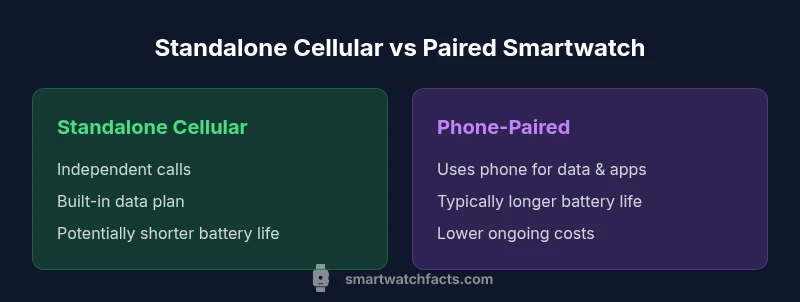
| Feature | Standalone cellular smartwatch | Phone-paired smartwatch |
|---|---|---|
| Connectivity | Cellular data with eSIM | Relies on phone for data |
| Call capability | Makes/receives calls without phone (depending on plan) | Cannot make calls without phone |
| Apps and ecosystem | Native app store with cellular features | Depends on phone's apps and companion apps |
| Battery life (typical use) | Varies; often moderate depending on cellular use | Typically longer when not using calls independently |
| Upfront cost | Higher upfront price | Lower upfront if you already own a watch |
| Carrier plans | Requires separate plan | No separate plan; uses phone plan |
| Best for | Independence, travel without phone | Everyday use with existing phone |
Strengths
- Gives true phone independence on the go
- Reduces reliance on your phone in travel or workouts
- Allows rapid access to calls and messages without your phone
Weaknesses
- Higher total cost (device + plan)
- Smaller app ecosystem and potential feature gaps
- Battery life can be shorter when cellular features are active
Standalone cellular watches are strongest for independence; paired models win on value and ecosystem depth
If you need true phone independence, choose standalone. If you value breadth of apps and lower ongoing costs, a phone-paired model is usually the smarter pick.
People Also Ask
Can a smart watch like phone truly replace a smartphone?
In some cases, standalone watches with a cellular plan can handle calls, texts, and basic apps, but practicality often hinges on battery life and app availability. Most users still rely on a phone for full functionality.
A standalone watch can replace many phone tasks in ideal conditions, but it’s not a perfect substitute for most users.
Do standalone cellular smartwatches require a separate carrier plan?
Yes, most standalone watches with cellular capabilities need a dedicated data plan from a mobile carrier. Some regions offer shared plans, but expect ongoing monthly costs.
Yes, you typically need a carrier plan for true independence.
What are the limits of using a cellular smartwatch without a phone?
You may face app limitations, reliance on built-in features, limited offline options, and potential delays when syncing with a larger ecosystem.
There are limits—fewer apps and offline options compared with a phone.
Are there privacy concerns with always-on connectivity?
Continuous connectivity can raise data privacy concerns. Review app permissions, OS privacy controls, and carrier data practices before enabling features.
Be mindful of permissions and privacy controls on your watch.
Is Android or iPhone compatibility a big factor?
Yes. Apple Watch pairs best with iPhone; Wear OS watches work well with Android and offer cross-compatibility with iPhone, though feature parity may vary.
Your phone's OS largely determines the best smartwatch choice.
What features should I prioritize on a standalone model?
Prioritize independent calling, reliable GPS, solid battery life, meaningful health sensors, and a robust app ecosystem for your daily tasks.
Look for calls, GPS, battery, and useful apps.
Can I use a smartwatch without ever owning a smartphone?
Some users adopt standalone watches, but most experiences improve with a compatible smartphone for updates, apps, and media syncing.
A watch can work solo, but a phone often enhances the experience.
How long will a standalone watch stay reliable with software updates?
Software support duration varies by brand and model; newer watches typically receive longer official support, but independent plans and hardware limits influence longevity.
Support length depends on the manufacturer and model.
Key Points
- Assess daily tasks you want to perform without your phone.
- Factor carrier plans into the total cost of ownership.
- Prioritize battery life for your typical day.
- Match the watch OS to your phone for best compatibility.