Smart Watch or Ring for Blood Pressure: A Practical Guide
Compare smart watch vs ring for blood pressure: accuracy, comfort, and cost. This guide covers measurement limits, setup tips, and buying decisions for buyers.


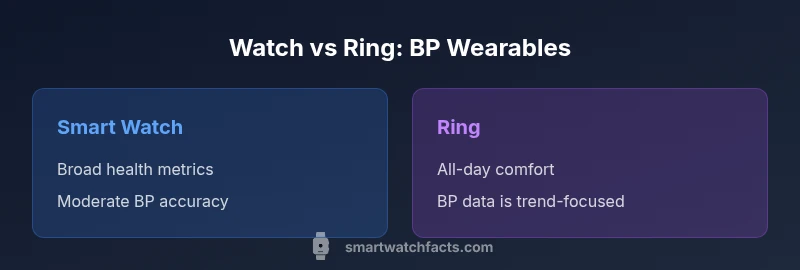
In most cases, a smart watch offers broader health tracking and faster data syncing, while a ring for blood pressure emphasizes comfort and continuous wear. For accuracy, cuff-based monitors remain the gold standard; wearables are best for tracking trends over time. Choose based on comfort, intended use, and the data you value most.
Why this comparison matters
When evaluating whether a smart watch or ring for blood pressure fits your lifestyle, it helps to start with a simple truth: wearables are great for trend monitoring and convenience, but they are not a substitute for clinical cuff measurements when diagnosing hypertension. According to Smartwatch Facts, wearable health devices have matured to offer continuous insights, alerting you to patterns over days and weeks rather than a single snapshot. The Smartwatch Facts team found that most shoppers prioritize daily wearability, battery life, and app integration when deciding between a smart watch or ring for blood pressure. If you are trying to decide between a smart watch or ring for blood pressure, keep the decision grounded in your daily routine, data needs, and comfort level. This beginner-friendly context helps you focus on what matters most: usable data that informs healthy choices without overwhelming you with false precision.
This opening section establishes the real-world lens for the comparison and sets expectations for what wearable blood pressure data means in practice.
Comparison
| Feature | Smart Watch | Ring |
|---|---|---|
| Core measurement approach | Cuffless oscillometric with sensors on the wrist | Cuffless with sensors at the finger/hand |
| Comfort for all-day wear | Typically larger, may feel bulky during long wear sessions | Typically lighter and less intrusive on the finger |
| Data integration | Wide app ecosystems, health metrics beyond BP | Narrower if focused on BP; strong comfort data |
| Battery life | Often 1-2 days depending on features | 1-5 days due to single-purpose design |
| Accuracy vs cuff | Good trend data, may require calibration | Often similar trend data but varied absolute values |
| Best for | Active users wanting multiple health metrics | All-day BP wear with minimal intrusion |
| Cost range (relative) | Mid to high, with broad price ladder | Lower upfront costs but vary by brand |
Strengths
- Noninvasive, convenient daily wear
- Continuous data stream for trend analysis
- Broad health metrics beyond BP on many watches
- Discreet form factors can be worn everywhere
Weaknesses
- Accuracy varies by model; not a clinical substitute
- Requires regular calibration with cuff measurements for best context
- Data privacy and app data sharing concerns
- Price and subscription requirements can add up
Smart watch generally wins for overall usability; ring excels in comfortable, discreet BP wear
If you want broad health insight and quick app integration, a smart watch is usually the better pick. If you prize comfort and nonstop BP wear, the ring is worth considering, but monitor accuracy and calibration needs closely.
People Also Ask
Can you trust BP readings from a smart watch or ring?
Wearable BP readings are useful for tracking trends over time, but they are not a medical-grade substitute for cuff-based measurements. Always confirm abnormal readings with a clinician and use devices that have done valid validations.
Wearable BP readings help you spot trends, but they are not a replacement for clinical checks. If readings look concerning, consult a healthcare professional.
Which is more comfortable for long-term BP monitoring, a watch or a ring?
Rings are generally more discreet for all-day wear, especially for those who dislike wrist bands. Watches can be bulkier but often offer broader health features. Your comfort will influence consistent use.
Rings are typically more comfortable for all-day wear, but choose what fits your routine best.
Do I need a cuff-based monitor to supplement wearables?
Yes. Use a cuff-based monitor for calibration and verification, especially if you have diagnosed hypertension or irregular readings. Wearables should supplement, not replace, clinical care.
A cuff-based monitor remains essential for confirmation in many cases; wearables add trend data.
Are there ongoing subscription costs for BP wearables?
Some devices include free apps, while others require premium subscriptions for advanced analytics or cloud storage. Consider total cost of ownership when comparing options.
Some BP wearables have optional subscriptions for extra features; check the total cost.
What is the best way to test a BP wearable before buying?
Try devices in-store or during a trial period. Compare readings against a medical-grade cuff under supervision, and verify that the device supports your preferred health apps.
Test readings against a cuff and check app compatibility before buying.
Key Points
- Prioritize comfort and daily wear when choosing between watch and ring
- Use BP wearables for trends, not as a stand-alone diagnostic tool
- Check device calibration options and cross-validate with cuff readings
- Consider app ecosystem and data privacy before buying
- Budget for potential subscriptions and accessories