Smart Watch Prices in 2026: A Practical Buying Guide
Discover current smart watch prices across entry, mid, and premium tiers, how features influence value, and smart buying strategies to maximize value in 2026.


Smart watch prices vary widely across brands and features. Entry-level models generally run in the low hundreds, mid-range options in the mid hundreds, and premium models can exceed a thousand dollars. In 2026, expect price bands that align with GPS, health sensors, and LTE capabilities, with frequent discounts during major shopping events.
Price Dynamics in 2026
Smart watch prices are driven by a mix of hardware, software, and ecosystem maturity. In 2026, the market continues to balance feature richness with durability and battery performance. Entry-level devices prioritize essential activity tracking and basic notifications, while mid-range models add better display quality, GPS, and more capable sensors. Premium watches push the envelope with LTE connectivity, advanced health metrics, larger app ecosystems, and premium materials. From a buyer’s perspective, price is a proxy for the breadth of capabilities you value, not merely a label. Smartwatch Facts analysis shows that price bands increasingly reflect core capabilities like GPS accuracy, SpO2 sensors, and on-board storage for apps, rather than vanity features alone. When evaluating smart watch prices, it helps to map your intended use to the feature set you truly need to avoid paying for bells and whistles you won’t use.
Price Segments and What You Get
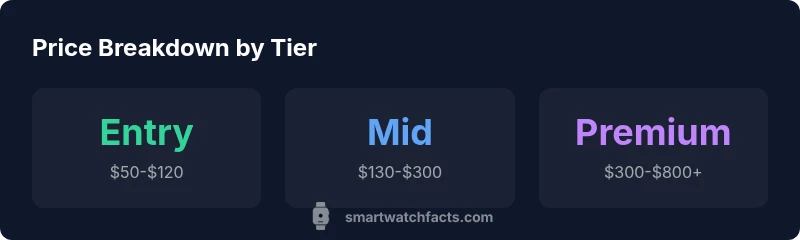
Most shoppers fall into three broad price bands. Entry-level watches typically cover basic fitness tracking, sleep monitoring, and smartphone notifications, with few if any third-party apps. Mid-range devices deliver stronger battery life, richer displays, better water resistance, and offline GPS, along with broader app ecosystems. Premium models bring LTE or eSIM, more precise health sensors (often including skin temperature and advanced heart-rate monitoring), larger storage, and premium materials like sapphire glass. Across segments, you’ll pay a premium for connectivity options and ecosystem depth. When considering price versus value, focus on how long you plan to keep the device and whether the added features align with your daily routines.
Hidden Costs: Bands, Subscriptions, and Accessories
The sticker price is only part of the total cost of ownership. Many buyers overlook ongoing costs such as extra bands, charging accessories, and optional subscription services for premium apps or cloud health data syncing. Some ecosystems encourage paid features or advanced health coaching. If you rely heavily on third-party apps, you may also encounter in-app purchase costs. These ancillary expenses can tilt the total price of ownership from a one-time purchase into a multi-year investment. Budget for replacements or upgrades to bands and chargers, especially if your chosen watch uses proprietary accessories.
How to Assess Value: Features vs. Cost
A robust framework is essential for evaluating smart watch prices. Start with core needs: basic activity tracking vs. advanced health metrics; GPS presence; water resistance; and battery life. Compare the cost of mid-range devices that deliver the features you use most against premium models that offer marginal gains in sensors or materials. Consider the app ecosystem: a broader app library can substantially increase long-term value, while proprietary health features may deliver better data integration across devices. Remember that software support lifespans matter; a device with longer promised updates can be more economical over time.
Shopping Strategies: When and Where to Buy
Timing matters for smart watch prices. Major shopping events (holidays, back-to-school periods, and retailer anniversaries) often yield the best discounts on both entry-level and mid-range watches. Refurbished or open-box devices can provide substantial savings with warranties, but verify seller credibility. Authorized resellers typically offer legitimate warranties and support, which reduces risk when buying higher-priced models. If you’re upgrading from an older watch, assess whether your current ecosystem supports a favorable trade-in value that can offset the new purchase.
Practical Scenarios: Pick the Right Price Band for You
Casual users who want notifications and fitness basics can confidently buy entry-level models without sacrificing reliability. Fitness enthusiasts who want reliable GPS, heart-rate monitoring, and longer battery life should target mid-range devices. Tech-forward users who value LTE connectivity, advanced sensors, and a rich app ecosystem should consider premium watches, but only if the incremental benefits align with their usage. In all cases, align the device’s capabilities with real-world needs to maximize value and avoid overspending on features you won’t use.
Price bands and core features by model tier
| Model Type | Typical Price Range | Key Features |
|---|---|---|
| Entry-level | $50-$120 | Basic fitness tracking, notifications |
| Mid-range | $130-$300 | GPS, better display, broader apps |
| Premium | $300-$800+ | LTE, advanced sensors, premium materials |
| Ultra-premium | $800-$1500+ | Top-tier materials, exclusive ecosystems |
People Also Ask
What affects smartwatch prices the most?
Prices fluctuate mainly with sensors, connectivity options, display quality, battery life, materials, and the breadth of the app ecosystem. Hands-on use often reveals whether higher-cost features justify the price.
Prices depend on sensors, connectivity, and software ecosystem—look for values that match your needs.
Do prices drop after a new model is released?
Yes, new models typically drive price reductions on older versions. Seasonal sales can accelerate these drops, sometimes making mid-range devices a better buy than last year's premium.
Prices usually fall after a new model launches and during sales.
Is it worth buying refurbished smartwatches?
Refurbished devices can offer solid savings with warranties from reputable sellers. Check return windows and verify the device’s condition and sensor accuracy before purchasing.
Refurbished watches can save money if you buy from trusted sources.
Should I pay extra for LTE connectivity?
LTE adds independent connectivity and convenience, but it increases cost and monthly plans. Choose LTE if you need phone-free use during workouts or commutes.
LTE is convenient but costs more; decide based on how often you need standalone connectivity.
Are iPhone-optimized watches always pricier?
Prices vary by model and feature set; some iOS-optimized watches offer strong value, but the price difference often reflects ecosystem integration rather than device capability alone.
Sometimes, but not always—choose based on features and ecosystem, not brand alone.
“Prices are a reliable signal of value when you weigh feature sets against long-term software support and ecosystem depth.”
Key Points
- Balance features with cost for real value
- Expect discounts during major sales events
- Consider ecosystem and app support over sticker price
- Account for extra costs like bands and subscriptions
- Choose a price band that matches your daily needs