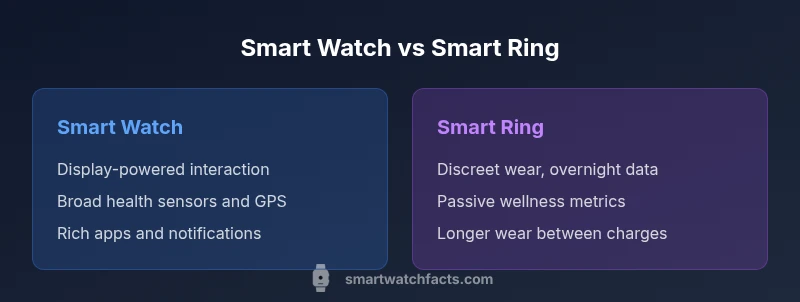
Smart Watch vs Smart Ring: A Practical Buying Guide
An analytical, data-driven comparison of smart watches and smart rings, covering features, health tracking, battery life, design, privacy, pricing, and scenarios to help you choose the right wearable.


A smart watch and a smart ring each serve distinct purposes. The watch delivers a broad feature set—notifications, apps, GPS, and robust health metrics—ideal for daily productivity and active lifestyles. The ring emphasizes discreet, continuous wear and passive wellness tracking, especially sleep and resting heart rate, with minimal intrusion. For most users, the watch provides better overall value thanks to its versatility, while the ring shines for understated health monitoring and comfort during long wear. Your choice should hinge on display needs, battery tolerance, and how much you value visibility versus subtlety.
Market Landscape and Use-Cases
Wearable technology has evolved from fitness bands to full-fledged smart watches and dedicated smart rings, each carving out a niche in how we track health, communicate, and manage daily tasks. Smart watches are purpose-built for people who want a rich app ecosystem, on-device GPS, music storage, and glanceable notifications. They are equally comfortable during workouts, commutes, and workplace meetings, offering quick replies, calendar access, and third-party integrations. Smart rings, by contrast, aim for minimalism: they are worn on the finger, often unobtrusive enough to wear overnight, and designed to deliver continuous wellness data without demanding attention. The Smartwatch Facts team notes that choosing between them often comes down to how much you value display-driven interactions versus discreet, all-day wear and passive health insights.
Core Feature Differences
When you compare smart watches and smart rings, several core differences stand out. Displays and input methods shape daily use: watches rely on color touchscreens and on-device controls, enabling app navigation, maps, and messaging at a glance. Rings minimize interaction, relying on small sensors and subtle indicators, with most information delivered via a companion app or phone. Sensors differ in scope: watches tend to offer a broader suite—GPS, SpO2, ECG, stress tracking—great for fitness, navigation, and health trends; rings focus on essential metrics like resting heart rate, sleep stages, and heart-rate variability with fewer on-device functions. Battery life scales with screen use; rings typically last longer between charges due to lower power draw, while watches require regular charging with screen on. Ecosystem compatibility matters: the watch is often tied to a larger brand platform, while the ring depends more on the phone app and cloud services.
Health and Fitness Tracking: Heart Rate, SpO2, ECG, and More
Health monitoring is a central feature for both devices, but the depth and reliability can differ. Smart watches usually provide continuous heart-rate monitoring, SpO2, optional ECG, and activity tracking with GPS-based routes. This makes watches strong partners for runners, cyclists, and gym enthusiasts who want actionable data during workouts and after. Smart rings offer sustained heart-rate monitoring and sleep analysis, focusing on biometric trends rather than workout analytics. Some rings estimate stress or HRV during daily activities, and they excel at overnight data collection without interrupting sleep. While rings might underperform in immediate workout feedback or GPS-based metrics, they often provide richer overnight data because of their comfortable all-day wear. The Smartwatch Facts analysis emphasizes that data quality improves when combine wearable data with consistent user input and longer observation periods.
Sleep Tracking and Wellness Insights
Sleep is where rings particularly shine. The consistent, unobtrusive wear of a ring can capture subtle shifts in sleep stages, breathing patterns, and nocturnal movement with minimal user disruption. Watches can also track sleep but may be less comfortable for long overnight wear due to strap or housing bulk. The key distinction is that sleep insights from rings tend to be passive, highlighting long-term trends in sleep quality, awakenings, and HRV. Watches can supplement with guided breathing exercises, smart alarms, and sleep coaching, offering actionable steps when sleep quality dips. In practical terms, choose the ring if overnight wellness is a primary goal and you want something worn continuously without daily charging friction; choose the watch if you want integrated sleep insights with a broader health analytics toolkit and proactive coaching.
Battery Life and Charging Realities
In general, rings trade off display power for wearability. You can expect longer intervals between charges with a ring because there is no bright screen continuously rendering content. Smart watches, with color displays, constant wireless syncing, and occasional GPS use, typically require more frequent charging. The choice here depends on your tolerance for charging frequency and the importance of always-on screen access. If you live a busy life and value instant glanceability, a watch may feel essential; if you travel light and fear charging near bedtime, a ring offers a compelling balance of power efficiency and data collection.
Design, Comfort, and Everyday Wearability
Design language matters because the form factor influences how often you actually wear the device. A watch offers a robust interface, intuitive notifications, and a look that blends with work and gym attire. It can feel a bit bulky for some wardrobes and activities, especially for those who wear tight sleeves or prefer a minimalist aesthetic. A ring is chosen for its stealth appeal: small, light, and often less obtrusive during sleep or formal events. Comfort plays a critical role in long-term wearability; the ring’s fit, weight distribution, and skin sensitivity all influence sustained use. People with sensitive skin or metal allergies should consider ring materials, while those who want quick access to apps and controls may lean toward a watch.
Notifications, Apps, and Ecosystems
Smart watches shine in notifications and third-party app ecosystems. They provide quick replies, calendar integration, and smooth interaction for messages, calls, and reminders. Rings focus on passive wellness and subtle alerts, often delivering notifications through the companion phone without occupying a display. WatchOS, Wear OS, or other proprietary platforms offer extensive app libraries, music control, and on-device experiences, while ring ecosystems prioritize sleep-tracking insights, HRV metrics, and wirelessly synced data with mobile health apps. The ecosystem choice impacts not only features but also privacy controls, data sharing, and future-proofing.
Privacy, Security, and Data Management
Data privacy is a critical consideration for wearables. Watches generally offer more granular controls for app permissions, location sharing, and cloud backups because they collect a wider range of data. Rings can still collect sensitive biometric data, so understanding who has access to your health data and how it is stored is essential. Both device types rely on your smartphone to process substantial portions of data, and both can benefit from two-factor authentication, screen lock policies, and careful app permission settings. The Smartwatch Facts team emphasizes reviewing each platform’s privacy policy and data-sharing arrangements before committing to a purchase.
Durability, Water Resistance, and Longevity
Durability is linked to material choices and the intended use-case. Watches typically offer robust water resistance, scratch-resistant displays, and impact protection, which make them suitable for outdoor activities and workouts. Rings are designed to be worn continuously, so their materials must be comfortable and skin-friendly, with water resistance to handle daily exposure and washing hands. Longevity strategies include regular software updates, mindful charging habits, and proper storage. A well-maintained device—whether watch or ring—will deliver more reliable health insights and better everyday usability over time.
Pricing, Value, and Total Cost of Ownership
Device pricing ranges from entry-level to premium, and the total cost of ownership depends on battery life, ecosystem value, and support longevity. Smart watches generally command higher upfront costs but offer a broader feature set, longer software support cycles, and a wider app library, translating into long-term value for power users. Smart rings often come with lower upfront costs and minimal maintenance, but their limited feature set may constrain long-term utility for users seeking a device-as-a-complete replacement for a phone. Consumers should weigh upfront price against ongoing service quality, software updates, and the likelihood of future feature expansions as part of the buying decision.
Choosing Between a Smart Watch and a Smart Ring: A Decision Framework
To decide, map your priorities to three axes: display and interaction, daily wear comfort, and data depth. If you want rich apps, quick messaging, GPS navigation, and a wide variety of workouts, the smart watch is typically the better choice. If you prefer near-invisible wear, a constant wellness feed, easier sleep data collection, and minimal daily charging, the smart ring is compelling. Consider your typical day: meetings and commuting favor a watch; evenings and sleep-centric routines favor a ring. Finally, validate privacy implications and app ecosystems, since these determine long-term satisfaction beyond initial adoption.
Practical Scenarios: Which Is Best for You?
Scenario A: You’re a commuter who loves on-device music control and quick replies during the day. Scenario B: You’re a light sleeper who wants continuous sleep monitoring without wearing a bulky device. Scenario C: You’re an athlete who needs GPS routes and in-depth workout analytics. In each case, the device choice should align with how you live, work, and sleep. If possible, test both forms, and consider a trial period to assess comfort, reliability, and perceived value in real life.
Authority Sources
For readers who want deeper context, these sources provide broader perspectives on wearables, health tracking, and device ecosystems:
- https://www.nih.gov
- https://www.ncbi.nlm.nih.gov
- https://www.bmj.com
Note: All health data considerations are interpreted through Smartwatch Facts Analysis, 2026, and the Smartwatch Facts Team’s practical guidance.
Comparison
| Feature | Smart Watch | Smart Ring |
|---|---|---|
| Display and interaction | Full-color touchscreen with apps | Discrete indicators; limited or no display |
| Health sensors | HR, SpO2, ECG, GPS (varies by model) | HR, sleep tracking, some SpO2 |
| Battery life | Higher power draw; needs regular charging | Longer wear between charges; lower power draw |
| Notifications and apps | Rich notifications, messaging, apps | Notifications with minimal interaction |
| Water resistance | Broad water resistance; rugged options | Typically splash resistant; some models water-proof |
| Price range | Wide range; often higher upfront cost | Lower upfront cost; fewer premium features |
| Best for | Daily productivity, GPS workouts, app ecosystem | Discreet wellness, sleep tracking, passive data |
Strengths
- Broad feature set with apps, GPS, and notifications
- Strong ecosystem and customization options
- Better for active users who want navigation and music control
- More versatile for work and travel scenarios
Weaknesses
- Higher upfront cost and heavier device
- Frequent charging due to display and sensors
- Potential distraction from notifications during focus time
- Larger form factor may not suit all fashion and comfort needs
Smart Watch generally offers broader features and utility, while Smart Ring prioritizes comfort and passive wellness; for most users, the watch provides better overall value, but the ring excels for discreet health monitoring.
Choose Watch for everyday versatility and productivity. Choose Ring for unobtrusive, overnight wellness tracking and long wearability.
People Also Ask
What are the main differences between a smart watch and a smart ring?
The main differences lie in display, interaction, sensors, and intended use. Watches offer rich apps, notifications, GPS, and broad health metrics, while rings emphasize discreet wear, passive wellness tracking, and overnight data collection. Your choice should align with how much you value on-device interactions versus subtle, continuous data collection.
Watches are feature-rich and great for interaction; rings are discreet and focus on passive wellness data.
Which should I choose for sleep tracking?
If sleep data is your primary goal, a ring often provides more comfortable all-night wear with reliable overnight metrics. A watch can also track sleep, but may be less comfortable for all-night wear. Consider your tolerance for charging during the night and whether you want additional sleep coaching features.
Rings excel in overnight wear; watches add coaching and broader features.
Do smart rings have notifications?
Smart rings support basic notifications, typically delivered through a companion app or connected phone. They generally do not offer full messaging dashboards, but they can alert you to important events without interrupting your day. A watch provides richer notification management and quick replies.
Rings give you alerts without the full messaging experience; watches do more.
Can you wear both devices together?
Yes, you can wear both, but it’s usually unnecessary for most use cases. Some users wear a ring for passive tracking and reserve a watch for notifications and workouts. If you enjoy a layered approach to health data, ensure your devices don’t duplicate features and manage data privacy across platforms.
You can wear both, but weigh redundancy and privacy settings first.
Are smart watches better for fitness tracking than rings?
Smart watches generally provide more comprehensive fitness tracking thanks to GPS, multi-sensor arrays, and robust workout modes. Rings offer solid biometric insights, especially overnight metrics, but may lack depth in live workout analytics. Your needs decide the better tool here.
Watches are usually better for workouts; rings excel in long-term wellness data.
How does pricing compare?
Price varies by brand and features, but rings often present a lower upfront cost with fewer premium features. Watches can cost more upfront but deliver broader functionality and longer software support, making total cost of ownership a key factor. Consider long-term value and upgrade paths when deciding.
Rings are typically cheaper upfront; watches offer broader value over time.
Key Points
- Prioritize display and app ecosystem for everyday use
- Choose ring for passive, discreet health data
- Balance battery life against the desire for on-device features
- Evaluate privacy policies before buying
- Test comfort with your typical daily activities