Smart Ring vs Smart Watch: A Practical Buying Guide
Compare smart rings and smart watches to choose the best wearable for daily tracking, alerts, and health features. This guide covers design, comfort, battery life, apps, and compatibility.


For most buyers, the smart watch is the more versatile choice, offering full notifications, robust apps, and broader health tracking. If you value subtlety and all-day wear with minimal distraction, a smart ring can be a compelling option. In short: choose based on how you want to interact with information daily and how much you value screen real estate.
Understanding the wearable landscape: rings vs watches
If you’re evaluating a smart ring or smart watch, you’re weighing two distinct approaches to wearable technology. The smart ring emphasizes discretion, lightness, and a low-profile silhouette that sits on your finger and blends into daily life. The smart watch prioritizes a visible display, quick access to apps, and a more traditional interface that mirrors your phone usage. In practice, the choice reflects your daily routines: does your day require quick glance information with minimal interruption, or do you want a more interactive device on your wrist? According to Smartwatch Facts, many shoppers favor practicality and comfort, and the two form factors serve different usage patterns. The Smartwatch Facts team also notes that user intent—health tracking, productivity, and social connectivity—drives the decision more than any single feature. In short, the smart ring or smart watch should slot into your habits, not force you into a new routine.
Design and comfort: how form factors affect wearability
Design is not merely aesthetics; it shapes when and how you wear a device. Rings are compact, light, and hard to notice, which makes them ideal for people who dislike bulky gadgets during meetings or workouts. However, their tiny footprint constrains screen size and app complexity. Watches, on the other hand, offer larger displays, tactile controls, and richer app ecosystems, but can feel conspicuous or bulky for some users. Comfort is a major differentiator: ring wearers may need to adjust sizing and skin sensitivity considerations, while watch wearers should consider band material, weight distribution, and strap durability for all-day comfort. The decision becomes a balance between aesthetic preferences and practical usability, especially for long sessions of screen-free time or constant notifications.
Health and wellness tracking: capabilities and limitations
Health features form a core part of any wearables decision. In general, smart watches tend to offer broader sensor arrays, such as heart rate monitoring, SpO2, stress tracking, sleep analysis, and sometimes ECG. Smart rings increasingly cover essential metrics like resting heart rate and sleep stages, but may not always support the same depth of health analytics as top-end watches. It’s important to map your health goals to sensor availability: if you want precise sleep insights or real-time workout coaching, a watch may be more suitable; if you mainly want passive health signals and occasional sleep data with a lighter form factor, a ring could suffice. Smartwatch Facts highlights that sensor quality varies by model, so check the specific device’s capabilities rather than relying on a general category claim.
Notifications, apps, and day-to-day usability
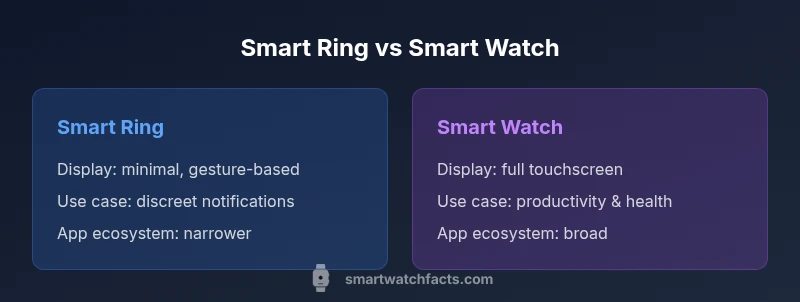
Notifications are a core reason people wear wearables. Smart watches typically show richer notifications, offer quick replies, and run a broader range of apps. They are often better suited for work contexts, travel, and exercise, where you want timely information at a glance. Rings provide subtler alerts—think gentle taps or limited notification previews—designed to minimize interruption. App ecosystems differ: watches generally enjoy a larger suite of third-party apps and smoother integration with smartphones, while rings concentrate on essential interactions and on-device gestures. Your everyday needs—whether you want to browse messages on a larger screen or simply receive a discreet nudge—will guide your preference here.
Smartwatch Facts emphasizes evaluating notification density vs. distraction; the right balance depends on your tolerance for alerts during meetings, workouts, or commutes.
Battery life and charging realities
Battery life remains a decisive factor. Watches typically consume more power due to their displays, always-on sensors, and vibrant interfaces. Rings, with smaller displays and lower-refresh interactions, can often last longer between charges, but may still require daily charging if they provide extensive wellness data. Consider your charging habits: if you’re away from a charger for long periods, comfort with a longer-life ring can matter. Conversely, if you rely on continuous app use and full-screen interactions, a watch’s higher energy draw may be acceptable. Remember that real-world battery life varies by usage, settings, and software updates.
App ecosystems, compatibility, and platform considerations
Platform ecosystems shape your experience. Smart watches usually offer robust integration with iOS or Android, plus strong app ecosystems and compatibility considerations with existing devices. Smart rings may operate best within a narrower app ecosystem, and some features may rely on companion apps or phone proximity. For iPhone users, a watch often provides seamless system integration and health data sharing; Android users may find comparable experiences with a few caveats. When evaluating, verify app availability, OS compatibility, and ongoing software support. The goal is a seamless experience that doesn’t require you to juggle multiple apps or devices unnecessarily.
Durability, water resistance, and everyday practicality
Durability matters for everyday wear. Smart rings typically feature water resistance ratings at the ring level and may be more resistant to incidental impacts; however, the risk of deformation or fit changes due to temperature and moisture exists. Smart watches offer rugged bands, glass protection, and IP ratings in many models, but the bulk can be more prone to scratches or accidental damage in certain activities. When choosing, consider your daily environment—workshop, gym, or office—and select materials and seals that match your risk profile. Also assess screen protection and ring sizing updates to ensure a long-term fit as you move between seasons.
Price ranges, value, and total cost of ownership
Price is a practical constraint. A basic smart ring can be lower in upfront cost and replacement frequency, while high-end rings with advanced sensors may approach the price of mid-range watches. Smart watches typically command higher upfront costs but offer richer displays, broader app ecosystems, and more comprehensive health tracking. Total cost of ownership should consider not just purchase price but charger availability, potential accessory costs, and software subscription requirements. Smartwatch Facts suggests mapping your expected lifespan and daily use to determine whether a ring’s simplicity or a watch’s versatility provides better long-term value.
Best-use scenarios: who should choose which form factor
Seize the form factor that aligns with your priorities:
- Best for subtlety and minimal distractions: smart ring, especially if you mostly need quick signals and passive health data.
- Best for productivity and rich health insights: smart watch, particularly if you want apps, on-device controls, and expansive notifications.
- Hybrid use cases exist: some people wear a watch for workouts and a ring for meetings, balancing the strengths of both devices.
The Smartwatch Facts team recommends analyzing your typical day—where you are, what you do, and how often you want to check your wearable—to determine the best fit.
How to decide: a practical 5-step framework
- Define your top three use cases: notifications, health metrics, and app usage.
- Compare display needs: do you want an extensive interface or a discreet form factor?
- Assess compatibility with your phone OS and ecosystem preferences.
- Consider maintenance: charging cadence, band or ring size, and cleaning requirements.
- Try the devices if possible: a hands-on test helps reveal comfort and real-world usability you can’t gauge from specs alone.
Comparison
| Feature | Smart Ring | Smart Watch |
|---|---|---|
| Display and interaction | Minimal display, gestures and taps | Full-color touchscreen with menus and apps |
| Notifications and apps | Concise alerts, limited apps | Rich notifications, extensive third-party apps |
| Health tracking scope | Core metrics (HR, sleep) with limited sensors | Broad sensors including ECG, SpO2, sleep stages |
| Battery life and charging | Longer standby potential, smaller drains | Higher power draw, more frequent charging |
| Durability and water resistance | Ring form factor can be robust but depends on ring design | Often rugged with IP ratings and protected displays |
| Comfort and wearability | Ultra-lightweight, continuous wear | Wrist-based comfort varies with strap and size |
| Price range and value | Typically lower upfront cost, model-dependent | Often higher upfront cost but broader value |
| Best for | Everyday discreet wear, minimal interactions | Productivity, health tracking, and app use |
Strengths
- Discreet, comfortable daily wear
- Low-profile design minimizes distraction
- Quicker to slip on and forget wearing
Weaknesses
- Limited display and app ecosystem for rings
- Longer-term wear may rely on phone connectivity
- Not all features available on every platform
Watch wins for versatility; ring wins for subtlety
Choose a smart watch if you want broad app support, rich notifications, and comprehensive health metrics. If you value a minimal, distraction-free form factor and all-day wear, the smart ring is a compelling alternative. Smartwatch Facts's verdict is to align your choice with daily habits and comfort.
People Also Ask
Can a smart ring replace a smartwatch for notifications?
In most cases, a ring cannot fully replace a smartwatch for notifications due to limited display and app support. It can handle quick alerts and basic previews, but you’ll likely miss deeper interactions and richer apps. Consider your tolerance for occasional check-ins and the importance of quick replies.
A ring can give you brief alerts, but it won’t replace a smartwatch for full notifications or apps.
Is a smart watch better for health tracking than a smart ring?
Generally yes, because watches often carry more sensors and advanced metrics. Rings can track core signals like heart rate and sleep but may not offer ECG or extensive wellness analytics. Align your health goals with the sensor set available on the device you choose.
Watches usually offer broader health tracking, but rings can cover essential metrics too.
Are smart rings waterproof and rugged enough for daily wear?
Many smart rings provide water resistance suitable for daily activities, but durability depends on the model and ring design. Rings may be more vulnerable to impact or sizing changes during physical activity. Check the manufacturer’s IP rating and care guidelines.
Most rings are water-resistant, but durability varies by model.
Do smart rings support third-party apps?
App availability on rings is typically more limited than on watches. Some rings offer essential companion apps and limited integrations; others rely on smartphone apps for full functionality. Verify available apps for the specific model you’re considering.
Rings usually have fewer third-party apps than watches.
Which should I buy if I use an iPhone?
If you’re an iPhone user, a smart watch often provides smoother integration with iOS, health data sharing, and notifications. Rings may work with iOS but could offer a more constrained experience. Decide based on how deeply you want to integrate with the Apple ecosystem.
For iPhone users, a watch usually offers better iOS integration.
What is the best approach for a budget-conscious buyer?
Budget-conscious buyers should compare entry-level models that provide essential health data and notifications. Rings can offer lower upfront costs, while watches with fewer features may still deliver meaningful value. Prioritize core needs and software support longevity when choosing.
If budget is key, compare entry models and focus on core needs.
Key Points
- Prioritize daily routine when choosing form factor
- Match health sensors to your wellness goals
- Assess app ecosystems before buying
- Consider charging habits and comfort for long-term use
- Weigh price against long-term value and needs