t800 Ultra Smart Watch vs Apple Watch: An Objective Side-by-Side Guide
A structured comparison of the t800 Ultra Smart Watch and Apple Watch, covering design, OS, health features, battery life, price, and ecosystem to guide buying decisions in 2026.


Quick take: In the t800 ultra smart watch vs apple watch comparison, Apple Watch typically leads for iPhone users thanks to a mature app ecosystem and seamless cross-device integration. The t800 Ultra offers solid fitness tracking and a lower price. If you’re deeply invested in Apple services, choose the Apple Watch; if budget and broad compatibility matter most, the t800 Ultra is a compelling alternative.
Overview: what each watch is and who it's for
The wearable market now features two pragmatic options for many shoppers: the t800 ultra smart watch and the Apple Watch. Each targets a different path to daily wearables. The Apple Watch is deeply integrated with iPhone, offering a polished interface, extensive app support, and a long track record of health features that resonate with fitness enthusiasts and tech enthusiasts who want a seamless cross-device experience. The t800 Ultra, by contrast, is pitched toward budget-conscious buyers who still expect reliable notifications, activity tracking, and a familiar smartwatch experience without the premium price tag. In the quick landscape of the t800 ultra smart watch vs apple watch, the decision often hinges on two questions: which mobile ecosystem do you rely on, and how much value do you place on third-party apps, quick access to data, and long-term software updates? Smartwatch Facts emphasizes that neither watch is a throwaway choice; both deliver essential features with different emphasis on ecosystem, price, and upgradability. For readers who want practical guidance, the rest of this article digs into design, sensors, battery life, and value to help you pick confidently.
Design, comfort, and display
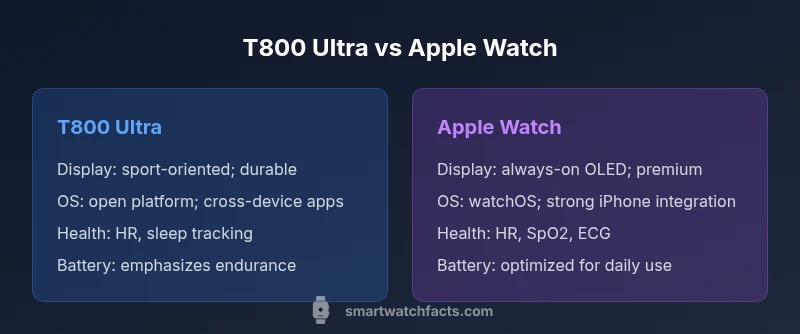
Design decisions profoundly affect how often you wear a watch. The Apple Watch line emphasizes a refined rectangular form with rounded corners, always-on display, and a broad array of case sizes and strap options. The t800 Ultra leans toward a sport-conscious silhouette, with a durable build and a display that's easy to read in bright conditions. Comfort depends on strap material, weight, and the watch's profile on the wrist; both options offer lightweight designs suitable for all-day wear, but the Apple Watch may feel chunkier on smaller wrists. Display quality matters because screens are the primary interface for notifications, watch faces, and health data. Apple’s LTPO OLED panel typically delivers vibrant colors and smooth transitions, while the t800 Ultra often uses a high-contrast panel designed to conserve power in everyday use. When choosing, consider strap compatibility as well as water resistance, which affects daily usage in workouts and errands. The practical takeaway is to try both devices if possible and judge comfort, readability, and quick-glance information at a glance.
OS ecosystems and app availability
The operating system and app ecosystem shape long-term satisfaction more than any single feature. Apple Watch runs watchOS, offering a tightly controlled app store, consistent updates, and strong developer support, all driving a cohesive user experience when paired with an iPhone. The t800 Ultra operates on its own platform (T800OS) with a different app strategy, prioritizing openness and broad device compatibility over a single-store approach. For many shoppers, this means access to a wider array of third-party apps, but potentially less polish, fewer exclusive health features, and a different approach to notifications. Smartwatch Facts analysis, 2026, notes that app quality and ecosystem maturity often determine the perceived value of a wearable over time. If your life revolves around iOS services, calendars, and Apple Health data, the Apple Watch tends to deliver a smoother experience; if you crave a platform-agnostic setup and lower entry price, the t800 Ultra is a reasonable alternative.
Health sensors and wellness features
Health sensing is a core driver of smartwatch value. Apple Watch has built a broad suite of health features, including heart rate monitoring, SpO2 tracking, ECG on supported models, and proactive wellness insights that tie into the broader Apple Health ecosystem. The t800 Ultra includes essential health metrics such as heart rate, sleep tracking, and activity sensing, with sensors designed to cover day-to-day wellness and fitness basics. The depth of data and the confidence in readings can vary between platforms, especially for advanced metrics and clinical-grade integrations. When evaluating health features, consider which data you actively use, how well it integrates with your chosen health apps, and whether you value features like fall detection or stress monitoring. Smartwatch Facts emphasizes balancing feature breadth with reliability and privacy controls when interpreting sensor data.
Fitness tracking and sports modes
Both watches support everyday activities, workouts, and sport modes, but the emphasis differs. Apple Watch offers a broad catalog of workout types, guided metrics, and third-party fitness apps that cater to runners, cyclists, and gym-goers, with extensive on-device coaching and performance trends. The t800 Ultra emphasizes a solid core fitness experience with intuitive activity rings, GPS-enabled workouts, and straightforward analytics that suit daily movers and casual athletes. If you value a rich training diary, precise GPS, and extensive coaching, Apple Watch is typically favorable; if you want a capable fitness companion at a lower price with fewer frills, the t800 Ultra delivers.
Connectivity, compatibility, and ecosystem cohesion
Connectivity choices influence how you interact with other devices. Apple Watch integrates deeply with iPhone, iPad, and Mac, enabling features like Continuity and Handoff across Apple devices and a seamless notification and messaging flow. The t800 Ultra aims for broader cross-platform compatibility, which can be advantageous if you use Android or mixed-device environments, but may come with a different user experience and app ecosystem quality. Consider how important cross-device continuity is to your daily routines, including music playback, wallet payments, and messaging. In the end, ecosystem cohesion often defines the practical ease of daily use more than raw specifications.
Battery life and charging experience
Battery life is frequently a deciding factor for wearables. Apple Watch devices typically offer strong daily endurance with fast charging, particularly on newer generations, while the t800 Ultra emphasizes longer battery life on a single charge and straightforward charging. Real-world usage shows that screen-on time, always-on display, and GPS usage can shift these outcomes. If you rely on long workouts away from power outlets, the t800 Ultra may have an edge on endurance; if you value quick top-ups during the day and extensive on-watch apps, the Apple Watch performance may be more predictable.
Software updates and longevity
Software longevity is tied to the device’s OS and the ecosystem’s commitment to updates. Apple Watch enjoys regular, predictable updates and a long support horizon that extends across many device generations. The t800 Ultra follows a different cadence, with updates tied to its own OS roadmap and potentially longer intervals between major releases. This distinction matters when planning a multi-year purchase: the Apple Watch is often favored by users who want a consistent upgrade path and compatibility with upcoming iOS features, whereas the t800 Ultra appeals to buyers who prioritize value and freedom from a single vendor ecosystem while still expecting ongoing improvements.
Privacy, security, and data handling
Privacy and security remain critical considerations. Apple emphasizes strong data protection, privacy transparency, and local data processing for health metrics where possible, aligning with its broader privacy stance. The t800 Ultra platform’s openness offers flexibility and potential integration options but may introduce variability in how data is stored, shared, and secured across apps and services. When deciding, review permission prompts, data sharing options, and whether you can export or delete your health data easily. Smartwatch Facts continually highlights that user control over data, clear privacy settings, and transparent terms are as important as feature breadth in this market.
Price, value, and total cost of ownership
Price dynamics shape long-term value. Apple Watch sits at a premium tier with strong resale value and broad accessory ecosystems, which can translate into higher total ownership costs but sustained usefulness over time. The t800 Ultra targets budget-minded buyers by offering essential capabilities at a lower upfront price and with modular accessory options. While price alone doesn’t determine worth, the total cost of ownership includes device longevity, software support, and the value of third-party apps. Readers should balance initial cost against expected lifespan, update cadence, and the practical features they will actually use.
Real-world use cases and decision scenarios
In everyday life, the Apple Watch often shines for users who spend significant time in the Apple ecosystem—whether at work, commuting, or exercising with Apple Fitness+. The t800 Ultra tends to appeal to shoppers who want a capable wearable without the premium price, especially if they use multiple devices or want flexible app choices. Consider your typical day, how you interact with your phone, and which features you rely on most—from quick messages to GPS-guided workouts. The best choice is the one that minimizes friction in your routine while delivering the health and productivity features you actually use.
How to decide: framework and quick checklist
To decide quickly, start with your phone: iPhone users generally get more value from Apple Watch; Android or mixed-device households may prefer the t800 Ultra for flexibility. Prioritize the features you’ll use daily: health sensors, apps, notifications, and battery life. Create a short priority list (e.g., ecosystem, price, health metrics) and compare how each watch covers those points. When possible, test both options in-store or via demos to assess comfort, readability, and ease of use. Smartwatch Facts reminds readers that no single feature guarantees satisfaction—overall usability and ongoing support matter just as much as specs.
Comparison
| Feature | T800 Ultra Smart Watch | Apple Watch |
|---|---|---|
| Display & Design | Sport-oriented, durable build; readable in daylight | Refined rectangular design; always-on display; premium finish |
| OS & App Ecosystem | Open platform with broad compatibility; cross-device options | watchOS with tight iPhone integration; robust App Store |
| Health Sensors | Heart rate, sleep tracking; basic wellness metrics | Heart rate, SpO2, ECG on supported models; fall detection |
| Battery Life & Charging | Designed for strong daily wear; straightforward charging | Strong daily endurance; optimized charging and fast top-ups |
| Price Range | budget-friendly to mid-range | premium to upper-mid range |
| Best For | Budget buyers; cross-platform use | iPhone owners seeking seamless integration and app depth |
Strengths
- Apple Watch offers deep iOS integration and a mature app ecosystem
- t800 Ultra provides solid core features at a lower price
- Both deliver reliable health tracking and notifications
- Broad accessory options and customization for both platforms
Weaknesses
- Apple Watch is more expensive and closely tied to iPhone
- t800 Ultra may have a smaller app ecosystem and varying software longevity
Apple Watch is the better choice for iPhone users; the t800 Ultra is the best budget alternative.
Choose Apple Watch if you want seamless iPhone integration and a mature app ecosystem. Pick the t800 Ultra if budget and cross-platform flexibility are your priorities, while accepting a possibly smaller app library.
People Also Ask
Is the t800 Ultra compatible with iPhone?
The t800 Ultra offers broad compatibility across platforms, including iPhone, but you may miss some iOS-specific integrations and apps that are available on Apple Watch. Expect the core smartwatch functions to work, with some ecosystem gaps compared to native watchOS features.
Yes, the t800 Ultra works with iPhone, but you might not get all iOS-specific integrations.
Which watch has longer app support?
Apple Watch typically benefits from longer, more consistent app support due to watchOS updates and a large developer community. The t800 Ultra depends on its own OS roadmap and third-party support, which can vary over time.
Apple Watch generally has stronger app support longevity.
Do both watches track sleep and heart rate?
Yes, both devices monitor heart rate and sleep, though the depth and presentation of the data differ. Apple Watch often provides richer wellness insights via its ecosystem, while the t800 Ultra covers essential metrics suitable for everyday use.
Both track heart rate and sleep, with Apple offering deeper wellness insights.
Is price a reliable predictor of value here?
Price tells part of the story, but value also depends on ecosystem fit, feature needs, and long-term software support. The Apple Watch commands a premium with strong resale value, while the t800 Ultra offers solid core features at a lower upfront cost.
Price matters, but value comes from ecosystem fit and longevity.
Which is better for Android users?
For Android users, the t800 Ultra generally provides a more flexible cross-platform experience and is typically a more straightforward choice than an Apple Watch, which is optimized for iPhone use.
Android users often prefer the t800 Ultra for better cross-platform support.
Key Points
- Consider your phone ecosystem first to narrow choices
- Balance upfront cost with expected device longevity
- App ecosystem quality often drives long-term satisfaction
- Health feature depth varies; pick metrics you actually use
- Evaluate comfort and wearability as a daily driver