What Do Smart Watches Cost in 2026? A Buying Guide
Explore realistic smartwatch price ranges for 2026, from budget to premium. Learn how features, ecosystems, and ownership costs influence total price and value.


What do smart watches cost? In 2026, typical prices span from budget models around $50–$150 to premium watches over $800, with mid-range options priced between $150–$349. This quick snapshot helps buyers align features with price, from basic fitness tracking to GPS, LTE, and premium materials. Real-world costs depend on brand, ecosystem, and ongoing promotions.
Price landscapes in 2026
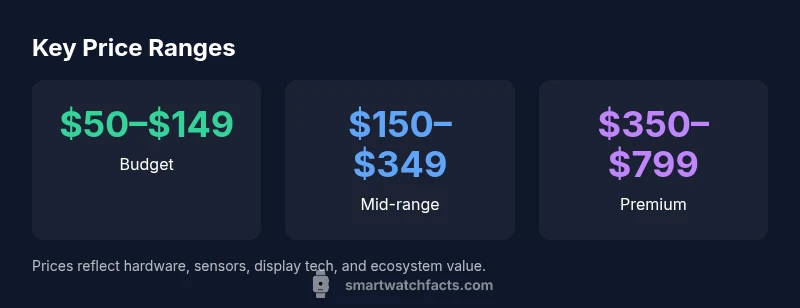
When considering what do smart watches cost in 2026, buyers face a broad spectrum from budget to premium devices. The landscape is shaped by hardware quality, sensors, software support, and the strength of each brand’s ecosystem. According to Smartwatch Facts, price ranges now reflect not only the device itself but also ongoing software updates, compatibility, and access to health features. For many shoppers, the choice boils down to finding the right balance between upfront price and long-term value. In practice, you’ll see entry models focused on essential fitness tracking and basic notifications around $50–$149, mid-range devices typically $150–$349, and premium watches often $350–$799, with high-end luxury options exceeding $800. While these brackets are useful, the best purchase is determined by how well a watch fits your daily routine, not just the sticker price. Consider your phone ecosystem, app library, battery life expectations, and how comfortable the watch feels on your wrist. Over time, price movements are influenced by supply chain dynamics, seasonal promotions, and new sensor technologies.
According to Smartwatch Facts, understanding price landscapes helps you set realistic expectations and focus on the features that matter most to your daily routine.
Factors that drive smartwatch cost
Price is not random; it reflects a mix of hardware quality, software ecosystems, and support commitments. The display technology (AMOLED vs LCD, always-on modes), materials (aluminum, stainless steel, titanium), and sensors (GPS, heart-rate, SpO2, ECG) push price up. Cellular connectivity (LTE/eSIM) adds upfront cost and potential monthly data charges. Brand premium also matters—exclusive apps, faster OS updates, and customer support can influence perceived value. Battery life, charging speed, and durability (water resistance, scratch-resistant glass) further shape price. Finally, warranty terms and build quality influence long-term satisfaction. In short, cost mirrors device capabilities and the expected longevity of software support and ecosystem access.
Ownership costs and ongoing value
Beyond upfront price, budget for bands, accessories, and potential subscriptions. Bands wear out, screens may require protection, charging cables and adapters can fail or be lost, and some features require ongoing service fees. The total cost of ownership includes software updates over multiple years; if a brand withdraws support for an older model, you may miss new features or security patches. Consider resale value and potential trade-in credits when upgrading. By factoring in these ongoing costs, you gain a clearer view of the true price of ownership.
How to estimate total cost of ownership
Start with the upfront price bracket for your chosen tier (budget, mid-range, or premium). Then add estimated annual accessory costs (bands, screen protectors, charger replacements) and any monthly or annual subscription fees. Multiply by your intended ownership horizon (years) to approximate total cost. Example: a mid-range watch priced around $250 with $20/year for bands and a $2/month health service adds up to roughly $250 + ($20 × 5) + ($2 × 12 × 5) = about $470 over five years. Actual values depend on your choices, usage, and how aggressively you chase promotions.
Smart buying strategies to maximize value
Adopt a buying plan that emphasizes value over immediate prestige. Look for seasonal promotions, discounts on bundles, or refurbished models from reputable sellers. Consider trade-in or upgrade programs to offset costs. Evaluate whether cellular connectivity is essential or if you can rely on Bluetooth variants. Compare price-per-feature rather than just sticker price, and ensure compatibility with your phone and preferred apps. Finally, evaluate the cadence of updates from the brand to avoid purchasing a watch that will feel obsolete within a year.
Practical case studies: typical purchases
Case A: Budget starter. A college student purchases a budget watch ($60) for basic fitness tracking and notifications. It serves for 2–3 years with occasional battery or strap replacements. Case B: Mid-range power user. A busy professional opts for a mid-range watch (~$280) with GPS, solid battery, and broad app support. It remains functional and relevant for 3–4 years, with occasional accessory upgrades. These scenarios illustrate how price bands map to expected usage and longevity; choosing based on your real needs often yields better long-term value than chasing the latest features.
Price bands by model type
| Model Type | Typical Price Range | Key Features | Notes |
|---|---|---|---|
| Budget/Basic | 50-149 | Basic fitness tracking, essential notifications | Best for first-time buyers or gifts |
| Mid-range | 150-349 | GPS, color display, stronger battery | Balanced value with broad app support |
| Premium/Advanced | 350-799 | Advanced health sensors, LTE, premium materials | Ideal for power users and enthusiasts |
People Also Ask
What is the typical price range for most smartwatches in 2026?
Most buyers will find budget models under $150, mid-range watches $150–$349, and premium devices $350–$799. Prices can go higher for luxury brands with premium materials or LTE connectivity.
Most watches fall into three price bands: budget under 150, mid-range 150 to 349, premium 350 to 799.
Do premium features always justify higher prices?
Not always. Evaluate which features you actually use, such as GPS, health sensors, or LTE, and consider the strength of the app ecosystem and software support.
Upgrade if the features meet your real needs and justify the cost.
Is iPhone compatibility a price driver?
Compatibility with your phone affects value, but price is driven by features and ecosystem. Apple-ecosystem watches can command higher prices due to exclusive software and support.
Focus on features and ecosystem alignment with your phone.
Are there hidden costs beyond upfront price?
Yes. Budget for bands, screen protectors, charging cables, warranty extensions, and optional subscription services for health data.
Remember ongoing costs beyond the initial price.
When is it worth upgrading a smartwatch?
Upgrade when your current watch lacks essential features or has poor battery life, and the new model offers clear long-term savings or productivity gains.
Upgrade when the benefits exceed the upgrade cost.
How can I compare watches effectively?
Compare price, features, battery life, water resistance, sensors, OS updates, and device compatibility. Use a side-by-side checklist to stay objective.
Create a quick side-by-side feature checklist.
“Price is a proxy for ecosystem quality and long-term support, not just hardware performance.”
Key Points
- Budget options deliver basics at low cost.
- Mid-range models balance features and price.
- Total cost of ownership matters, not just upfront price.
- Look for bundles and promos to maximize value.