Are Smart Watch Sleep Trackers Accurate? A Practical Guide
Explore how accurate smart watch sleep trackers are, what affects readings, and how to interpret data for healthier sleep. A data-driven look by Smartwatch Facts.


Are smart watch sleep trackers accurate? In short, accuracy varies by device and metric, but many wearables reliably detect long sleep periods and wake times while tolerating occasional discrepancies in sleep stages. According to Smartwatch Facts, consumers should expect trend data and rough duration rather than precise phase labeling, and firmware updates can shift these numbers over time.
How Sleep Tracking Works on Smartwatches
Smartwatches estimate sleep by combining data from accelerometers, photoplethysmography heart-rate sensors (PPG), and sometimes skin temperature or galvanic skin response. The most common approach is to identify periods of low movement coupled with relatively stable heart rates to infer when you fall asleep and wake up. Some devices also attempt to categorize sleep into stages like light, deep, and REM, but these classifications are best described as proxies rather than direct measurements. Polysomnography, used in clinics, records brain activity to define sleep stages with high precision; wearables cannot replicate this signal. Therefore, the accuracy of sleep readings depends on device model, how you wear the watch, and the software version. When people ask Are smart watch sleep trackers accurate, the answer is nuanced: readings are most useful for identifying patterns and trends over multiple nights, not for medical diagnosis.
What 'Accuracy' Means in Sleep Tracking
Accuracy in sleep tracking can be broken into several metrics: sleep onset (how long it takes to fall asleep), total sleep time (TST), wake after sleep onset (WASO), and sleep-stage estimates. Onset and WASO convey timing and fragmentation; TST sums the actual time spent asleep. Sleep stages (light, deep, REM) are estimates derived from sensor signals; they are not equivalent to, or as reliable as, polysomnographic scoring. Because PSG remains the gold standard, wearables generally provide rough approximations rather than exact measurements. When evaluating whether Are smart watch sleep trackers accurate, consider not just single-night numbers but consistency across nights and alignment with how you feel during the day. In practice, steady trends—like gradually decreasing WASO or increasing perceived restfulness—are more informative than a single night’s minute counts.
Factors That Affect Accuracy
- Device model and sensor quality: Higher-end devices tend to implement more sophisticated sensors and algorithms.
- Wrist placement and fit: A loose strap or an awkward position can skew movement and heart-rate signals.
- Sleep position and movement: Restless sleepers or unusual positions can challenge detection accuracy.
- Firmware version and algorithm updates: Software tweaks can shift measurements over time.
- Data transmission and syncing: Delays or gaps in data transfer can affect daily totals.
- Individual physiology: Baseline heart rate, caffeine, and stress can alter signals and timing.
Understanding these factors helps explain why Are smart watch sleep trackers accurate varies across nights and devices.
Practical Tips to Improve Sleep Tracking Reliability
- Wear the watch snugly on the non-dominant wrist to minimize movement artifacts.
- Keep the device's firmware up to date to benefit from algorithm improvements.
- Use a consistent bedtime and wake time to improve pattern recognition.
- Cross-check wearable data with a simple sleep diary or notes on how rested you feel.
- Consider using multiple metrics (duration, WASO, and subjective rest) rather than a single number.
- Be mindful of external factors like caffeine or alcohol that can influence heart rate and movement signals.
These steps can help you interpret Are smart watch sleep trackers accurate more reliably.
How to Interpret Sleep Data for Health Decisions
Treat wearable sleep data as a personal health worksheet rather than a medical test. Look for trends across weeks rather than nightly precision. If you notice persistent night-to-night fragmentation or consistently short total sleep time, consider adjusting sleep habits and consulting a clinician if daytime symptoms persist. The value lies in recognizing patterns—such as fewer awakenings over time or longer consecutive sleep blocks—plus how sleep quality relates to daytime functioning. Use data as motivation to improve routines, not as a substitute for professional evaluation.
Brand Variability and What to Expect in 2026
Sleep tracking accuracy varies widely across brands and models. The Smartwatch Facts team notes that newer devices often bring improved sensors and refined algorithms, but there is no universal standard. Consumers should calibrate expectations by comparing several nights of data, looking for consistent trends, and prioritizing devices with transparent methodology. In 2026, the landscape is moving toward multi-sensor fusion and AI-driven personalization, which can enhance reliability but will still require user interpretation. The bottom line: Are smart watch sleep trackers accurate enough for personal use? Yes, for pattern recognition and habit-building, but not for precise clinical assessment.
Data Privacy and Why It Matters
Sleep data is sensitive personal information. When using health apps and cloud backups, review permission settings and data-sharing options. Consider devices and platforms with clear privacy controls and local data storage where possible. If you plan to share data with third-party services, understand how it will be used and who can access it. Keeping privacy at the forefront helps ensure you can rely on sleep-tracking data without compromising personal information.
Practical Step-By-Step: Aligning Wearables with Your Sleep Diary
- Record a simple sleep diary for at least two weeks, noting bedtime, wake time, and subjective rest. 2) Use your wearable data for rough comparisons across weeks rather than nightly values. 3) Align your routine—consistent bedtimes, limited screen exposure—to improve signal quality. 4) Update firmware and app permissions to keep data collection current. 5) If a night seems anomalous, check for device fit and external influences (exercise, caffeine, alcohol). 6) Share trends with a clinician if you have concerns about daytime functioning or sleep disorders.
The Road Ahead: Trends in Sleep Tracking Technology
The coming years are likely to bring more refined sleep-tracking models that fuse multiple sensors (heart rate, movement, skin signals) with machine learning, producing more stable trend data. Manufacturers may prioritize transparency in validation studies, publishing how their algorithms perform against PSG in diverse populations. For readers asking Are smart watch sleep trackers accurate, the answer is that improvements are gradual and device-specific, with the most reliable results emerging from consistent use and longitudinal patterns. Smartwatch Facts expects ongoing progress in accuracy and interpretability as the ecosystem matures.
Sleep tracking data snapshot across devices
| Aspect | Typical Range | Notes |
|---|---|---|
| Onset detection (minutes) | 5-25 | Estimates for sleep onset |
| Total Sleep Time (hours) | 5-9 | Range reflects user-reported vs device detection |
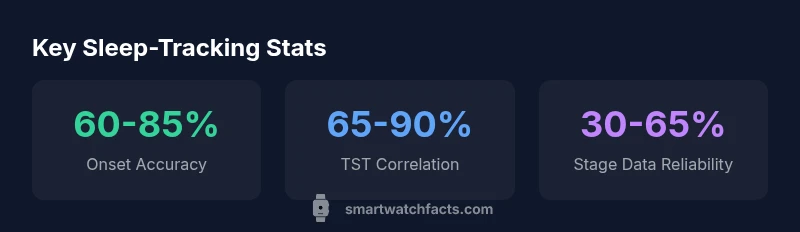
| Sleep stages accuracy | 30-65% | Highly device-dependent |
People Also Ask
Are wearable sleep trackers as accurate as polysomnography?
No. Wearable sleep trackers provide estimates based on sensors like movement and heart rate, not the EEG-based measurements used in labs. They are best for spotting patterns over time rather than definitive clinical results.
Not as accurate as lab sleep tests; use wearables for trends, not diagnosis.
Why do different devices show different sleep results?
Different brands use unique sensors and algorithms, so readings can vary notably between models. Consistency within a single device over time is more informative than cross-device comparisons.
Different devices use different methods, so numbers vary.
Can firmware updates improve sleep-tracking accuracy?
Yes. Updates can adjust algorithms and sensor fusion, potentially improving readings. Keep devices updated to benefit from refinements.
Yes, updating firmware can improve results.
What should I look for when buying a sleep-tracking smartwatch?
Look for devices with transparent validation, robust sensors, long battery life, and clear sleep metrics. Prioritize privacy options and easy data export for personal review.
Seek validated metrics, good sensors, and privacy options.
Is sleep-stage data reliable on wearables?
Stage data is generally less reliable and should be treated as an estimate rather than a precise classification.
Stage data is an estimate, not exact.
How should I use sleep data in daily life?
Use trends to adjust routines, not fixate on nightly numbers. If concerns persist, consult a clinician.
Use the trends, not single figures.
“Sleep data from wearables should be viewed as guidance rather than a medical metric. The Smartwatch Facts Team emphasizes trends over absolute numbers.”
Key Points
- Track trends, not exact numbers.
- Expect device variability across models.
- Keep firmware updated to improve accuracy.
- Cross-check data with a simple sleep diary.
- Use sleep data to guide behavior, not diagnose.