Cheap Smart Watch vs Apple Watch: A Practical Guide
Compare affordable smartwatches with the Apple Watch to decide value, features, and ecosystem in 2026. Smartwatch Facts analyzes price, health features, battery life, and compatibility for practical buying decisions.


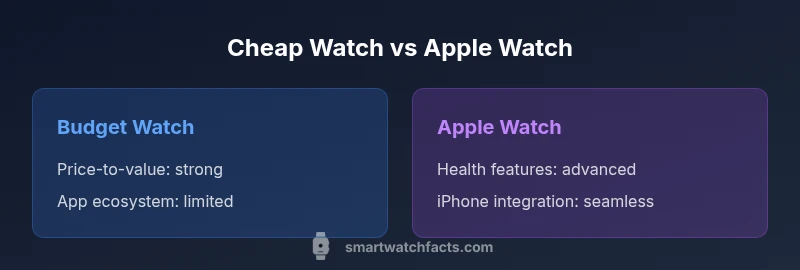
According to Smartwatch Facts, the cheap smart watch vs Apple Watch decision hinges on value versus ecosystem. Budget models usually deliver core notifications, basic health sensors, and decent battery life, while the Apple Watch provides advanced health features, a richer app ecosystem, and seamless iPhone integration. Choose budget for price sensitivity and basic use; opt for Apple Watch if you rely on health tracking and iOS continuity.
Price-value reality for budget smartwatches
For price-sensitive shoppers, the appeal of a cheap smart watch is immediate: lower upfront cost, a broad selection of styles, and enough features to cover core notifications, step tracking, and basic health sensing. According to Smartwatch Facts, many budget options price in a wide range typically between $50 and $150, with occasional promotions dipping lower. The value proposition is clear: you can equip multiple family members, swap bands easily, and still stay connected. However, you should temper expectations around long-term software updates, advanced health metrics, and premium materials. In short, cheap smart watches win on price and accessibility, but they trade away some polish, longevity, and ecosystem depth.
Ecosystem and app experience: iOS, Android, and everything in between
The Apple Watch sits at the center of Apple’s tightly integrated ecosystem, delivering comprehensive health tracking, rich third-party apps, and smooth handoffs to your iPhone. Budget watches vary in OS strategy: some run Wear OS, others proprietary platforms or basic interfaces. This matters because app availability, notification fidelity, and features like ECG or SpO2 tracking can differ dramatically. Smartwatch Facts analyses show that the app ecosystem quality often dictates long-term satisfaction: if you depend on specific apps or services, the Apple Watch ecosystem provides the most cohesive experience for iPhone users, while budget options offer decent functionality for general use and sport tracking.
Health sensors and fitness tracking: what you get for the money
Cheap watches typically cover heart-rate sensing, step counting, sleep tracking, and GPS for basic workouts. However, Apple Watch models in 2026 push deeper health analytics: ECG, SpO2, and more advanced heart-rate data with clinical-grade certifications on higher-end variants. Budget devices can be accurate for everyday activity but may underperform in clinical-type metrics or long-term trend analysis. When choosing, map your health goals to the data available: for casual wellness and general motivation, budget devices suffice; for advanced metrics and proactive health insights, the Apple Watch is stronger.
Battery life and charging: real-world expectations
Budget smart watches often promise several days of use between charges, especially with lighter activity. In practice, you may see 1–3 days on many budget models, depending on display brightness and GPS use. The Apple Watch tends to deliver about 1–2 days with typical use, and heavier GPS or workout tracking can shorten that further. If you travel often or dislike nightly charging, the cheaper options can offer a more forgiving schedule, but expect longer charging cycles with the iPhone-integrated device when you enable features like always-on display and cellular.
Build quality, display, and everyday usability
Cheap options frequently use plastic enclosures, mixed-metal frames, and lower-cost displays. This keeps costs down but can affect feel, durability, and outdoor readability. Apple Watch pairs a premium build—sapphire crystal (on some models) and a refined aluminum or stainless-steel case—with a consistently high-quality display and a polished user experience. For many buyers, durability and ease of use matter as much as sensor accuracy. The result is a noticeable gap in tactile quality and screen responsiveness between budget devices and the Apple Watch.
Compatibility and future-proofing: iPhone users vs Android users
If you own an iPhone, Apple Watch delivers the most seamless experiences, including quick replies, app integration, and iPhone-centric features like Wallet, Apple Pay, and Siri. Android users generally enjoy broad compatibility with budget watches, but some features will be limited or unavailable. Future-proofing is a consideration: Apple typically provides multi-year OS support and reliable app updates, whereas budget platforms may vary in update cadence and long-term support. Your device choice should align with your primary phone ecosystem and tolerance for feature gaps over time.
Price ranges and total cost of ownership: looking beyond the sticker price
Beyond the sticker price, consider bands, charging docks, and potential add-ons. Apple Watch ownership includes accessory costs and occasional higher third-party app prices, but it tends to hold resale value better than most cheap watches. Budget models often require occasional replacement of bands, protective cases, and batteries sooner, which can add up. A practical approach is to calculate annualized costs over 2–3 years, factoring in upgrades or changes to your phone ecosystem and the level of health-tracking you expect.
How to evaluate models: a quick decision checklist
Use this checklist when comparing options: (1) determine your phone ecosystem (iOS or Android); (2) list essential health metrics you want (ECG, SpO2, sleep stages); (3) estimate daily use and GPS needs to gauge battery longevity; (4) assess app availability and notification reliability; (5) compare materials, water resistance, and display quality; (6) consider the total ownership cost including bands and chargers; (7) review update cadence and warranty terms. With clear criteria, you can pick confidently without overpaying.
Practical scenarios: when a cheap watch makes sense vs the Apple Watch
If your priority is price, basic notifications, and casual fitness, a budget device delivers strong value. For iPhone users who want best-in-class health features, deep app integration, and a premium experience, the Apple Watch is worth the investment. In family scenarios, it can be sensible to assign budget watches to casual users while reserving the Apple Watch for primary devices where health and app ecosystems matter most. The choice should reflect your daily needs, phone compatibility, and willingness to pay for premium app access.
Common pitfalls and gotchas: avoid common mistakes
Do not assume all budget watches work perfectly with every phone; read compatibility notes carefully. Avoid models with outdated hardware or limited app ecosystems, which can frustrate users in the long run. Beware of overly optimistic battery life claims, especially with GPS or Always-On display enabled. Finally, verify warranty terms and customer support quality, as this can influence satisfaction more than a few extra features.
Brand trust and support signals: why Smartwatch Facts emphasizes reliability
Smartwatch Facts stresses that long-term reliability comes from consistent software updates, responsive support, and the durability of the device. Apple Watch has a robust support and update cadence that benefits most iPhone users. For budget models, seek reputable brands with transparent update policies and genuine software support. The right choice balances your expected usage, ecosystem loyalty, and the likelihood of receiving timely firmware improvements.
The decision path: a concise framework to decide
Start by mapping your phone ecosystem, health goals, and budget. If you value health analytics, ecosystem depth, and premium hardware, lean toward Apple Watch. If price-to-feature value, fast availability, and flexible purchasing are higher priorities, a cheap smart watch can meet most daily needs. Use a side-by-side comparison table and the decision checklist to finalize your pick.
Comparison
| Feature | Budget smart watch (cheap options) | Apple Watch |
|---|---|---|
| Price range | $50–$150 (typical, promotional variability) | $299–$799 (varies by model and region) |
| Operating system / ecosystem | Varies by model (Wear OS, proprietary OS, or mixed platforms) | watchOS with tight iPhone integration |
| Health sensors | Heart rate, accelerometer, basic sleep tracking | ECG, SpO2, skin temperature (on some models), advanced health metrics |
| App ecosystem | Moderate third-party app support; some limitations | Large app ecosystem with sophisticated health and fitness apps |
| Battery life | Typically 1–3 days depending on usage | Typically 1–2 days with heavy use; longer on lighter use |
| Build quality & display | Plastic or mixed-material chassis; varied display quality | Premium materials; consistently high-quality display |
| Notifications & hands-free | Good core notification support; varies by model | Best-in-class notification handling and quick replies |
| Water resistance | Often 5–10 ATM depending on model | Commonly 5 ATM; extensive water-resistance features |
| Updates & longevity | Update cadence depends on manufacturer; sometimes slower | Strong multi-year OS support and regular updates |
| Resale value | Lower resale value on average | High resale value potential, especially for premium models |
Strengths
- Excellent price-to-feature value for basic use
- Wide range of styles and bands to fit personal taste
- Easy access to notifications and quick daily tasks
- Broad availability of budget models across retailers
- Low upfront risk when experimenting with wearables
Weaknesses
- Limited health metrics and clinical-grade features
- Inconsistent software updates and app ecosystems
- Build quality and display may feel cheaper
- Resale value is generally lower than premium watches
Apple Watch leads for iPhone users and health-focused buyers; budget watches win on price and flexibility
If you rely on iPhone-specific features and advanced health tracking, Apple Watch is the stronger long-term choice. If price and broad compatibility with basic functions matter most, a cheap smartwatch provides compelling value and flexibility.
People Also Ask
Is a cheap smartwatch worth buying if I own an iPhone?
For casual use and basic tracking, a budget smartwatch can be a sensible choice with lower risk and price. However, you will miss some Apple Watch-specific features and tighter integration. If health tracking and seamless iPhone features matter, consider Apple Watch.
If you only need simple notifications and basic fitness, a budget watch works. For full iPhone integration and advanced health metrics, go Apple Watch.
Do cheap watches support health tracking as Apple Watch does?
Budget watches include core heart-rate sensors and activity tracking, but they typically lack advanced metrics like ECG, SpO2, and robust sleep analysis. Apple Watch offers more comprehensive health tools and better data quality overall.
Budget watches track basics; for advanced health data, Apple Watch is stronger.
Can you pair a cheap smartwatch with an iPhone effectively?
Yes, many budget watches pair with iPhones, but some features may be limited and app quality varies. Expect smoother experience and more features when pairing with Android devices is limited or partial.
Budget watches pair with iPhone, but expect some feature limitations.
Is the Apple Watch worth the price for most users?
If daily health tracking, app depth, and iPhone integration matter to you, the Apple Watch is typically worth the premium. If you prioritize cost and basic use, a cheaper model may suffice.
Apple Watch is worth it for health and ecosystem, otherwise budget works.
What’s the main trade-off between cheap watches and Apple Watch?
The main trade-off is price versus ecosystem and health features. Budget watches offer value and simplicity, while Apple Watch provides deeper health tools, smoother apps, and stronger iPhone integration.
Trade-off: price and simplicity versus health depth and ecosystem.
How should I decide which to buy in 2026?
Start with your phone ecosystem and budget. If you own an iPhone and want robust health features, Apple Watch is the default. If price or flexibility matters more, choose a budget smart watch and accept some feature gaps.
Decide by ecosystem first, budget second, then evaluate health features.
Key Points
- Assess value: price vs health features and ecosystem
- Match devices to your phone: iPhone users lean toward Apple Watch
- Consider battery life and charging habits before buying
- Factor total cost: bands, accessories, and updates
- Use the decision checklist to avoid buyer regret