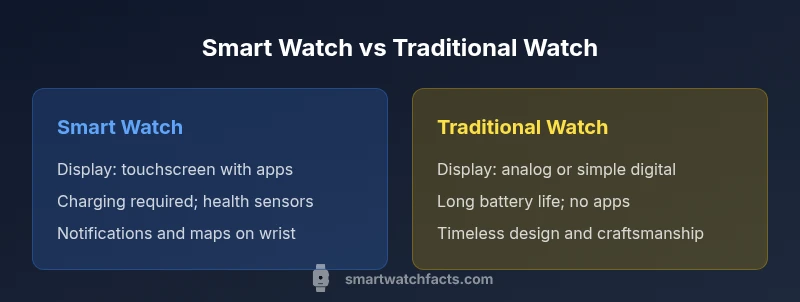
Difference Between Smart Watch and Normal Watch: An Analytical Guide
A detailed, evidence-based comparison of smart watches and traditional watches, covering display, sensors, ecosystems, battery life, pricing, and buying tips to help you decide.


The difference between smart watch and normal watch centers on function and ecosystem. A smart watch adds digital features, health sensors, and app support, while a traditional watch prioritizes timekeeping and design. This comparison explains practical implications for daily use, battery life, and long-term value.
Difference Between Smart Watch and Normal Watch
In exploring the difference between smart watch and normal watch, the focus is on function, not just form. A smart watch extends timekeeping with software and sensors that track health, activity, and environment, and it can connect to your phone and the internet. According to Smartwatch Facts, the distinction hinges on usage patterns and ecosystem expectations: if you want apps, alerts, and data, the smart path dominates; if you value craftsmanship and simplicity, a traditional watch remains compelling. As we compare, keep in mind that the best choice depends on how you plan to use the device daily and how much you value ongoing updates and integration. This page treats the topic with care, weighing practicality against style and long-term costs.
Display technology and user interfaces
Display plays a central role in the difference between smart watch and normal watch. Smartwatches use touchscreens or rotating crowns with vibrant, always-on interfaces that can show calendars, maps, and fitness dashboards. Traditional watches rely on mechanical dials, luminous indices, or simple digital numerals, and they require no charging for timekeeping. The user experience diverges here: a smartwatch invites interaction, apps, and customization; a classic watch prioritizes legibility and tactile cues. The evolution of display tech means you can choose a minimalistic analog watch with a digital companion, or a full-featured smartwatch with a traditional watch face. This section highlights how display philosophy shapes daily usability and personal style.
Health sensors and fitness tracking
Health sensors are a hallmark of the difference between smart watch and normal watch. A smartwatch often includes a heart-rate sensor, SpO2, step counting, sleep tracking, and GPS. Some models offer skin temperature, stress monitoring, and guided breathing programs. Traditional watches usually provide only timekeeping and, at best, a basic timer or chronograph. While a few dress watches feature luxury certifications, they do not track health metrics in real time. The presence of sensors can influence lifestyle decisions, motivate activity, and provide data for wellness goals. When evaluating options, consider which metrics matter most and whether you want continuous monitoring or occasional checks.
Apps, ecosystems, and software updates
Smartwatch software is built around an operating system with an app store, watch faces, and integrations with smartphones and services. This enables weather alerts, music control, reminders, and third-party health apps. In contrast, traditional watches do not run apps or retrieve data from the internet; they rely on the wearer’s engagement with time and style. Software updates can improve features and security on smart watches but may also yield occasional compatibility changes. For many users, the app ecosystem adds tangible value, turning a watch into a compact personal assistant. If you value customization and ongoing enhancements, the software layer becomes a defining factor in your long-term satisfaction.
Battery life, charging, and usage patterns
Battery life is a practical difference between smart watch and normal watch. Smartwatches typically require daily or multi-day charging, depending on features like GPS, notifications, and always-on displays. Traditional watches offer decades of battery life with quartz movements or require no battery at all in certain mechanical designs. Real-world usage matters: if you wear your device continuously for health monitoring and smart features, plan for daily charging; if you wear it primarily for timekeeping and occasional notifications, a traditional watch can feel almost maintenance-free. Consider also the tradeoffs of fast charging and wireless charging ecosystems that can simplify daily routines.
Notifications, calls, and communication features
One of the clear advantages of the difference between smart watch and normal watch is access to notifications and calls. Smartwatches can deliver messages, calendar alerts, navigation prompts, and even make or answer calls when paired with a phone or cellular modem. Traditional watches do not display notifications, and while some digital or hybrid watches may offer limited alerting, the experience is far more constrained. For some users, this connectivity translates into productivity gains; for others, it becomes a source of distraction. Evaluate your tolerance for interruptions and the need for quick communication when choosing between options.
Durability, water resistance, and care
Durability expectations differ across the two categories. Traditional watches have a long-standing reputation for craftsmanship and a timeless build, often with robust case materials and clear water resistance ratings. Smartwatches add electronics that require careful design choices; water resistance is common, but the internal complexity can affect serviceability and battery longevity. Regardless of type, protective cases, screen protectors, and proper charging hygiene extend life. If you travel frequently or engage in sports, look for models with rugged builds, sapphire crystal faces, and secure band options. The care routine for a smart watch includes software updates and sensor calibration, while a traditional watch centers on strap maintenance and movement servicing.
Design, aesthetics, and personalization
Design plays a decisive role in the difference between smart watch and normal watch for many buyers. A traditional watch exudes heritage, craftsmanship, and resale appeal; smartwatches often emphasize sportiness, modern minimalism, or bold fashion statements. Personalization is easier with smartwatches through interchangeable bands, watch faces, and app-driven aesthetics; makeup and dial choices let you tailor the vibe, while traditional watches rely on case material, dial texture, and hand design to convey personality. Decide whether you want a fashion-forward accessory or a technologically integrated device that blends with your digital life. The answer often hinges on your style priorities and functional needs.
Price, value, and ownership costs
Both categories involve long-term value considerations but approach pricing differently. Traditional watches can range widely in upfront cost, and with proper care, can retain value or become heirlooms. Smartwatches come with perpetual software updates and potentially higher ongoing costs, including band replacements and screen repairs. When weighing the difference between smart watch and normal watch, it's important to factor in not only the initial price but the total cost of ownership over several years. Consider warranties, service cycles, and the likelihood of upgrading hardware to keep pace with software requirements.
Use-case scenarios: who benefits most
Different use cases illuminate the distinction between a smart watch and a normal watch. A busy professional with a need for on-wrist notifications and quick access to apps may prefer a smartwatch. An avid minimalist who values craftsmanship, a low-maintenance device, and a timeless wrist presence might choose a traditional watch. For travelers, a smartwatch can provide offline maps and payment options, while a traditional watch offers reliability in low-tech environments. The choice becomes practical when you map daily tasks to device capabilities and battery constraints.
Setup, privacy, and data management
Setting up either type of watch is straightforward but their data implications differ. A smartwatch typically requires pairing with a phone or online account, enabling data sync, backups, and app permissions. Privacy considerations include how health data is stored and shared. Traditional watches do not collect digital data but may track ownership through serialization and service histories. For most users, understanding permissions and opting out of unnecessary data sharing protects privacy while preserving functionality. Smartwatch users should also keep firmware up to date to mitigate security vulnerabilities.
Buying guide: practical checklist
To simplify the difference between smart watch and normal watch, here is a practical checklist: define must-have features; assess battery expectations; compare app ecosystems; evaluate durability and comfort; consider style and size; check compatibility with your phone; review warranty and service options; and test the user experience in-store or via demos. This checklist helps you avoid overpaying for features you won't use while ensuring the device aligns with your daily routines and aesthetic preferences.
Common myths and misconceptions
Several myths persist about smart watches and traditional watches. Some people assume all smart watches are fragile or expensive to repair; others believe traditional watches cannot keep accurate time anymore. In reality, smartwatches offer durable designs, and modern traditional watches use robust quartz movements. Another misconception is that smart watches always require constant connectivity; many models support offline features and local storage for essential tasks. Debunking these myths helps buyers make informed choices based on actual usage and personal priorities.
The evolving landscape: final considerations
Technology and fashion continue to shape the future of wristwear. As components become more energy efficient and software platforms mature, the gap between smart watches and traditional watches may blur for some users. The difference between smart watch and normal watch could shrink as hybrid models evolve, offering balanced timekeeping with essential smart features. When deciding which path to take, align your decision with real-world needs, lifestyle, and the brand ecosystems you trust. The choice is ultimately about how you want to interact with time and technology on your wrist.
Comparison
| Feature | Smart Watch | Traditional Watch |
|---|---|---|
| Display and interface | Digital touchscreen with apps | Analog or simple digital face |
| Connectivity | Bluetooth, Wi‑Fi, GPS, cellular options | None or limited to basic digital timekeeping |
| Sensors and health metrics | Heart-rate, SpO2, sleep, activity, GPS | Typically none beyond basic timekeeping |
| Apps and ecosystem | App store, watch faces, third-party apps | No apps; design and timekeeping focus |
| Battery life (typical usage) | 1–3 days; uncertain with GPS/always-on | Months to years depending on movement and battery type |
| Durability and repair | Software updates; screen care; repair costs vary | Long-lasting mechanical/Quartz; fewer electronic parts |
| Price range | Mid-range to premium; $150-$500 typical | Typically $50-$700 depending on brand and movement |
| Maintenance | Charging routine; strap care; software updates | Occasional battery swap in some models; strap care |
Strengths
- Offers on-wrist productivity and health insights
- Provides customizable interfaces and app ecosystems
- Convenient all-in-one device for fitness and notifications
- Early access to new features through software updates
Weaknesses
- Requires regular charging and tech updates
- Higher upfront cost and ongoing accessory expenses
- Potential for notification fatigue and distractions
- Privacy considerations with health data
Smartwatch wins for everyday utility; traditional watches win on timeless design and long battery life
If you want on-wrist features, health data, and app-driven versatility, a smartwatch is the stronger choice. If you prize classic aesthetics, mechanical reliability, and minimal maintenance, a traditional watch remains a compelling option. The Smartwatch Facts team emphasizes choosing based on real-world usage and long-term value.
People Also Ask
What is the key difference between a smart watch and a traditional watch?
The core difference lies in function: smart watches add digital features, sensors, and app ecosystems, while traditional watches focus on timekeeping and design. The distinction affects daily use, maintenance, and long-term value.
The key difference is that smartwatches add apps and health features, while traditional watches focus on timekeeping and style.
Are traditional watches more reliable for timekeeping than smartwatches?
Traditional watches are designed for pure timekeeping and often excel in reliability, especially quartz models. Smartwatches rely on software and connectivity, which can impact accuracy in rare cases during updates or syncing.
Traditional watches excel at pure timekeeping; smartwatches rely on software and can be affected by updates.
Can I use a smart watch with an iPhone or Android device?
Yes. Most smart watches support both major ecosystems, with some models offering best features on one platform. Always check compatibility with your phone and the specific apps you value.
Yes—most smart watches work with iPhone and Android, but features vary by platform.
Do smart watches always require internet connectivity to be useful?
No. Many smart watch functions work offline, such as fitness tracking and local music playback. Internet access enhances features like updates and cloud sync.
Not always—many features work offline; internet boosts updates and cloud features.
Is a smart watch a good gift for older adults?
Smart watches can be helpful for health monitoring and navigation, but consider usability, display size, and whether the recipient prefers simplicity or connectivity.
They can be a great gift if you choose a model with simple interfaces and clear displays.
Key Points
- Define must-have features before buying
- Expect some charging for smart watches; traditional watches may last years
- App ecosystems drive long-term value in smartwatches
- Durability and repair approach differ; plan for service costs
- Balance style and function with your lifestyle