Difference Between Smart Watch and Digital Watch
Explore the difference between smart watch and digital watch, including features, battery life, usability, and buying tips to help you choose wisely. This guide analyzes core tech and real-world use cases for Smartwatch Facts readers.


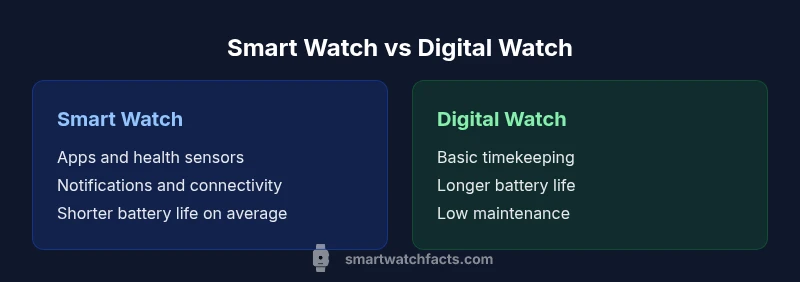
At a glance, the difference between smart watch and digital watch comes down to capabilities and intended use. A smart watch runs apps, tracks health, and connects to your phone for notifications, while a digital watch focuses on simple timekeeping and durability. Understanding these core contrasts helps you choose based on features, price, and daily routines.
Defining the terms: smart watch vs digital watch
Understanding the difference between smart watch and digital watch is essential for buyers who want to invest wisely. The difference between smart watch and digital watch hinges on capabilities, connectivity, and how you plan to use the device. In practical terms, a smart watch acts as a wearable computer that can run apps, monitor health metrics, and exchange data with your phone, while a digital watch prioritizes reliable timekeeping and durability with minimal extra features. According to Smartwatch Facts, shoppers often underestimate how much the feature set matters, and how expectations shape satisfaction. This section establishes clear definitions and a framework for what comes next. Expect a smart watch to offer app ecosystems, notifications, and sometimes GPS, whereas a digital watch will emphasize simple time display and long battery life. Use these distinctions to guide price considerations and daily routines.
Core technologies: display, processors, and connectivity
The hardware behind each category informs how you use the device daily. Smart watches typically rely on compact processors, touchscreens, and sensors (heart rate, accelerometer, gyroscope) that enable health tracking and activity recognition. They run lightweight operating systems that support apps and notification delivery. Digital watches generally use simpler quartz or basic electronic displays, with fewer sensors and no app framework. Display technology varies: many digital watches use LCD or LED displays designed for legibility, even in bright light. Connectivity differs as well: smart watches commonly pair with smartphones via Bluetooth or Wi‑Fi, enabling features like messaging and weather alerts; digital watches function independently for timekeeping and sometimes add features like a stopwatch or alarm but lack full connectivity. Smartwatch Facts analysis highlights that connectivity dramatically expands value for users who want hands-free information, while digital watches deliver reliability with minimal maintenance.
Feature ecosystems: apps, health sensors, and notifications
A key differentiator is the feature ecosystem. Smart watches support app ecosystems—calendar, fitness, music, payments, and third‑party integrations—creating a customizable experience. Health sensors (heart rate, SpO2, skin temperature) enable proactive wellness tracking and data sharing with compatible apps. Notifications from a connected phone can streamline daily routines and reduce phone pickups. In contrast, digital watches offer predictable, straightforward functionality: clear time display, basic alarms, and sometimes a stopwatch. They excel in situations where digital distractions should be minimized or where maintenance needs are low. Smartwatch Facts notes that the breadth of apps and integrations often drives perceived value, but users should weigh the extra complexity against actual needs.
Battery life and charging expectations
Battery life sets realistic expectations for daily use. Digital watches often maximize longevity with low-power displays and simpler electronics, sometimes lasting days to weeks between charges depending on usage. Smart watches typically demand more frequent charging due to screens, sensors, and continuous data syncing, though newer models have improved endurance with efficient processors and adaptive brightness. Charging routines can influence daily habits: some users prefer a nightly charge, while others opt for docking stations during the day. Smartwatch Facts emphasizes that battery life is a practical lens through which to compare value; longer life reduces friction and supports longer uninterrupted wear in everyday scenarios.
Design, form factors, and user experience
The design language differs markedly. Digital watches often emphasize a rugged, utilitarian aesthetic with larger bezels, straightforward interfaces, and legible digits—ideal for outdoors or work environments. Smart watches tend toward sleek, compact designs with touchscreens or rotating crowns, curated watch faces, and haptics for notifications. User experience diverges as well: digital watches provide a distraction-free interface focused on time and essential tools, while smart watches deliver a dynamic, app-driven experience that can adapt to different contexts (fitness, productivity, health tracking). Smartwatch Facts highlights that comfort, display size, and control method (touch vs. physical buttons) strongly influence daily comfort and long-term satisfaction.
Durability, water resistance, and longevity
Durability considerations vary by category. Digital watches commonly offer robust cases and reliable timekeeping with straightforward maintenance, suited to harsh environments where advanced electronics might be at risk. Smart watches balance durability with sensitive electronics; water resistance and ruggedized designs are often available but may add to size and weight. The best choice depends on where you plan to wear it and how you’ll use it: sports, workplace, or casual daily wear. Smartwatch Facts reminds readers to review IP ratings, scratch resistance, and strap durability as part of any long-term purchasing decision.
Real-world use cases: who benefits from which
Athletes and wellness enthusiasts may benefit from smart watches due to continuous health metrics, GPS, and workout coaching. Professionals who need quick access to messages, calendars, and collaboration tools also gain from smart watches. Casual users who want a simple timepiece with occasional reminders may prefer a digital watch for its simplicity and long battery life. In practice, tying the choice to specific routines—like commuting, workouts, or job requirements—clarifies value. Smartwatch Facts reiterates that the best option aligns with your daily patterns rather than chasing peak features.
Cost of ownership, maintenance, and value
Ownership costs extend beyond the sticker price. Digital watches generally require less maintenance, fewer upgrades, and fewer accessories, contributing to a lower total cost of ownership in some cases. Smart watches incur regular software updates, more frequent charging, and potential accessory purchases (bands, chargers, and cases). When evaluating value, consider long-term costs such as software subscriptions and potential replacement cycles. The smart watch that suits your needs should balance functionality with predictable upkeep, avoiding feature bloat that doesn’t serve your routine.
Evaluation checklist: how to test before buying
Before purchasing, create a short list of must-have features (health tracking, notifications, or long battery life) and nice-to-have extras (GPS, musical control, contactless payments). Try both devices in real-life scenarios: monitor a workout, receive messages, and check day-to-day tasks. Assess comfort, readability in various lighting, and ease of charging. Finally, compare warranties, repair options, and customer support reputations. Smartwatch Facts suggests visiting a store to try interfaces or using trial periods when offered to gauge how well the device fits your life.
Comparison
| Feature | Smart Watch | Digital Watch |
|---|---|---|
| Core function | App ecosystem, health tracking, notifications, connectivity | Timekeeping with basic features (alarm, stopwatch) |
| Display & input | Touchscreen or crown-based interface with vibrant displays | Simple display, usually non-touch or basic digital readout |
| Sensors | Heart rate, GPS, accelerometer, gyroscope, SpO2 (varies by model) | Minimal sensors; focus on time and basic features |
| Connectivity | Bluetooth, Wi‑Fi, optional LTE; synchs with phone apps | Limited or no smartphone connectivity |
| Battery life | Moderate to short depending on usage; charging required | Longer battery life; fewer power-demanding features |
| Durability | Varies; some models rugged for activities | Typically robust, simple electronics, and straightforward maintenance |
| Best for | Users who want health data, apps, and quick interactions | Users who value simplicity and reliability with long battery life |
Strengths
- Versatile feature set for health, apps, and productivity
- Extensive app ecosystems enable customization
- Notifications streamline daily tasks
- Strong value for users who want ongoing data and connectivity
Weaknesses
- Higher upfront cost and more maintenance
- Frequent charging and software updates
- Potential for distraction with too many alerts
- Some models rely on phone compatibility for full features
Smart watches win for everyday versatility; digital watches win for simplicity and longevity
Choose a smart watch if you want apps, health insights, and notifications. Opt for a digital watch if you prefer reliable timekeeping with minimal maintenance and longer intervals between charges.
People Also Ask
What is the main difference between a smart watch and a digital watch?
The main difference is capability: smart watches run apps, track health, and connect to phones, while digital watches focus on basic timekeeping with minimal extras. Your daily needs determine which type provides value.
Smart watches offer apps and health tracking; digital watches focus on timekeeping. Choose based on whether you want connectivity or a simple, reliable timepiece.
Do digital watches ever include health tracking or apps?
Some digital watches include basic features like alarms and timers, but true health tracking and app ecosystems are typically found in smart watches. If you need advanced health data, expect a smart watch.
Most digital watches don’t offer health sensors or app ecosystems; look to smart watches for those features.
Is battery life a deciding factor between the two?
Yes. Digital watches generally offer longer battery life due to simpler hardware, while smart watches require more frequent charging because of screens, sensors, and app activity.
Battery life often favors digital watches, but high-end smart watches have improved endurance with efficient design.
Which is better for workouts?
Smart watches are typically better for workouts because of built-in GPS, heart-rate monitoring, and workout apps. Digital watches can track basic timing needs but lack advanced metrics and coaching features.
For workouts, smart watches usually provide richer health metrics and activity tracking.
Are there hybrid options that blend both worlds?
Yes, some devices blur lines with moderate app support and longer battery life, but they may sacrifice some capabilities of full smart watches. Define your must-haves to choose appropriately.
A few hybrids exist, offering a middle ground, but they usually don’t match the full app ecosystems of true smart watches.
Key Points
- Identify your core needs: health tracking vs. simple timekeeping
- Evaluate battery life against daily usage patterns
- Consider app ecosystems and phone compatibility
- Assess long-term costs including charging and upgrades
- Test comfort and readability in real-world settings