Difference Between Smartwatch and Analog Watch: A Practical Guide
Discover the key differences between smartwatches and analog watches, from design and features to battery life and buying tips to help you choose the right timepiece in 2026.


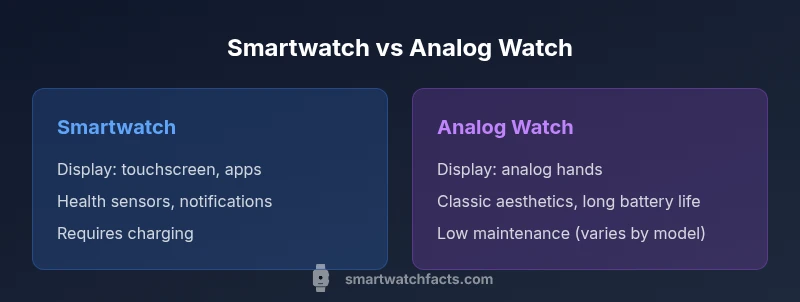
Smartwatches and analog watches share one goal—telling time—yet they differ in how they deliver it. A smartwatch adds a digital display, apps, sensors, and notifications, turning your wrist into a connected hub. An analog watch relies on traditional timekeeping, with mechanical or quartz movement and timeless styling. If you want health metrics and smart features, a smartwatch makes sense; if you prefer classic design and low upkeep, an analog watch fits better.
What is the difference between smartwatch and analog watch?
At its core, the difference between smartwatch and analog watch lies in the primary purpose and the scope of features each device offers. An analog watch tells time with hands on a dial, and may include a date window, a bezel for style, and mechanical or quartz movement. A smartwatch packs a computer-like processor, a digital display, wireless connectivity, and a suite of software that can run apps, track health metrics, and show notifications. This distinction matters not only for how you read the time, but for how you manage daily tasks, stay connected during commutes, and monitor your health across workouts. The result is two very different user experiences: one focused on pure timekeeping and design, the other on digital convenience and ecosystem integration. As you compare, consider what you want on your wrist every day—fashion or function, long battery life or ongoing data streams, minimal maintenance or maximum customization. According to Smartwatch Facts, the tide of wearable tech has reshaped expectations around timekeeping.
Historical context of timekeeping on wrists
Wristwatch history is a tale of two threads: elegance and utility. Analog watches rose to prominence with precision movements, becoming everyday talismans that paired with suits, casual wear, and sports. The digital era brought smartwatches, which integrate sensors, apps, and connectivity, turning the wrist into a small computer. While the analog model honors tradition and craftsmanship, the smartwatch embodies modern interactivity and personalization. This fork in evolution means most buyers are choosing between a heritage piece that signals taste and a multi-function device that supports health tracking and on-the-go communication. Understanding this context helps you recognize why these devices appeal to different priorities and styles.
Display, interaction, and user experience
The display is one of the most visible differences between smartwatch and analog watch. An analog dial uses fixed hands to indicate hours and minutes, often with a separate seconds dial, and may include a date window. A smartwatch relies on a programmable touchscreen, always-on options, and customizable watch faces. Interaction patterns diverge as well: analog reading is quick and distraction-free, while smartwatches encourage swiping, tapping, and voice input. The result is two distinct user experiences on the same wrist: one rooted in legible timekeeping and tactile feedback, the other in interactive information and app-driven workflows. If you wear the device in professional settings, consider legibility and formality; if you want quick status checks during workouts, the smartwatch interface can offer more context at a glance.
Power, timekeeping accuracy, and maintenance
Power arrangements shape when and how you use each type. Analog watches can be powered by a wound mainspring or a small battery, often running for years with minimal intervention. Smartwatches rely on rechargeable batteries and software-driven features which can impact accuracy and performance if not kept up to date. Timekeeping accuracy for analog watches is typically stable when well-made, while smartwatches can offer automatic time updates via network connectivity but may occasionally drift if syncing fails. Maintenance varies accordingly: analog watches may require occasional service for mechanical parts or battery changes; smartwatches require regular charging, firmware updates, and app maintenance. Smartwatch Facts analysis shows that user routines—commuting, workouts, and screen-on time—strongly influence battery life and perceived reliability.
Health sensors, fitness, and wellness features
One of the most cited distinctions is health tracking. Smartwatches come with heart-rate sensors, SpO2 monitors, GPS, sleep tracking, and sometimes advanced metrics like VO2 max or ECG readings in some models. They pair this data with reminders, coaching, and integration to health apps. Analog watches, by contrast, focus on timekeeping and design; they do not include built-in sensors for health monitoring. Some luxury analogs include mechanical complications or quartz accuracy that appeal to enthusiasts, but they lack the digital health features of a smartwatch. If wellness insights matter to you, a smartwatch offers actionable data and real-time feedback; if you prefer a pure timepiece, the analog watch remains precise and distraction-free.
Connectivity, apps, and ecosystems
Smartwatches sit at the intersection of hardware and software. They connect to your phone via Bluetooth or Wi‑Fi, run apps, and support voice assistants. This ecosystem unlocks features such as notifications, music control, mobile payments, maps, and third‑party integrations. Analog watches operate independently of networks and apps; their value rests in aesthetics, craftsmanship, and reliability. While some analog watches include smart modules, these hybrids are relatively rare and typically do not offer the same breadth of features as dedicated wearables. The platform you select—for iPhone or Android—will shape app availability, software updates, and long-term support, affecting the overall ownership experience.
Build quality, materials, wearability, and fashion
Material choices and construction drive both durability and style. Analog watches emphasize polished cases, leather or metal straps, and mechanical movements that can be treasured as heirlooms. The dial design and case finishing influence perceived quality and legibility, and the watch can be resized by swapping bands. Smartwatches prioritize lightweight, durable plastics or metal, with reinforced glass and interchangeable bands to match activity and fashion. Warranties and service networks differ, too: you may find broader parts support for mainstream analog brands and extensive software support for popular smartwatch platforms. In practice, wearability comes down to weight, balance, strap comfort, and how well the device fits your everyday wardrobe.
Use cases and scenario planning
Different scenarios favor different devices. For travel, a smartwatch can streamline navigation, translation apps, and contactless payments, reducing packing friction. For formal events or classic wardrobes, an analog watch can complement attire with a timeless silhouette and refined finishing. Fitness-focused users may lean toward smartwatches for real-time workout stats and heart-rate monitoring, while minimalist users may prefer analog watches for distraction-free timekeeping. Budget considerations also influence decisions: entry-level analogs can be affordable; smartwatches span a wide range of prices with varying hardware and software commitments.
Cost, value, and ownership considerations
Price dynamics differ meaningfully between the two categories. Analog watches cover a broad spectrum—from affordable mass-market pieces to luxury mechanicals—often delivering long-term value with minimal ongoing costs beyond battery changes or occasional servicing. Smartwatches generally carry a higher upfront price and ongoing costs such as screen protection, replacement bands, and software subscriptions in some ecosystems. Total cost of ownership includes charging infrastructure, potential insurance considerations for high-end gadgets, and the need for occasional refreshes as software support evolves. For most buyers, the choice hinges on the balance between initial expense, ongoing maintenance, and the desire for health data and smart features.
Maintenance, durability, and longevity considerations
Analog watches are frequently lauded for their durability and longevity, especially models designed to be serviced or rebuilt by skilled watchmakers. Quartz analogs are low-maintenance; mechanicals may require regular servicing to preserve accuracy. Smartwatches require regular charging, software updates, screen protection, and occasional resets. The ecosystem support is also a factor: as platforms evolve, older smartwatches may lose app compatibility. If you care about longevity in the classic sense, analog watches with solid construction can outlive many digital devices; if you value ongoing software improvements and adaptive health tracking, a smartwatch remains current longer in practical terms.
Decision framework: how to choose your wrist companion
Start with your primary goal: do you want a classic timepiece or a smart, data-rich companion? If you value timeless design and minimal maintenance, start with a well-crafted analog model and consider alt options for occasional digital needs. If you crave health metrics, connectivity, and customization, map your ecosystem (iOS vs Android) and pick a smartwatch with the features you use most—notifications, GPS, and heart-rate tracking. Budget thoughtfully, consider battery life and charging habits, and examine resale value or service availability for the model you choose. Finally, try both styles in person if possible to assess readability, comfort, and aesthetic appeal in real-world settings.
Shopping checklist and practical guidance
Before you buy, use this checklist: read the dial, check legibility from different angles; test strap comfort for long wear; evaluate water resistance specs for your activities; inspect the finish and scratch resistance of cases; compare battery life and charging convenience; verify software support horizons and app compatibility; consider maintenance costs and availability of service. If you are undecided, allocate a portion of your budget for a watch you can learn from—perhaps a reliable analog with a future addition of a smartwatch if needed. This approach helps you balance aesthetics, function, and long-term value.
Comparison
| Feature | Smartwatch | Analog watch |
|---|---|---|
| Display/Time Reading | Digital touchscreen; dynamic faces | Analog dial with hands |
| Power source / Battery | Rechargeable battery; needs charging | Quartz or mechanical movement; long intervals between servicing |
| Health & sensors | Heart rate, SpO2, GPS, sleep tracking | No built-in health sensors |
| Notifications & Apps | Push notifications, apps, voice assistants | No apps; timekeeping-focused |
| Maintenance | Regular charging; software updates; case maintenance | Occasional battery or service depending on model |
| Aesthetics | Tech-forward; flexible bands | Classic; timeless dial designs |
| Price Range | Typically mid-to-high upfront cost; ongoing ecosystem costs possible | Wide range from affordable to luxury; long-term value varies |
| Best For | Tech enthusiasts, fitness tracking, on-the-go info | Tradition lovers who prefer low upkeep and style |
Strengths
- Smartwatch advantages include health data, notifications, and app access.
- Analog watch advantages include timeless design, readability, and long battery life.
- Broad aesthetic and price options for both styles.
- Low ongoing maintenance for high-quality analog models.
Weaknesses
- Smartwatches require charging and can depend on ecosystem quality.
- Analog watches lack built-in health sensors and digital connectivity.
- Smartwatches may incur accessory costs (bands, protection) and software updates.
- Luxury analogs can be expensive to service; some mechanicals require regular maintenance.
Analog watches are best for classic style and low maintenance; smartwatches excel at health data and connectivity.
If you value traditional timekeeping and minimal upkeep, analog wins. If you want real-time metrics, notifications, and app ecosystems, the smartwatch is superior. The Smartwatch Facts team emphasizes choosing based on your daily routine and style.
People Also Ask
What is the core difference between a smartwatch and an analog watch?
The smartwatch adds digital features, sensors, and connectivity, while an analog watch sticks to traditional timekeeping with hands on a dial. Your decision hinges on whether you want on-wrist data and apps or classic aesthetics and simple maintenance.
The core difference is that smartwatches include digital features and health data, whereas analog watches focus on traditional timekeeping and style.
Can analog watches track health metrics?
Most analog watches do not include built-in health sensors. They focus on timekeeping and design. If health data is important, a smartwatch is typically required.
Analog watches usually don’t track health metrics; you’ll need a smartwatch for that data.
Are smartwatches compatible with iPhone and Android devices?
Many smartwatches offer cross-platform compatibility but performance and app availability can vary by OS. If you use an iPhone, look for Apple ecosystem integration; for Android, check compatibility with your preferred apps and services.
Most smartwatches work with both major mobile platforms, but check OS-specific features.
Is an analog watch more accurate than a smartwatch?
Analog watches are designed for reliable timekeeping in any setting, especially higher-end mechanicals or quartz variants. Smartwatches rely on network time updates and can drift if syncing is unavailable, though most keep good accuracy when connected.
Analog watches are often very accurate; smartwatches rely on syncing but are usually reliable when connected.
What should I consider about cost when choosing?
Analog watches span a wide price range from affordable to luxury, with potential long-term value. Smartwatches typically cost more upfront and may involve ongoing costs for accessories or subscriptions depending on the model and ecosystem.
Cost varies a lot; analog watches can be cheaper upfront with long life, while smartwatches often start higher and may have ongoing costs.
Are there hybrid or crossover options?
Yes, there are watches that blend traditional analog displays with limited digital features, but they seldom match the full capacity of a dedicated smartwatch or the simplicity of a pure analog piece.
Hybrid watches attempt to combine both worlds, but they usually don’t match the depth of either.
How should I test these watches before buying?
Try both styles in person to assess readability, comfort, and your emotional reaction to design. Check battery life in real-use scenarios and verify that the features you care about (health data, notifications) meet your expectations.
If possible, try both types in person and test the features you’ll use daily.
Key Points
- Compare daily use: style vs. data-driven features.
- Battery life matters more for analog than smartwatch wearers.
- Ecosystem support can determine long-term satisfaction.
- Choose one that fits your wardrobe and lifestyle.