Difference Between Smartwatch and Activity Tracker
Explore the difference between smartwatch and activity tracker, from core features and battery life to buying guidance, so you can pick the device that best fits your lifestyle.


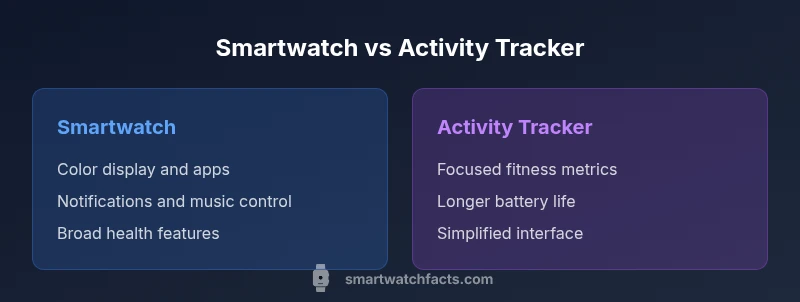
A smartwatch is a multi‑purpose wearable with apps, notifications, and a color display, while an activity tracker focuses on core fitness metrics like steps and sleep with a simpler interface. For most buyers, a smartwatch provides broader utility and smart features; an activity tracker excels at focused fitness tracking and longer battery life with lower upfront cost.
What is a smartwatch?
The difference between smartwatch and activity tracker becomes clearer when you compare what each device is designed to do. A smartwatch is a full‑fledged wearable computer on your wrist. It pairs with your phone, runs apps, displays rich color content, and supports communications like notifications, calls, and messages. In practice, a smartwatch acts as a compact, wearable smartphone companion—great for daily tasks, quick replies, and quick access to information without reaching for your phone. According to Smartwatch Facts, the line between smartwatch capabilities and traditional watches has blurred as displays become brighter and apps more capable. For many users, this means a watch that can serve as a mini‑dashboard for your digital life, not just a fitness tool. In addition to fitness features, you’ll find calendar integration, music control, voice assistants, and increasingly sophisticated health features. This breadth explains why many shoppers gravitate toward smartwatches when they want an all‑in‑one device that makes daily routines easier.
If you’re evaluating a smartwatch, consider how you’ll use it day to day: notifications during meetings, quick replies on the go, GPS for routes, and the ability to run third‑party apps. The best candidates balance display quality, battery life, and app availability. The emphasis is on versatility and convenience, rather than a single fitness metric.
What is an activity tracker?
An activity tracker is primarily a fitness‑focused wearable. It emphasizes core metrics such as steps, calories, distance, and sleep quality, often with a simple, uncluttered interface and a comfortable form factor. Activity trackers typically prioritize battery life and ease of use over broad app ecosystems. They excel at day‑to‑day activity tracking, goal setting, and long wear times, making them popular for users who want to keep fitness front and center without the overhead of a larger device. While many trackers now offer some smartwatch‑like features, their central mission remains logging and improving activity data. In practice, an activity tracker is usually lighter on notifications and apps but stronger on continuous wearability and straightforward health insights.
The difference between smartwatch and activity tracker: core differences
The difference between smartwatch and activity tracker becomes most evident when you lay out the core differentiators side by side. Both devices track movement and health signals, but the scope, emphasis, and user experience diverge significantly. A smartwatch tends to deliver a richer display, color interfaces, notifications, apps, and often GPS. An activity tracker prioritizes minimalism, long battery life, and precise tracking of activity metrics with simple screens. This leads to distinct advantages: smartwatches provide a more integrated digital lifestyle, while trackers deliver a focused, low‑friction fitness companion. To decide, weigh the value of apps, notifications, and display versus battery longevity and simplicity. The Smartwatch Facts team notes that understanding this difference can reduce decision fatigue and align your purchase with daily habits and fitness goals.
Real‑world use cases: who benefits most
People who want a device that complements their phone, supports quick replies, and runs a variety of apps tend to benefit from a smartwatch. It’s ideal for professionals who value calendar alerts, music control, and immediate access to information during commutes or workouts. In contrast, individuals who prioritize tracking activity with minimal distractions, longer battery life, and a lower price point may prefer an activity tracker. If you’re primarily counting steps, monitoring sleep patterns, and setting fitness goals, a tracker can often deliver the essentials more efficiently. The choice reflects lifestyle priorities: a smartwatch for breadth and convenience, an activity tracker for focus and durability.
Battery life and charging: how long they last on a single charge
Battery life is a common differentiator between smartwatch and activity tracker. Smartwatches with vivid displays and multiple features typically require more frequent charging, especially during heavy use of apps, GPS, and notifications. Activity trackers, by contrast, emphasize low‑power operation and can often stay on your wrist longer between charges. When evaluating options, consider how often you’re willing to charge and whether you need all‑day wear without interruption. If you travel frequently or have limited charging opportunities, an activity tracker can be a practical choice that minimizes downtime.
Practical tip: review the charging method and the expected daily wear time from user reviews rather than spec sheets alone, as real‑world use often reveals differences between advertised and actual battery performance.
Data accuracy and health metrics: what to expect from each
No wearable is perfect, but the difference between smartwatch and activity tracker shows up in data depth and accuracy. Smartwatches frequently provide a broader health suite, including heart rate monitoring, blood oxygen sensing, GPS, and sometimes advanced resting HR and irregular heart rhythm alerts. They may also include exercise recognition for a wider range of activities. Activity trackers typically focus on distance, steps, calories, and sleep with reliable day‑to‑day accuracy but fewer health signals. If health tracing is a priority, ensure the device supports the specific metrics you care about and review third‑party validation where available. Consider how the data integrates with your preferred health platform and whether the device’s sensors align with your goals.
Apps, ecosystem, and compatibility: platform lock‑in matters
Platform ecosystems influence the long‑term value of either device. Smartwatches generally rely on a broader app ecosystem and more robust smartphone integration, which translates to greater customization and cross‑device compatibility. Activity trackers may offer limited apps and stricter compatibility, but they often pair easily with most smartphones and provide straightforward data export. If you prize app availability, watchOS or Wear OS ecosystems typically rise to the top, while many trackers prioritize a streamlined, no‑frills interface with simplified syncing. Your choice may hinge on whether you want a branded, feature‑rich experience or a lean, fitness‑focused companion.
Price, value, and long‑term ownership considerations
Price is a practical lens for comparing smartwatch and activity tracker. Smartwatches tend to carry higher upfront costs, driven by display technology, processing power, and app ecosystems. Activity trackers generally come in at a lower price point, with fewer features but solid value for core metrics. Over the long term, consider software updates, compatibility with future phone models, and potential data portability. If you anticipate changing phones or upgrading frequently, ensure the device you choose maintains long‑term support and offers a straightforward data transfer path. In summary, the decision often comes down to how much you value breadth of features versus straightforward reliability and affordability.
How to choose: a practical buying guide
To choose effectively, start with your primary goals: Do you want notifications and apps, or do you want simple, dependable fitness tracking? List must‑have features (GPS, music, sleep tracking, heart rate, etc.) and nice‑to‑have extras (nfc payments, LTE, voice assistants). Assess battery expectations in real‑world use, introspect on app ecosystems, and compare long‑term costs. Finally, read user reviews focused on daily wear, comfort, and accuracy, and test devices in store if possible. The goal is a balanced decision that matches your daily rhythm and budget.
Comparison
| Feature | Smartwatch | Activity Tracker |
|---|---|---|
| Display and UI | Full-color touchscreen with rich apps | Basic screen with focused indicators |
| Notifications and apps | Broad notifications, third‑party apps, and replies | Limited apps, essential alerts, no or basic replies |
| Health and sensors | Broad health suite (HR, SpO2, GPS, HRV on some models) | Core activity metrics (steps, sleep, calories) |
| Battery life | Moderate, depends on usage and display | Longer battery life with lighter features |
| App ecosystem | Robust app stores and integrations | Smaller app selection and simpler integrations |
| Price range | Higher upfront cost typical | Lower upfront cost typical |
| Best use case | Daily wear with productivity features | Pure fitness tracking and goals |
Strengths
- Helps users quickly decide between breadth (smartwatch) and focus (activity tracker)
- Smartwatches offer notifications and apps, boosting daily usefulness
- Activity trackers usually provide longer wear time with simpler interfaces
- Clear expectations for price vs. features
Weaknesses
- Smartwatches can be more expensive and require more frequent charging
- Activity trackers may miss advanced health metrics
- Apps and integrations can vary by platform and model
- Some devices may have limited cross‑platform compatibility
Smartwatch is best for users seeking a connected, multi‑function wearable; activity tracker suits those prioritizing fitness data and battery life.
Choose a smartwatch for a broad digital experience with notifications and apps. Choose an activity tracker for focused fitness tracking with longer battery life and lower cost.
People Also Ask
What is the main difference between a smartwatch and an activity tracker?
The main difference is scope: smartwatches offer apps, notifications, and broader functionality, while activity trackers prioritize core fitness metrics with simpler interfaces. Your choice should reflect whether you want a device for daily convenience or a focused fitness companion.
Smartwatches are more like tiny smartphones on your wrist, while activity trackers stay focused on fitness data and simplicity.
Can I get fitness data from a smartwatch?
Yes. Most smartwatches include comprehensive fitness tracking, but the depth and accuracy can vary by model. If pure fitness data is your goal, confirm the metrics and how they’re displayed before purchasing.
Most smartwatches track fitness well, but check the specific metrics you care about.
Are there devices that are both smartwatches and trackers?
Yes. Many devices blend features, offering notifications and apps along with fitness tracking. The balance shifts toward broader functionality or tighter fitness focus depending on the model.
Some devices combine both, but check which features you value most.
Do activity trackers have GPS?
Some trackers include GPS for activity mapping, while others rely on your phone’s GPS. If GPS is essential for workouts like running or cycling, verify GPS availability in the model you pick.
GPS capabilities vary; confirm on the model you want.
Which lasts longer on battery, a smartwatch or a tracker?
Generally, activity trackers last longer between charges due to simpler displays and fewer features. Smartwatches with vibrant displays and apps usually require more frequent charging.
Trackers usually last longer between charges than smartwatches.
Is a smartwatch worth it for casual fitness users?
If you want a single device that covers fitness plus notifications, music control, and apps, a smartwatch can be worth it. If your primary goal is simple activity tracking, a dedicated tracker may offer better value.
For casual fitness users, it depends if you want extra features beyond tracking.
Key Points
- Clarify priority: smart features or fitness focus
- Check app ecosystem and smartphone compatibility
- Balance cost against feature breadth
- Evaluate battery life under real‑world use