Huawei Smart Watch vs Amazfit: A Practical Guide
Explore a rigorous, data-driven comparison of Huawei smart watches and Amazfit devices, focusing on design, health sensors, battery life, OS compatibility, app ecosystems, and buying guidance.


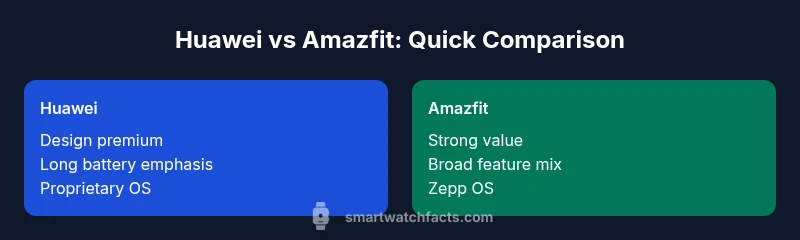
When comparing huawei smart watch vs amazfit, you’ll notice Huawei often emphasizes battery life and refined fitness analytics, while Amazfit prioritizes value, feature balance, and broad compatibility. The choice depends on OS ecosystem, device compatibility, and price. This quick comparison highlights the core trade-offs to help you decide which brand fits your routine.
Design language and build quality
Huawei watches tend to present a premium silhouette with metal cases, curved glass, and lighter, more refined chassis designed for daily wear and formal settings. The design language emphasizes minimalism, thin bezels, and understated branding, which appeals to professionals who want a watch that blends with business attire. Amazfit devices lean toward sport-inspired aesthetics and versatile silhouettes that are comfortable during workouts and outdoor activities. They often use lightweight materials and more robust case shapes, which helps during training sessions and active use. In terms of finish, Huawei frequently opts for ceramic or glass textures in higher-end models, while Amazfit prioritizes durable polycarbonate and reinforced aluminum for a rugged feel.
Material choice directly affects weight, grip, and daily comfort. In real-world wear, the Huawei option may feel more premium but less forgiving when engaging in high-intensity activities, whereas Amazfit models may feel chunkier but more secure during runs and gym sessions.
From the Smartwatch Facts perspective, a well-built watch should deliver both a clean everyday look and reliable comfort during long sessions. The user should assess wrist size, preferred strap material, and color options to match their wardrobe. Additionally, consider how the watch's physical buttons or crown respond under sweat and rain.
Comparison
| Feature | Huawei smartwatch | Amazfit smartwatch |
|---|---|---|
| Design and display | Premium, refined aesthetics | Sport-centric, versatile looks |
| OS and app ecosystem | Huawei's proprietary OS ecosystem | Zepp OS with broad app support |
| Health sensors and tracking | Heart rate, SpO2, sleep analytics | Heart rate, SpO2, sleep tracking, stress monitoring |
| GPS and activity tracking | Advanced GPS with reliable tracking | Multi-sport GPS with reliable performance |
| Battery life and charging | Focus on efficiency and longevity | Balanced life with fast charging variations |
| Water resistance and durability | Typically rated for daily wear and swimming | Durable build with water resistance for workouts |
| Price and value | Premium pricing with strong fitness depth | Competitive pricing with broad feature mix |
Strengths
- Strong value for money with robust features
- Long-term battery efficiency and fitness depth
- Wide range of models and price points
- Solid app ecosystem with third-party integrations
- Good cross-brand compatibility with Android devices
Weaknesses
- Software experiences vary by brand and update cycle
- iPhone integration can be more limited
- Huawei ecosystem feels less penetrant outside China
- Feature depth may vary across models
Amazfit offers better overall value for most buyers, while Huawei remains compelling for battery life and focused health analytics.
For most shoppers, Amazfit delivers more features per dollar and broader app support. The Huawei option still serves users who prioritize long battery life and focused fitness metrics, especially in Android environments.
People Also Ask
Which smartwatch typically offers longer battery life, Huawei or Amazfit?
Both brands optimize for efficiency, but Huawei often prioritizes extended autonomy in its watches. Amazfit balances endurance with feature breadth. Your usage pattern (GPS, notifications, and sensors) will determine which is preferable.
Huawei usually aims for longer battery life, while Amazfit balances endurance with features.
Are Huawei watches fully compatible with iPhone?
Huawei watches pair with iPhones, but some advanced health features and certain notifications may be limited compared to Android pairing. If iPhone-first use matters, verify current support in your region.
Huawei works with iPhone, but some features may be limited.
Does Amazfit offer broader app support than Huawei?
Amazfit uses Zepp OS with a growing app library, often providing broader third-party app support than Huawei in many markets.
Amazfit’s Zepp OS has broad app support.
Which brand is better for Android users?
Android users typically enjoy stronger app ecosystems and smoother integration with Amazfit, though Huawei also offers solid Android support with a focus on health features.
Android users may get better ecosystem support from Amazfit.
Are there regional differences in support and availability?
Yes. App catalogs, features, and support can vary by country. Always check local availability, app store presence, and warranty terms before buying.
Regional availability can affect features and support.
Key Points
- Prioritize OS compatibility and app ecosystem
- Balance battery life against feature depth
- Consider price vs performance for long-term value
- Check cross-brand support for health metrics
- Evaluate GPS usage and workout tracking needs