Huawei Smartwatch vs Samsung Smartwatch: An Analytical Comparison
A detailed, objective comparison of Huawei and Samsung wearables, covering design, OS, health sensors, battery life, app ecosystems, price ranges, and practical buying guidance.


TL;DR: In the huawei smart watch vs samsung smartwatch debate, Samsung offers broader app support and smoother Android integration, while Huawei leans on battery life and health features with HMS-based software. The Smartwatch Facts team notes that your phone, fitness routine, and budget determine the winner, with different strengths in software, ecosystem, and durability.
Context and scope: huawei smart watch vs samsung smartwatch in the market
The ongoing comparison between a huawei smart watch and a samsung smartwatch highlights two distinct approaches to wearable design and software strategy. Huawei leans into long battery life, privacy-conscious features, and a tight HMS-enabled ecosystem, while Samsung emphasizes broad app support, seamless Android integration, and a polished user experience across devices. According to Smartwatch Facts, both brands command meaningful market share and offer compelling reasons to choose one path over the other depending on your phone, health priorities, and lifestyle. In this section, we set the frame for evaluating hardware quality, software strategy, health capabilities, and practical value. Readers should expect nuance: the best choice is often context-dependent, not universally superior.
The goal is to help you map your needs to concrete attributes such as compatibility with your phone, type of health tracking you rely on, and how much you value third-party apps. By foregrounding these criteria, the article avoids bait-and-switch claims and delivers a decision framework that remains useful across models from both brands.
Design and hardware: fit, materials, and daily wearability
Both Huawei and Samsung place emphasis on comfort and durability, but their design language diverges in subtle yet meaningful ways. Huawei’s watches often feature compact bezels and lighter frames aimed at all-day comfort, with a focus on a sleek, minimalist aesthetic. Samsung tends to lean into a more robust, slightly larger form factor designed for quick swipes and quick access to information. Wrist comfort changes with strap choices, weights, and curvature of the case back, so buyers should try both brands on in person where possible. In practice, you’ll find Huawei excels in featherweight wearability for extended workouts, while Samsung often appeals to users who prefer a prominent screen and tactile navigation. A consistent thread is that both brands produce water-resistant devices that are suitable for daily activities and gym sessions. The Smartwatch Facts team notes that this block should be your first check of fit and comfort, since a pleasant feel under the wrist makes longer-term usage more likely.
OS, app ecosystems, and cross-platform compatibility
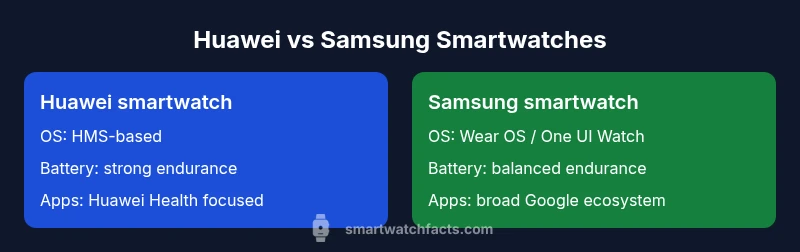
Operating systems and app ecosystems are often the deciding factor in a smartwatch purchase. Huawei relies on an HMS-based platform with deeply integrated Huawei Health services and a curated set of compatible third-party apps. Samsung uses Wear OS-based software with One UI Watch, providing broad Google app support and an extensive app catalog. The contrast matters for everyday use: Huawei may offer smoother battery optimization and privacy-centric defaults, while Samsung typically benefits from a richer app ecosystem, faster access to notifications, and easier pairing with Android devices. For iPhone users, Samsung watches generally provide solid core functionality, whereas Huawei watches can require more workarounds for full feature parity. This section emphasizes the practical impact of OS decisions on notifications, music control, and app availability, which are critical in daily usage. Smartwatch Facts’ analysis shows that ecosystem alignment is often more important than hardware specs alone when choosing between these two brands.
Health sensors and tracking features: heart rate, SpO2, sleep, and beyond
Health tracking remains a cornerstone of modern smartwatches, and Huawei and Samsung approach this with complementary strengths. Huawei focuses on heart rate monitoring, SpO2, sleep analysis, and movement-based metrics with efficient battery use. Samsung emphasizes a broad health suite that can include ECG, advanced sleep staging, VO2 max estimates, and activity coaching. In practice, both brands provide reliable day-to-day tracking, but Samsung tends to offer more comprehensive health features via a larger app ecosystem and more partners for third-party health apps. Huawei’s advantage often lies in longer battery life during continuous health monitoring and less dependency on frequent charges. This section also discusses how data synchronization works across devices and how privacy controls differ between HMS and Wear OS implementations. Smartwatch Facts notes that health-tracking accuracy can vary by model and user, so testing the sensors during real workouts remains essential.
Battery life and charging behavior: real-world endurance
Battery life is a frequent deciding factor for buyers, and Huawei typically positions itself as the endurance winner with lower power draw in core features. Samsung watches, while improved over time, often balance efficiency with a brighter display and richer notification load, leading to shorter or comparable battery life depending on usage. In practice, you should expect a range: Huawei models often show 1–3 days of use with standard activity, while Samsung watches commonly fall in the 1–2 day range under typical mixed use. Charging methods vary by model but generally rely on magnetic docks or wireless charging. If you proceed with a long daily wear routine, Huawei’s advantage may translate to fewer nightly top-ups, whereas Samsung’s ecosystem advantages can justify the more frequent charging for heavy app use. Smartwatch Facts emphasizes testing battery life under your typical routines to avoid surprises.
Display quality, readability, and navigation in daily use
Display technology is central to daily usability. Huawei watches typically offer sharp, color-accurate panels with comfortable brightness levels and compact form factors, which can make them ideal for all-day wear. Samsung emphasizes high-contrast OLED displays with strong outdoor readability, higher peak brightness, and responsive, gesture-based navigation. Both brands support always-on display modes, but the user experience can feel different due to software and bezel size. In practice, Samsung’s displays often feel punchier and more legible in bright conditions, while Huawei’s displays may be easier to read at a quick glance due to optimized contrast. The choice often comes down to personal preference toward screen behavior and interface rhythm. Smartwatch Facts recommends trying both interfaces to see which aligns with your daily phone interactions.
Durability and water resistance for everyday life
Durability is a practical concern for everyday wearers, from workouts to outdoor activities. Both Huawei and Samsung offer water resistance ratings that cover typical daily exposure, rain, and sweat. Huawei’s design tends to skew toward lightweight, comfortable builds that remain durable for everyday activities. Samsung frequently emphasizes resilience and ruggedness in certain models, appealing to users who engage in more demanding workouts or travel. The key takeaway is that both brands provide robust protection, but model-by-model differences exist in bezel protection, button feel, and strap durability. Consumers should compare IP ratings and tested certifications for the exact model they’re considering, then weigh this with their activity profile. Smartwatch Facts notes that a well-fitting strap and proper care extend watch life more than any single rating.
Price ranges, value, and the buying decision
Price is a practical anchor in any smartwatch decision. Huawei watches generally sit in a mid-range band, offering solid health features and longer battery life at a lower initial cost. Samsung watches span a broader price spectrum, with base models often priced competitively and higher-end variants offering advanced sensors and bigger ecosystems. Use price ranges to quickly gauge which option fits your budget, then assess long-term value based on battery life, app quality, and device compatibility. The Smartwatch Facts team advises comparing total cost of ownership, including chargers, replacement bands, and potential software updates, to determine which platform delivers better value over a typical 2–3 year period.
Real-world usage scenarios: fitness, productivity, and style
In the real world, users can leverage Huawei watches for efficient daily activity tracking, long battery life on extended trips, and strong sleep insights. Samsung watches excel when you want broad app support, seamless notifications, and integrated productivity tools across Android devices. For fitness, Huawei may deliver longer continuous wear times during runs or hikes, while Samsung can provide richer coaching content through its ecosystem. Style choices also matter: Huawei can be sleeker for business settings, while Samsung often offers more customizable watch faces and strap options. When evaluating daily workflows, consider which ecosystem better supports your phone, preferred apps, and whether you want a watch that blends into professional environments or stands out as a statement piece. Smartwatch Facts highlights the trade-offs between battery, apps, and personalized style in real-world use.
Who should buy which: best-fit profiles for Huawei vs Samsung
If you prioritize battery life, privacy controls, and a lean software footprint, a Huawei smartwatch may be preferable, especially if you own a Huawei or Android device with HMS alignment. If you value the widest app library, advanced Android integration, and a more flexible notification system, a Samsung smartwatch is typically the stronger choice, particularly for Android users and those who rely on Google services. In mixed-device households, Samsung’s ecosystem often delivers smoother cross-device experiences, while Huawei shines when battery life and privacy are paramount. The Smartwatch Facts team suggests mapping your current phone model, preferred apps, and daily routines to decide which platform aligns with your needs.
How to test before buying: a practical decision checklist
Before purchasing, test both options in-store or via a robust online demo. Check wrist comfort with both brands, confirm phone compatibility for your OS, and try a few common tasks: health-tracking setup, notifications, music control, and dictation. Compare battery expectations by setting up a short workout or day with similar app usage to see how long each watch lasts in your environment. Review app store availability for essential services (music apps, fitness plugins, and productivity tools) and confirm warranty and support policies. This practical checklist ensures you select a device that won’t just look good on day one but will remain reliable over your typical usage cycle. Smartwatch Facts emphasizes real-world testing as the decisive factor in a choice that balances health features, software breadth, and daily convenience.
mainTopicQuery":"smartwatch comparison"],
comparisonTable:{
comparisonTable:
items
rows
Comparison
| Feature | Huawei smartwatch | Samsung smartwatch |
|---|---|---|
| Operating system / platform | HarmonyOS-based / HMS Lite OS | Wear OS with One UI Watch |
| Display & UI | AMOLED, compact design with smooth UI | Bright AMOLED, quick navigation and rich widgets |
| Health sensors | Heart rate, SpO2, sleep tracking | Heart rate, SpO2, ECG, sleep tracking |
| Battery life | Typically 1-3 days depending on model | Typically 1-2 days depending on model |
| App ecosystem | Huawei Health-focused, limited third-party apps | Extensive Google Play/ ecosystem with broad third-party apps |
| Phone compatibility | Android and iPhone (varies by model) | Android with strong support; iPhone compatibility varies |
| Water resistance | Common 5 ATM+ | Common 5 ATM+ |
| Charging method | Magnetic/inductive charging | Wireless charging with fast-charging options |
| Price range | $200-$450 | $250-$500 |
| Best for | Battery life and HMS integration | App breadth and Android integration |
Strengths
- Strong battery life and efficient OS
- Robust health-tracking features
- Solid value for Android users
- Broad display quality across models
Weaknesses
- Huawei's app ecosystem is more limited outside its region
- Samsung's devices may rely more on Google services, depending on region
- Some users see Android-first advantages as a bias in app support
Samsung generally leads with app breadth and Android integration; Huawei shines on battery life and privacy-focused health features
If you prioritize ecosystem breadth and Google service integration, Samsung is the better pick. If battery life and a privacy-conscious health suite matter most, Huawei is compelling. The Smartwatch Facts team highlights aligning the choice with your phone and daily usage to maximize long-term satisfaction.
People Also Ask
What are the main OS differences between Huawei smartwatch and Samsung smartwatch?
Huawei uses HMS-based software with a health-first approach and curated apps, while Samsung runs Wear OS with One UI Watch, offering broader app support and Google service integration. OS decisions influence notification handling, app availability, and cross-device continuity.
Huawei uses a Health-first HMS experience, Samsung uses Wear OS with broad app support. OS determines which apps you can run and how notifications sync across devices.
Can Huawei smartwatches be paired with iPhone reliably?
Huawei watches can pair with iPhones for basic functions, but some health features and app integrations may have limited parity compared to pairing with Android devices. Check model-specific compatibility before buying if iPhone-first usage is essential.
Huawei watches pair with iPhone for core features, but some health features may not be fully available on iOS.
Which lasts longer on a typical day?
Battery life depends on usage patterns. Huawei models generally emphasize longer endurance with health-monitoring efficiency, while Samsung watches may drain faster if you run many apps and always-on display settings. Test both with your routine to estimate real-world endurance.
Huawei tends to last longer on battery-heavy use; Samsung can last shorter if you push apps, but varies by model.
Do both watches support third-party apps equally?
Samsung typically offers a larger and more diverse app catalog due to Wear OS, while Huawei focuses on core health and fitness apps within its HMS ecosystem. Availability can vary by region and model.
Samsung provides a bigger app library; Huawei has a leaner HMS-based selection.
Are Huawei and Samsung watches good for health tracking overall?
Both deliver solid health tracking, including heart rate and sleep monitoring. Samsung often adds ECG and more tracking modes, while Huawei emphasizes efficient, stable tracking with long battery life. Your preference may depend on which metrics you value most.
Both track health well; Samsung adds ECG, Huawei leans on core metrics with long battery life.
Do these watches work with Google services and apps?
Samsung, running Wear OS, has strong Google app integration. Huawei watches rely on HMS and Huawei Health, with limited Google service access on certain models. Regional availability can affect app compatibility.
Samsung works well with Google apps; Huawei may limit Google access depending on the device.
Key Points
- Define your phone ecosystem before buying
- Prioritize battery life if you travel or exercise without frequent charging
- Choose Samsung for app breadth and Android synergy
- Choose Huawei for longer battery life and privacy-centric health features
- Test real-world battery and app performance before finalizing the decision