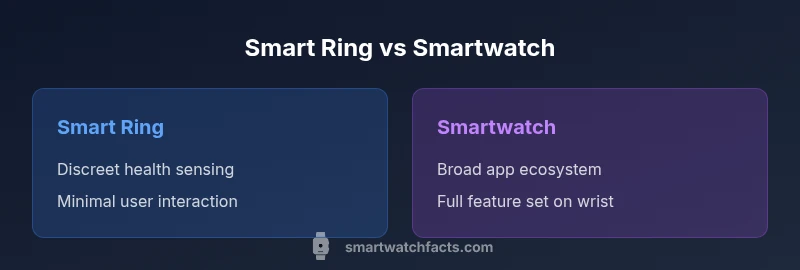
Is a smart ring or smartwatch better: A comprehensive comparison
Discover whether a smart ring or smartwatch is better for your daily use. This analytical comparison covers form factor, sensors, battery life, apps, durability, pricing, and real-world scenarios to help you choose in 2026.


For most users, a smartwatch offers broader functionality and app access, while a smart ring excels in discreet health tracking and daily comfort. If you prioritize on-wrist apps, notifications, and navigation, choose a smartwatch; if you want a minimal form factor with subtle health metrics, consider a smart ring. The best choice depends on your daily habits and budget.
Is a smart ring or smartwatch better for daily wear?
As Smartwatch Facts observes in their 2026 analysis, the core question hinges on how you plan to wear and use your device. The choice is not merely about features; it’s about how a wearable integrates with your routine. A smartwatch typically covers a broad spectrum of needs—from notifications and music control to app ecosystems and GPS—whereas a smart ring emphasizes unobtrusive health metrics and a lightweight, comfortable profile. In practical terms, the decision often boils down to two axes: convenience versus capability, and discretion versus display. The Smartwatch Facts team emphasizes that the right answer is highly personal and depends on your lifestyle, work environment, and comfort priorities. This guide dissects those axes with a clear decision framework you can apply right away.
The two forms of wearable convergence: rings and wrists
Wearables have converged around two core form factors. The ring form aims for continuous wear with minimal friction, relying on sensors placed on the finger to track heart rate, sleep, and activity patterns without demanding attention. The wrist-worn smartwatch, by contrast, prioritizes visibility and interaction, providing quick access to apps, messages, and location data. Both categories leverage increasingly sophisticated sensors, but the use-case clarity remains distinct. If your day requires quick glances and constant connectivity, the watch is usually the better fit. If you value tasteful, unobtrusive wear that you can wear around the clock, the ring may be the superior choice.
What “better” means in real life: two primary use cases
Consider everyday scenarios. For someone who spends long hours at a desk and wants minimal interruptions, a smart ring’s discreet presence can improve comfort and reduce gadget fatigue. For a commuter, traveler, or fitness enthusiast who relies on apps and real-time navigation, a smartwatch delivers tangible value. The goal is to map your routine to device strengths. The Smartwatch Facts team highlights that the best option often emerges from a careful audit of your daily tasks, your tolerance for charging, and your preference for screens versus glanceable indicators.
Sensor quality and health data: how they compare in practice
Smart rings generally focus on essential metrics like heart rate and sleep, occasionally including SpO2 or calorie estimation. Smartwatches frequently offer richer sensor suites, including ECG, blood oxygen levels, skin temperature, GPS, and more. In real-world use, this translates to more versatile health insights on the watch, while the ring provides a calmer picture that’s perfect for day-to-day wellness tracking. Consider whether you need deep health analytics or simply a reliable pulse and sleep snapshot to guide lifestyle changes. The difference in data density can influence long-term health decisions.
Battery life and charging discipline
Battery expectations differ clearly between the two categories. Smart rings typically offer longer intervals between charges due to the smaller display and more conservative sensor workloads. Smartwatches, with vibrant displays and always-on features, generally require more frequent charging. Your tolerance for charging rituals matters here: if you prefer a device you can forget about for several days, the ring shines; if you want continuous, full-featured capability, the watch demands regular top-ups. Planning a charging routine that fits your day is essential to maintain uninterrupted use.
Notifications, apps, and interface design
A smartwatch acts as a fully fledged companion, delivering messages, reminders, and third-party app experiences directly on your wrist. This convenience comes with a learning curve and a larger surface for distractions. A smart ring, conversely, emphasizes subtle notifier patterns—vibration sequences or LED cues—without a bright screen. If you depend on quick replies and app-driven workflows, the smartwatch is the better fit. If you want a device that signals status with minimal interruption, the ring provides a calmer, more focused experience.
Durability, water resistance, and environmental resilience
Rings tend to offer solid water resistance and robust daily wear, but they’re often more sensitive to chemical exposure, finger size changes, and temperature fluctuations. Smartwatches can be engineered for higher water resistance and more rugged use, including swim-friendly designs in premium lines. The trade-off is that the watch’s case and screen can be more prone to scratches or impact if not protected. When selecting, consider the environments in which you live and work, and whether you need higher resilience or a subtler form factor.
Pricing, warranties, and total value
Pricing for smart rings and smartwatches varies widely by brand, features, and materials. Rings generally target a lower to mid-range market, but premium rings may approach watch-like costs if equipped with advanced sensors. Smartwatches span a broad spectrum, from affordable models to high-end devices with GPS, advanced health sensors, and large app ecosystems. Warranty terms also differ; longer warranties and robust customer support can affect long-term value. A methodical price-to-value analysis helps you avoid overpaying for features you won’t use while ensuring you don’t compromise on critical capabilities.
Real-world scenarios: when to choose which
Scenario 1: You’re active and travel often. A smartwatch is advantageous for navigation, music control, and quick app access. Scenario 2: You wear rings for comfort and have a desk job. A ring can provide essential health signals with less daily burden. The more you rely on digital workflows, notifications, and GPS, the more you tilt toward a smartwatch. If you crave minimalism without sacrificing core health metrics, a ring becomes compelling. The final decision should reflect both daily habits and personal comfort preferences.
Your step-by-step decision framework
- List daily tasks that require app access versus glanceable information. 2) Gauge your tolerance for charging and screen interruptions. 3) Compare the most important health metrics you want (heart rate, sleep, SpO2, etc.). 4) Weigh budget, warranty, and brand ecosystem. 5) Consider future upgrades and ecosystem compatibility with your phone. This framework helps you translate needs into a concrete choice rather than relying on hype.
Future-proofing and ecosystem considerations
Both devices evolve quickly; sensor accuracy, battery efficiency, and software capabilities improve with new generations. Consider ecosystems, compatibility with your phone’s OS, and the availability of trusted third-party apps. Your choice isn’t a one-time event—it’s an ongoing alignment with your changing health goals and daily routines. The Smartwatch Facts team suggests prioritizing durable hardware, strong app ecosystems, and clear upgrade paths to stay current for years.
Summary of practical guidance and next steps
If your priority is a feature-rich experience with navigation and a broad app library, start with a smartwatch and verify its comfort and battery cycle in real life. If you value a discreet, comfortable form factor with essential health signals that you can wear all day, a smart ring is a compelling alternative. Use the decision framework above to map your habits to the right device and plan a test period with a flexible return policy to confirm your choice in the real world.
Comparison
| Feature | Smart ring | Smartwatch |
|---|---|---|
| Form factor | Discreet ring that fits on a finger | Wrist-worn device with a display |
| Primary use | Discreet health tracking; notifications via haptic cues | Comprehensive apps, GPS, media control, messaging |
| Battery life | Typically longer between charges due to simple display | Often requires more frequent charging due to display and sensors |
| Health sensors | Heart rate, sleep; some include SpO2 | ECG, BP/SpO2, GPS, skin temperature in premium models |
| App ecosystem | Limited apps; core wellness features | Full app ecosystems; third-party apps supported |
| Water resistance | Wide range; usually splash resistant or ring-rated | Typically swim-proof with higher water resistance |
| Price range | Lower to mid-range models; premium options exist | Broad range from affordable to premium with many features |
| Best for | Discretion, daily wellness with minimal distraction | Power users needing navigation, notifications, and apps |
Strengths
- Smartwatches provide broad app ecosystems and quick access to information
- Smart rings offer discreet wear and comfortable all-day sensing
- Both work with most smartphone ecosystems for health tracking
- Modern rings and watches are water-resistant in many models
Weaknesses
- Smartwatches can feel bulky and require regular charging
- Smart rings have limited screens and fewer apps
- Premium devices can be expensive; value depends on usage
- Rings may require precise sizing and can be affected by finger swelling
Smartwatch is typically the stronger overall choice; smart rings excel for discreet wear and lightweight health tracking
If you need robust apps, GPS, and comprehensive notifications, go with a smartwatch. If comfort, discretion, and minimal maintenance matter most, a smart ring is a compelling alternative. Your decision should hinge on daily routines and tolerance for charging.
People Also Ask
What should I consider when choosing between a smart ring and smartwatch?
Start with form factor, battery life, and required features. Decide if you need a broad app ecosystem or a discreet, glanceable device for daily wellness. Consider your budget and the phone ecosystem you use, then test real-world use before buying.
Think about how you’ll wear it, how often you’ll use apps, and how often you’re willing to charge. Start with comfort and core features, then expand to apps if you choose a smartwatch.
Are smart rings as accurate as smartwatches for heart rate?
Heart rate data from both rings and watches is generally reliable for everyday wellness, but watches often have more sensor種類 and calibrations. For medical-grade metrics, consult model specifications and any in-device accuracy notes.
Rings are good for daily heart rate. For clinical-grade data, check the device's official specs and studies.
Can smart rings track sleep reliably?
Smart rings typically track sleep stages with a focus on comfort and night-long wear. Watches can also monitor sleep but may rely more on battery usage and device position. Look for consistent sleep insights across several nights when evaluating.
Rings often provide solid sleep trends without a bulky device. Check long-term consistency across nights.
Are smart rings waterproof?
Many rings offer water resistance suitable for daily activities and handwashing, but swimming suitability varies by model. Always verify the water resistance rating for your chosen ring.
Most rings handle daily water exposure, but confirm swimming capability per model.
Do smartwatches offer better battery life than rings?
Smartwatches typically require more frequent charging because of displays and GPS, while rings often last longer between charges due to simpler interfaces. Your actual experience depends on usage, screen usage, and monitoring features enabled.
Watches usually need more frequent charging; rings stay powered longer between charges.
Is there a price gap between the two categories?
Prices span a wide range in both categories. Rings can be more affordable at entry levels, while premium rings and watches can both reach higher price points depending on sensors and materials. Always compare total cost of ownership including warranties.
Entry rings tend to be cheaper, but premium options exist for both rings and watches. Consider long-term value.
Key Points
- Assess daily routines to map needs to device strengths
- Prioritize comfort and form factor in addition to features
- Consider battery expectations and charging habits
- Budget and ecosystem compatibility shape long-term value
- Test devices with a flexible return policy before committing