Why Smart Ring Over Smart Watch: A Comprehensive Comparison
Explore why a smart ring may be the better choice for discreet wear and continuous health data, versus a feature-rich smart watch. This analytical guide compares form, sensors, battery life, ecosystems, and value.


TL;DR: A smart ring excels in comfort, discreet health features, and 24/7 wear, making it ideal for daily wear and sleep tracking. A smart watch offers richer apps, quicker glance notifications, and broader smartwatch capabilities, better for active use. If you prioritize subtlety and consistent health data, choose the ring; for robust app support and GPS, choose the watch.
Context and rationale for comparing ring vs watch
In 2026 the wearable market presents two prominent paths for everyday health data and notifications: smart rings and smart watches. This article investigates why smart ring over smart watch is a meaningful framing for shoppers who value wearability, comfort, and steady data accumulation. The key question is not just which device has more sensors, but which form factor integrates best into daily life without forcing compromises on essential features. According to Smartwatch Facts, the ring category emphasizes unobtrusive wear and passively collected metrics, while watches emphasize visibility, apps, and navigation. The goal here is to help you align your priorities with real-world use cases, rather than chasing the most feature-rich device. By comparing design, sensing, battery strategy, and ecosystem, we illuminate where the ring outperforms the watch and where the watch remains the better overall tool for certain activities. This framework applies to readers across the buying spectrum—from early adopters to practical shoppers looking for a low-friction health tech companion.
The ring’s appeal: wearability and consistency
A primary reason many shoppers ask why smart ring over smart watch centers on wearability. A ring sits on a finger in a way that is nearly invisible to the outside world, enabling 24/7 wear without drawing attention. That constant presence translates into more consistent data collection, especially for sleep and resting heart-rate metrics. While a watch must be worn on the wrist and can feel intrusive during sleep or long workdays, a ring minimizes friction. Smartwatch Facts notes that for people who dislike bulky devices or who want a minimal tech footprint, the ring’s subtlety is a practical advantage. The ring paradigm also reduces the likelihood of screen fatigue, since most interactions occur via a companion app or subtle haptics rather than a bright display.
The watch counterpoint: depth and versatility
The smart watch remains the default choice for users who want on-device apps, navigation, and rapid notifications. It serves as a multi-tool on the wrist, capable of GPS tracking, music control, contactless payments, and more expansive fitness features. For athletes and travelers who rely on real-time data, the watch’s larger display and richer interface can make a meaningful difference in usability. This section unpacks where those benefits land and how they compare with the ring’s strengths. Smartwatch Facts analysis indicates that while rings track core health metrics reliably, watches typically offer a more extensive ecosystem and higher screen-based interactivity, which matters for productivity and activity tracking.
Data quality and measurement philosophy
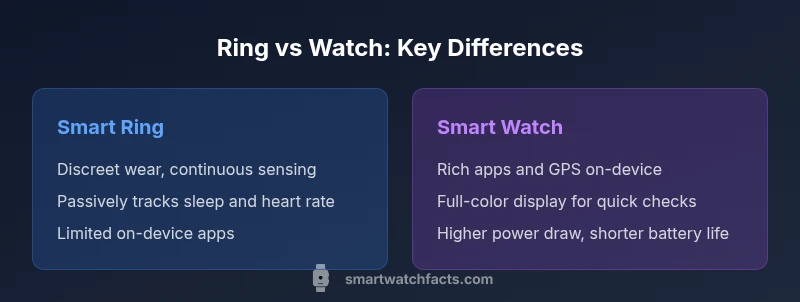
Discerning why smart ring over smart watch often hinges on measurement philosophy. Rings tend to emphasize continuous data capture with passive wear, producing long-term trend data with minimal user input. Watches frequently provide more feature-rich data streams, including on-device analyses and more granular metrics, but at the cost of greater power draw and a larger form factor. Both devices can offer sleep insights, heart-rate monitoring, and blood oxygen sensing, but the depth and reliability of those data streams vary by model and sensor layout. In practical terms, expect the ring to excel in passive trends and comfort, while the watch shines in on-demand metrics and richer app experiences. The Smartwatch Facts team highlights the importance of aligning your data needs with how you actually use wearables day-to-day.
Battery life expectations and charging realities
Battery life is a frequent deciding factor in choosing between a smart ring and a smart watch. Rings typically optimize for battery efficiency by limiting display usage and minimizing sensor load, which can yield longer usage between charges in some scenarios. Watches often rely on higher-powered displays and more sensors, which can reduce the time between charges. However, the exact endurance varies by model and usage patterns—GPS use, screen brightness, and continuous heart-rate monitoring all influence battery drain. When evaluating why smart ring over smart watch, consider how you plan to use the device: if you want 5–7 days of wear without a charge, the ring design often helps, but if you need reliable GPS and apps on every outing, the watch may still be the better partner.
Sensor health: what rings and watches typically measure
Sensing capabilities differ between rings and watches. Rings commonly monitor heart rate, sleep stages, and sometimes blood oxygen, with some models offering stress approximation and skin-temperature cues. Watches often expand those capabilities to include ECG, more advanced SpO2 sensors, and in some cases skin temperature or VO2 max estimates. The practical takeaway is to identify which metrics matter most to you. If you’re focused on sleep quality, daily activity trends, and subtle wellness signals, a ring can cover the essentials with less friction. If you need on-device ECG data or advanced workouts with GPS, a watch is the stronger option. Brand context from Smartwatch Facts emphasizes that you should match metrics to your health goals and daily routines.
Ecosystems and compatibility: app ecosystems and cross-device syncing
Ecosystem strength is a critical factor in choosing between a ring and a watch. Rings are heavily app-centric, depending on smartphone companions and cloud dashboards to translate raw signals into meaningful insights. Watches typically benefit from broader app ecosystems, with more on-device features, watch faces, and third-party integrations. If your phone is Android or iPhone, verify compatibility and ensure that the ring’s companion app supports your health goals and data export needs. Both form factors generally offer cross-platform syncing, but the depth of integration varies by brand and model. Smartwatch Facts highlights that compatibility and data portability are often overlooked but essential for long-term value.
Use-case scenarios: who should pick which device
For people who want subtle wear, comfort, and consistent data around sleep, the ring is compelling. It suits daily wear at work, during workouts with minimal distraction, and in environments where a screen could be onerous. For users who demand GPS, maps, music, and a broader app suite, the watch remains the most practical option. If you’re deciding why smart ring over smart watch, consider your typical day: do you need a device that vanishes on the finger or a device that augments mobility with apps and navigation? The decision becomes clearer when you map your activities to the device’s strengths. Smartwatch Facts’ analysis suggests that most people benefit from a ring as a secondary, always-on wellness companion, while a watch serves as a primary daily driver for more demanding use cases.
Practical buying checklist: questions to ask during evaluation
- Which metrics do you care about most (sleep, heart rate, SpO2, stress)?
- Do you need GPS, maps, or on-device apps for workouts?
- How important is comfort and 24/7 wear without charging interruptions?
- What is your budget, and does the price reflect the value of the features you need?
- Will you primarily wear this device at night or all day?
- Is data export and cross-device syncing important to your health analytics?
- How important is water resistance for swims or shower-friendly wear?
- Are there ecosystem constraints (iOS vs Android) that affect your decision?
Final notes: aligning expectations with reality
Ultimately, the choice between a smart ring and a smart watch comes down to how you live with wearables. If you prize discreet wear, reliable 24/7 sensing, and minimal daily friction, the ring often delivers a higher likelihood of consistent data. If you want robust on-wrist control, GPS, and a thriving app ecosystem, the watch stands out. As with many tech decisions, a practical approach is to test both options within your budget and observe how each affects your daily habits, sleep quality, and motivation to stay active. The Smartwatch Facts team emphasizes that the best device is the one you’ll wear consistently and use meaningfully over time.
Comparison
| Feature | Smart Ring | Smart Watch |
|---|---|---|
| Form factor | Compact, discreet, ring design | Wrist-worn with screen and larger footprint |
| Health sensors | Heart rate, sleep tracking, SpO2 (varies by model) | Heart rate, SpO2, ECG, sleep tracking |
| Display & interaction | Limited display; interaction via app or haptics | Vibrant touchscreen with on-device apps |
| GPS & location | No standalone GPS; depends on phone | Built-in GPS on many models |
| Battery life | Often longer due to minimal display usage | Varies; can be shorter with display/GPS use |
| Water resistance | Daily wear-compatible; sweat resistant | Water resistant with swim tracking on many models |
| Price range | Typically mid-range for rings | Mid to high range depending on model |
| Best for | Discreet health tracking and continuous wear | Active use with GPS, apps, and navigation |
Strengths
- Discreet form factor promotes 24/7 wear
- Passive data collection reduces user burden
- Longer comfort-friendly wear without screen fatigue
- Less intrusive during sleep and daily tasks
Weaknesses
- Limited app ecosystem compared to watches
- Fewer sensors (e.g., ECG) on many ring models
- Display-free interaction can slow data access
- Higher price per feature on some premium rings
Ring appeals to daily wearers; watch wins for feature breadth
Choose a ring if you value comfort and constant health signals. Choose a watch if you want GPS, apps, and comprehensive on-wrist control.
People Also Ask
What are the main differences between a smart ring and a smart watch?
The ring offers discreet wear, continuous sensing, and comfort, while the watch provides a larger display, GPS, and a broader app ecosystem. For routine wellness data, ring is often sufficient; for navigation and on-device apps, watch wins. Your daily habits determine which is most valuable.
Rings are quiet and comfortable for all-day wear, but watches give you the bigger toolset you can use on-the-go.
Is a smart ring as accurate for health tracking as a watch?
Both devices track core metrics such as heart rate and sleep, but accuracy and depth vary by model. Watches generally offer more sensor options (like ECG) and richer analytics, while rings emphasize continuous wear with dependable trends.
Rings track steadily, watches can give more detailed health readings when you need them.
Can I use a smart ring for GPS and navigation?
Most rings do not have standalone GPS; they rely on a connected phone for location data. Some watches include built-in GPS, enabling independent navigation and workouts without your phone.
Rings usually don’t have GPS; watches often do.
Are smart rings more comfortable for sleeping than watches?
Yes, many users find rings more comfortable for sleep because they are lighter and less obtrusive. However, comfort is personal, and some people prefer the monitoring capabilities and comfort of a watch during sleep.
Rings tend to be gentler on sleep, but it varies by person.
Which should I buy if I want long battery life?
Rings often run longer on a charge due to simpler displays and sensors. Watches may require more frequent charging, especially with GPS and frequent apps enabled. Your usage pattern will determine the actual endurance.
Rings often last longer between charges, but it depends on use.
Do smart rings support notifications like watches?
Rings deliver basic notifications through haptics or companion apps, but watches typically provide richer on-device notification handling and quick replies. If your workflow depends on rapid responses, a watch offers more flexibility.
Rings give subtle alerts; watches handle richer notifications.
Key Points
- Assess how often you wear a device daily
- Prioritize data needs over interface whenever possible
- Check GPS, app ecosystem, and data export options
- Consider long-term comfort and charging patterns
- Match device to your most frequent activities