Oura Ring vs Smartwatch: A Practical Wearables Guide
Compare the Oura Ring and a typical smartwatch across sleep tracking, health metrics, notifications, battery life, and value. Practical buying guidance helps you pick the right wearable for your daily life and wellness goals.


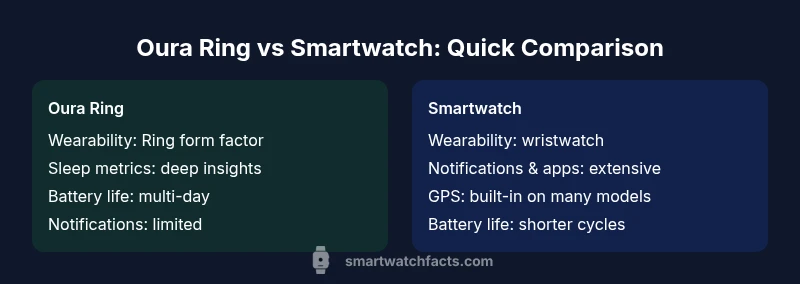
For everyday versatility, a smartwatch generally offers broader functionality—notifications, apps, GPS, and quick access to services. The Oura Ring excels at deep, long-term sleep and readiness insights with a discreet, comfortable form factor. If you want a watch-like experience with broad ecosystem support, choose a smartwatch; if you prioritize sleep data, subtle wear, and multi-day battery life, consider the Oura Ring.
What the comparison really boils down to
In the world of wearables, the question of how the Oura Ring compares to a traditional smartwatch hinges on usage patterns, priorities, and tolerance for bulk. The Oura Ring is designed to be worn 24/7 with minimal intervention, focusing on sleep quality, recovery, and activity trends rather than on-device apps or streaming notifications. A smartwatch, by contrast, acts as a portable computer on your wrist, delivering notifications, third‑party apps, GPS, music control, and quick messaging. When you see the phrase "oura ring vs smart watch", you should immediately think about trade-offs between unobtrusive wear and day-to-day functionality. According to Smartwatch Facts, these trade-offs are not just about features, but about how you intend to live with the device day after day.
Core optimization: daily use vs wellness focus
- Oura Ring optimizes for rest, readiness, and long-term trend data. Its strength lies in sleep stage estimation, heart rate variability, and temperature sensing that helps map recovery. - Smartwatches optimize for real-time communication, app ecosystems, and situational awareness. They excel when you need turn-by-turn navigation, quick replies, or streaming workouts without pulling out your phone. The "oura ring vs smart watch" decision often comes down to which of these capabilities you value most in your routine.
Comparison
| Feature | Oura Ring | Smartwatch |
|---|---|---|
| Design & Wearability | Ring form factor; extremely discreet and lightweight | Wristwatch form factor; larger and more visible on the arm |
| Sleep & Recovery | Dedicated sleep and readiness metrics with long-term trend analysis | Sleep tracking available but designed around overall day-to-day use and notifications |
| Health Sensors | HR, HRV, skin temperature, SpO2 (varies by model) | Heart rate, ECG (on some models), SpO2, activity sensors |
| Notifications & Apps | Limited notifications; no third-party app store on most versions | Full notification support; access to apps and services |
| GPS & Location | No built-in GPS; relies on phone for location data | Built-in GPS on many models; independent tracking |
| Battery Life | Multi-day to week-long battery life depending on use | Typically 1-2+ days with higher usage; charger needed more often |
| Water Resistance | Water resistance suitable for daily wear; generally durable for routine activities | Water resistance varies by model; suitable for swimming on many watches |
| Price / Value | Mid-range to premium with potential ongoing costs for advanced features | Wide range; upfront price often higher but long-term value tied to ecosystem |
| Ecosystem & OS | App ecosystem is built around the Ring app; cross-platform data sharing | Prolific app ecosystems; supports iOS and Android variants with Wear OS or watchOS |
Strengths
- Low-profile wear with strong focus on sleep data
- Excellent battery life and minimal maintenance
- Discreet design that blends with daily wear
- Voice- or app-based insights that translate wearables data into trends
Weaknesses
- Limited app ecosystem and notifications compared to smartwatches
- No built-in GPS on most models; location tracking requires a paired phone
- Potential ongoing costs for advanced features depending on model and plan
- Less suitable for those who want a smartwatch experience on the wrist
Smartwatch generally offers broader day-to-day utility; Oura Ring excels in sleep and recovery with discreet wear
If your priority is real-time communication and app access, a smartwatch is the stronger choice. If you want focused sleep insights with minimal distraction, the Oura Ring is a compelling option.
People Also Ask
Can an Oura Ring replace a smartwatch for most daily tasks?
For most daily tasks like messaging, calls, and navigation, the Oura Ring cannot replace a smartwatch. It’s designed to complement your day by providing sleep and readiness insights with minimal disruption. If you rely on apps and real-time notifications, a smartwatch is more suitable.
No. The Oura Ring focuses on sleep and wellness data, while a smartwatch handles messages, apps, and navigation.
Which device is best for sleep tracking?
The Oura Ring generally offers deeper sleep analytics and longer-term trend data, which is valuable for sleep-focused users. Some smartwatches also track sleep but typically emphasize active features and notifications.
If sleep is your primary goal, the ring often provides more detailed insights.
Are there any overlap features between the two devices?
Yes. Both devices track heart rate and activity, and both can monitor basic wellness metrics. The key difference is the depth and focus of data—sleep and readiness versus daily notifications and apps.
They overlap on basic metrics, but data depth and use cases differ.
What should I consider about OS compatibility?
Oura works with iOS and Android through its app. Smartwatches vary by brand—some work best with iPhone, others with Android. Consider your phone ecosystem and app needs when choosing.
Check whether the ring or watch integrates best with your phone’s OS.
Is there a price advantage to choosing one over the other?
Price depends on model and ecosystem. The ring typically offers a lower upfront cost but may involve ongoing features via subscription; smartwatches range widely and may require accessories and service plans.
Pricing varies by model and ecosystem; factor long-term value and potential subscriptions.
Who should consider the Oura Ring as their main wearable?
People who want minimal wear, strong sleep insights, and long battery life may prefer the ring. If you value notifications, apps, and GPS, a smartwatch is a better fit.
Choose the ring if you want discreet, sleep-focused wear; choose a smartwatch for broad functionality.
Can I wear both devices together for maximum data?
Yes. Wearing both can provide a fuller picture: the ring captures sleep and recovery, while the smartwatch handles day-to-day tasks. Data integration may require multiple apps, so review compatibility.
You can wear both, but expect two apps and some data management.
Key Points
- Prioritize needs: sleep focus or all-day smart features
- Oura Ring offers long battery life and discreet wear
- Smartwatches provide GPS, apps, and broad notifications
- Consider OS and ecosystem compatibility before buying
- Budget for potential ongoing costs and accessories