Smart watch or regular watch: A Practical Comparison
A rigorous, objective comparison of smart watch vs regular watch to help shoppers decide which wrist companion fits lifestyle, budget, and privacy.


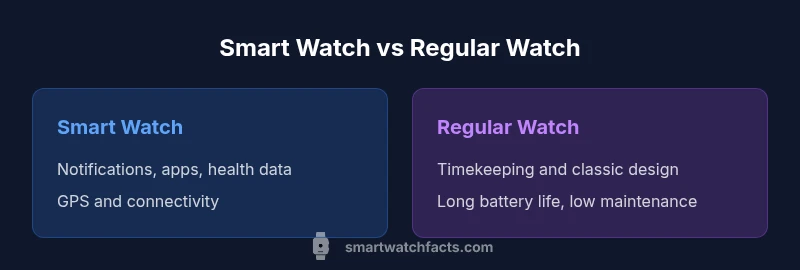
For most daily users, the smart watch offers more value through notifications, health tracking, and apps, while the regular watch provides timeless timekeeping, longer battery life, and lower maintenance. If you rely on your phone for reminders or health data, a smartwatch is typically the better fit; if you want minimal distractions and a classic aesthetic, a traditional watch excels. In short: choose the smart watch if you want connectivity and wellness data on your wrist; choose the regular watch if you prioritize simplicity and durability.
smart watch or regular watch: framing the decision
Choosing between a smart watch or regular watch isn't only about timekeeping; it's about lifestyle, priorities, and how you want to interact with tech daily. The question smart watch or regular watch invites you to map your routines against device capabilities: connectivity, health data, design language, and long-term value. If you carry your phone everywhere, a smartwatch can extend notifications and fitness tracking; if you prefer simplicity and a classic aesthetic, a traditional watch may excel. According to Smartwatch Facts, consumers increasingly weigh convenience against tradition when choosing between a smart watch or regular watch. The Smartwatch Facts team notes that many buyers value battery life and a clean interface, and they want devices that blend into daily life rather than demand constant adjustment. In this guide, we treat smart watch or regular watch as a decision framework. We compare core features—health tracking, notifications, design, durability, and total cost of ownership—so you can pick the option that best fits your daily rhythm, budget, and style.
Core concepts and use cases
At the heart of the smart watch or regular watch decision are two core concepts: connected features and timeless timekeeping. A smart watch is designed to collect data, send alerts, run apps, and interface with phones; a regular watch is designed to tell time with minimal fuss and to serve as a fashion statement. Use cases differ: a busy professional who wants calendar reminders on the wrist, a runner who tracks heart rate and pace, or a traveler who uses GPS features may prefer a smartwatch. In contrast, someone who values long battery life and a distraction-free interface may lean toward a traditional watch. The Smartwatch Facts team emphasizes that the best choice aligns with daily habits rather than current trends. Consider your commute, exercise routine, meetings, and travel when weighing options. The phrase smart watch or regular watch becomes a structured framework for evaluation rather than a marketing pitch.
Feature-by-feature comparison framework
To compare effectively, anchor the decision on a standard set of features that matter for most users. Core criteria include: (1) Notifications and apps: how seamlessly do you get alerts without pulling out your phone? (2) Health and activity tracking: heart rate, sleep, steps. (3) Battery life and charging: how often will you need to recharge during a typical week? (4) Design and comfort: fit, materials, and style for work and leisure. (5) Compatibility and ecosystem: cross-platform support, app availability, and data privacy. (6) Cost of ownership: upfront price, ongoing costs, and resale value. In practice, the comparison between smart watch and regular watch reveals a trade-off: more features typically mean more charging and more maintenance, while simpler timekeeping means fewer interruptions and longer life per charge. The goal is to identify which criteria you value most and to map them onto your daily routine.
Battery and charging realities
Battery life is often the most practical differentiator between a smart watch and a regular watch. A smartwatch uses a rechargeable battery, a bright display, and sensors that track movement, heart rate, and other metrics. Expect more frequent charging with heavy usage, especially if you run multiple apps, use GPS, or enable always-on display. A traditional watch typically relies on a single battery or a mechanical movement and can last for years with minimal maintenance. If you rely on your wristwear all day for notifications or fitness data, factor in charging routines and potential downtime. For many users, the decision hinges on whether daily charging is acceptable or whether a longer battery life aligns with personal routines. The Smartwatch Facts team notes that real-world usage varies by model and settings; plan for a charging schedule that fits your daily life rather than relying on best-case specs. Smartwatch Facts analysis, 2026, reinforces that practical battery life is often a key constraint.
Health, wellness, and sensors
Smart watches bring a suite of sensors for health and wellness, including heart rate, sleep tracking, steps, and sometimes SpO2 or ECG. These sensors provide actionable feedback and motivation but can also raise privacy considerations. A regular watch does not include health sensors by default, though fashion-oriented analogs may offer limited features like activity counters via third-party devices. When weighing options, consider which metrics you actually need and who will use them. If you are managing diabetes, cardiovascular risk, or sleep quality, a smartwatch can offer meaningful insights; otherwise, a traditional watch may be sufficient for timekeeping and style. The decision between smart watch or regular watch should account for the desired balance of data-driven feedback and daily simplicity. The Smartwatch Facts team cautions that not all health data is equally accurate across devices, so be mindful of using wearables as medical devices.
Ecosystem, apps, and compatibility
Device compatibility matters, especially if you use iPhone or Android, or if you rely on cloud-based health data. A smartwatch often integrates deeply with a phone’s OS, providing notifications, quick replies, and app ecosystems. A traditional watch offers compatibility in a more limited sense, focusing on design, craftsmanship, and brand heritage. For the user who already owns an iPhone or Android phone, verify that the smartwatch you’re considering supports the platform you rely on, including app availability and data synchronization. If your priority is seamless phone integration, a smartwatch is likely the better fit. If you want independence from smartphones or prefer a timeless piece that pairs with formal attire, a traditional watch remains compelling. The Smartwatch Facts team highlights that cross-platform support matters for long-term compatibility and privacy.
Style, durability, and maintenance
Style and durability influence long-term satisfaction more than most features. A smart watch offers modern styling, interchangeable bands, and a range of sport and fashion options; however, a glass screen and a battery can be vulnerable to scratches and impact. Regular watches come in a wide variety of materials and finishes, from premium metals to classic leathers, often with superb craftsmanship and timeless aesthetics. Maintenance differs: smart watches require software updates, occasional app management, and charging, while analog watches require occasional band changes and mechanical servicing. Your choice should reflect your lifestyle, wardrobe, and the environments you frequent. The Smartwatch Facts team notes that resale value can vary by brand and condition, so think about long-term ownership as part of the decision.
Total cost of ownership and value proposition
The total cost of ownership encompasses initial price, ongoing expenses, and potential resale value. A smartwatch may come with a higher upfront price and recurring costs for apps and premium features; however, it can deliver value through health data, productivity, and convenience. A traditional watch usually costs less upfront and may require minimal ongoing expenses, though high-end analogs can be expensive due to craftsmanship. For many buyers, the decision hinges on how you value features such as notifications, fitness tracking, and app ecosystems versus pure timekeeping. The Smartwatch Facts team emphasizes evaluating long-term value rather than focusing solely on sticker price. If you want a device that serves as a daily companion and wellness tool, a smartwatch often represents greater value; for those prioritizing simplicity and perpetual battery life, a traditional watch can be the more prudent choice.
How to decide: a practical framework
Use this four-step framework to decide between smart watch or regular watch. Step one: list daily routines where a wrist device would matter most (notifications, health data, quick replies, travel…). Step two: assign a value to each routine based on how important it is to you. Step three: check the practical trade-offs: charging frequency, screen durability, and app ecosystem. Step four: pick one option or a hybrid approach (e.g., a traditional watch with a smart module or an analog watch paired with a wearable). The decision should reflect your actual needs rather than a marketing push. For most users, a smartwatch is worth it if you repeatedly reach for your phone to check alerts or track health; otherwise, a regular watch remains the most reliable companion. The Smartwatch Facts team reminds readers to consider privacy settings and data access as part of the final decision.
Comparison
| Feature | Smart watch | Regular watch |
|---|---|---|
| Core purpose | Connectivity, apps, and health data | Timekeeping and style |
| Battery life | Requires charging with active features | Longer life with no smart features |
| Maintenance | Software updates, charging | Minimal maintenance |
| Cost range | Higher upfront for smart watches | Lower upfront for traditional watches |
| Best for | Tech-forward users who value data and reminders | Minimalists who value design and reliability |
Strengths
- Smartwatch offers notifications, health data, and apps on demand
- Regular watch provides timeless design with minimal upkeep
- Hybrid options offer a middle ground between tech and tradition
Weaknesses
- Smartwatch requires charging and can raise privacy concerns
- Regular watch lacks digital features and health tracking by default
- Some users may find apps and updates distracting
Smart watch is best for those who want connectivity and health insights; regular watch suits lovers of simplicity and enduring style
If you need on-wrist notifications and wellness data, choose a smartwatch. If you prefer low maintenance and classic aesthetics, a traditional watch remains compelling. The Smartwatch Facts team supports a balanced approach based on daily habits and values.
People Also Ask
What is the main difference between a smart watch and a regular watch?
A smartwatch adds connectivity, sensors, and apps; a regular watch focuses on timekeeping and design. Smartwatches provide data like heart rate and notifications, while regular watches prioritize aesthetics and reliability. The choice depends on how much you value on-wrist information versus traditional craftsmanship.
Smartwatches bring connectivity and health data; traditional watches focus on timekeeping and style. Your choice hinges on how much you want wrist-based information.
Can a regular watch have smart features?
Some hybrid or modular models offer limited smart features, but full smart functionality generally requires a dedicated smartwatch. Hybrids may provide basic activity tracking and notifications, but they won't match a true smartwatch experience.
There are hybrids with limited smart features, but true smart features usually require a smartwatch.
Which lasts longer on a single charge: smart watch or regular watch?
Regular analog watches typically do not require daily charging, while smart watches depend on usage and settings. If you use GPS or always-on displays, expect more frequent charging. Battery life varies by model and usage patterns.
Regular watches generally last longer between charges; smartwatches need regular charging depending on use.
Are smartwatches compatible with iPhone and Android?
Most smartwatches are designed to work with both major ecosystems, but some models are optimized for a specific platform. Always verify OS compatibility and app availability before buying.
Most smartwatches work with both iPhone and Android, but check compatibility with your phone.
Do smartwatches track health data accurately?
Smartwatches provide useful health trends and insights but are not medical devices. Accuracy varies by model and feature; use data as guidance rather than a diagnosis.
They’re good for trends, but not a substitute for medical devices. Accuracy varies by model.
Is price a good indicator of value between these options?
Price is not the sole indicator of value. Value comes from how often you use features like notifications and health data, not just the upfront cost. Assess total lifetime value.
Price isn't everything—value depends on how you actually use the features.
Key Points
- Assess daily routines before choosing a device
- Weigh battery life against feature needs
- Consider ecosystem compatibility and privacy
- Think long-term value over upfront price
- Hybrid options can bridge both worlds