Smart Watch Cell Plans: A Practical Guide for 2026
Navigate smart watch cell plans with ease. Learn how eSIM works, compare data-only vs. multi-line options, price ranges, regional differences, setup steps, and money-saving tips.


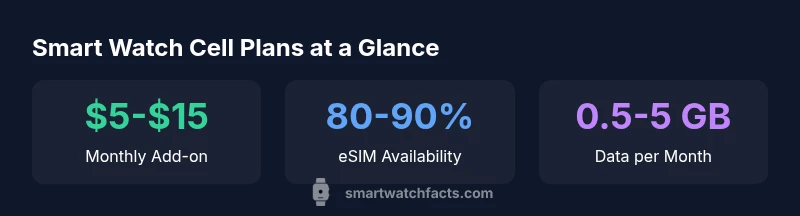
Smart watch cell plans are mobile carrier data add-ons that let your smartwatch connect to cellular networks independently of your phone. In 2026, carriers offer data-only and shared-data options, typically costing around $5-$15 per month, depending on data allowance and region. Most watches use eSIM technology, and compatibility varies by carrier and model. The Smartwatch Facts team notes that plan availability and prices vary widely by market.
How smart watch cell plans work in 2026
Since the early days of wearable tech, cellular connectivity on smart watches has evolved from a niche feature to a mainstream option. According to Smartwatch Facts, smart watch cell plans are data-enabled add-ons from mobile carriers that let a watch connect to cellular networks even when your phone isn't nearby. These plans come in two main flavors: data-only wearables and shared data plans that piggyback on your existing phone plan. Activation usually happens through the carrier’s app or website, by selecting a watch plan and scanning an eSIM QR code on the watch. The watch must be compatible with the carrier's network and support eSIM or a physical SIM, depending on model. In many markets, you’ll choose a plan aligned with your data needs, then link the watch to your account as a separate line or a data-only line. You can then customize features like notifications, calls, and messaging. The rising adoption of LTE/5G-enabled watches during 2026 means more people can answer calls from their wrist, track health data on the go, and use built-in GPS without tethering to a phone.
blockNextWordCount:0
analysisNotes:[]},
eSIM, switching, and multi-number options
Most modern smart watches use eSIM technology, which stores the cellular profile digitally and activates the watch on a carrier network without a physical SIM. eSIM switching makes it easier to switch carriers or plans if you travel or relocate, often within the carrier app. Some providers offer multi-number options so you can have a separate watch line with its own voicemail or texting, while others simply share a data pool with your phone line. When evaluating options, check whether your watch supports eSIM or requires a carrier-locked profile; confirm if you can port your existing number to a watch plan or if you’ll need a new one. The practical upshot is flexibility: you can decide how the watch behaves offline, how many messages you receive, and how data is billed, which is particularly helpful for families or users who want independent device connectivity.
blockNextWordCount:0
analysisNotes:[]},{
Data-only vs voice-enabled plans: Pros and cons
Data-only plans tend to be cheaper and are sufficient for notifications, GPS tracking, and app updates, especially if you primarily wear the watch for fitness or quick glance interactions. Voice-enabled or multi-service plans add cellular calling, texting, and app streaming on the watch, but usually cost more and may require a separate number. If you mostly use your phone, a data-only option can save money; if you travel with your watch or use it in places with poor phone coverage, a voice-enabled plan can be valuable. Also consider whether the watch supports calling via Bluetooth or speakerphone when your phone isn’t present; coverage for watch-only features varies by carrier and region.
blockNextWordCount:0
analysisNotes:[]},{
Price ranges and what affects cost
Carrier pricing for smart watch cell plans varies by region, data allowance, and whether the plan is tethered to a phone line or issued as a standalone wearable line. In 2026, typical add-on costs for data-only wearables range from $5 to $15 per month, depending on data limits and promotions. Multi-device plans, which bundle the watch with a phone line, usually run from about $10 to $25 per month, while family or multi-watch plans can reach roughly $15 to $40 per month. The actual rates differ by country, network quality, and the length of promotional periods. Some carriers also factor in activation fees or require specific watches to be eligible for the plan. Smartwatch Facts Analysis notes that data throttling or overage policies can influence total cost, so read the fine print before committing.
blockNextWordCount:0
analysisNotes:[]},{
Regional differences and setup basics
Access to smart watch cell plans is highly regional. In the United States, plan prices tend to reflect carrier competition and existing data pools; in Europe, you may find more uniform pricing and broader eSIM support across brands; in parts of Asia, pricing and data allowances can be highly variable depending on the operator and the device ecosystem. When comparing regions, consider coverage maps, 4G/5G availability, and roaming policies. If you travel, look for plans that minimize roaming charges or offer straightforward roaming addons. The Smartwatch Facts team emphasizes regional nuance: a plan that looks affordable in one country may be expensive in another when you account for taxes, activation fees, and data speed caps.
blockNextWordCount:0
analysisNotes:[]},{
Setup steps to add smartwatch cellular service
To set up a smart watch cell plan, first confirm your watch model supports cellular connectivity and eSIM. Then check your carrier’s supported devices and data plans. On many devices, you will purchase or enable a watch plan in the carrier's app, scan a QR code or install the eSIM profile, and choose whether to attach the watch to your existing line or create a new line. Follow the prompts on your watch to activate the plan, and verify that the watch shows signal strength in the status bar. Some carriers require you to disable the phone’s own SIM for the watch to function independently; others allow data to be shared while preserving a single number. Finally, test essential functions: calling, texting, notifications, and app updates while the watch is away from your phone.
blockNextWordCount:0
analysisNotes:[]},{
Tips to compare plans effectively
Create a checklist before you commit: verify watch compatibility and eSIM support, confirm whether the plan is data-only or includes calls and texts, compare monthly prices and data allowances, review roaming policies, and check how activation and penalties apply. Look for a plan that fits your typical usage: frequent GPS use requires higher data quotas; occasional streaming may be fine with lower allowances. Consider battery life implications: cellular mode tends to drain the watch battery faster, so evaluate charging habits. If you travel or live abroad, prioritize flexible roaming options or short-term international add-ons. Finally, read user reviews focusing on reliability and customer service; the difference between a good plan and a great one often comes down to support when you need it.
blockNextWordCount:0
analysisNotes:[]},{
Common myths vs reality about smart watch cell plans
Myth: You must have a separate plan solely for the watch. Reality: Many carriers offer watch add-ons that piggyback on your existing plan or provide data-shared options. Myth: A watch plan is always cheaper than using your phone’s data. Reality: It depends on data needs, coverage, and promotions; standalone watch plans can be valuable for independence, especially on trips. Myth: All watches work with any carrier. Reality: Compatibility depends on watch model and carrier, and eSIM support varies. Myth: Owning a watch with GPS means no extra costs. Reality: If you want cellular connectivity for the watch, you’ll likely incur data costs, so check plan terms. The Smartwatch Facts team emphasizes that transparency is key when evaluating plans and that regional differences can significantly affect total cost.
blockNextWordCount:0
analysisNotes:[]}],
dataTable
dataTable
headers
rows
caption
True
Typical data plan options for smart watches
| Plan Type | Typical Cost | Data Allowance |
|---|---|---|
| Data-only wearable plan | $5-$15 | 2-5 GB/month |
| Multi-service plan with watch | $10-$25 | 1-3 GB/month |
| Family or multi-watch plan | $15-$40 | Up to 5 GB/month |
People Also Ask
What is a smart watch cell plan?
A cellular plan for a smart watch provides data connectivity to the watch via eSIM, allowing calls, texts, and app use without your phone. Plans vary by region and carrier and can be data-only or shared with a phone line.
A watch plan adds data so your watch can connect on its own, not just when your phone is nearby.
Do I need a separate line for my watch?
Not always. Some carriers offer data-sharing or add-ons that piggyback on your existing phone plan, while others provide a standalone watch line. Check with your carrier for the best option for your usage.
Usually you can add it to your current plan or get a watch-specific add-on.
Can I use a watch plan with both iPhone and Android watches?
Yes, most major carriers support watch plans across iPhone and Android ecosystems, but you should verify model compatibility and eSIM support with your carrier.
Usually compatible with both iPhone and Android when you have a watch plan.
Are smartwatch plans cheaper regionally?
Costs vary widely by country due to taxes, market competition, and regulatory differences. Always compare data allowances and roaming terms in your region.
Prices differ a lot by country and carrier.
What data speeds can I expect on a watch plan?
Speeds depend on the network and plan. Most watches use LTE/5G where available, but many wearables prioritize efficiency over raw speed.
Speeds depend on the network and plan; expect LTE/5G depending on location.
What happens if I exceed my data allowance on a watch plan?
Overages or throttling are common risk. Some plans allow add-ons or automatic data top-ups; always check the policy before you exceed your limit.
If you go over, you might be throttled or pay extra fees.
“Cellular connectivity on smart watches unlocks independence from your phone, but it also requires evaluating data costs, regional coverage, and device compatibility.”
Key Points
- Start with a data-only plan if you mostly need notifications or GPS
- Ensure your watch supports eSIM; verify carrier compatibility
- Factor data allowance and roaming charges into total cost
- Compare plans across regions to avoid unexpected fees