Smart Watch vs Mechanical Watch: A Practical Buying Guide
Compare smart watches with traditional mechanical watches to understand pros, cons, durability, price ranges, and ideal use cases for different lifestyles.


TL;DR: For most buyers seeking daily practicality and broad feature sets, a modern smart watch offers convenience, health tracking, and app compatibility, while a mechanical watch emphasizes craftsmanship and long-term value. If you want notifications and fitness data, choose smart watch; if you value traditional aesthetics and mechanical mastery, choose a mechanical watch.
The modern question: smart watch vs mechanical watch in 2026
In today's market, the choice between a smart watch vs mechanical watch isn't just about telling time; it's about how you want to interact with technology and tradition. A smart watch blends digital convenience with everyday wear, offering notifications, health metrics, and app ecosystems that extend beyond timekeeping. A mechanical watch, by contrast, leans into age-old watchmaking artistry, with hand-finished movements, intricate craftsmanship, and a reputation built on decades of tradition. The decision hinges on how you value immediacy, data, and connectivity versus craftsmanship, durability, and timeless style. Throughout this guide, we’ll compare the two on practical criteria like maintenance, price, and everyday use to help you decide what best fits your lifestyle.
Core differences at a glance
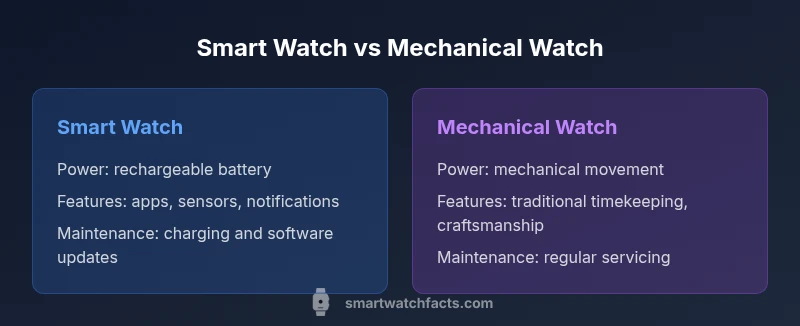
- Timekeeping: Smart watches rely on digital frameworks, input from sensors, and often a connected smartphone; mechanical watches depend on precision movement for timekeeping.
- Power: Smart watches draw energy from rechargeable batteries; mechanical watches run on a wound mainspring.
- Features: Smart watches provide notifications, apps, GPS, and health tracking; mechanical watches focus on traditional timekeeping and aesthetic value.
- Maintenance: Smart watches require software updates and charging cycles; mechanical watches require periodic servicing and lubrication.
Design and build quality: aesthetics, materials, and finish
Design decisions for smart watches emphasize lightweight, durable cases, vibrant displays, and interchangeable bands suitable for active wear and professional settings. Materials range from aluminum to stainless steel with sapphire or hardened glass. Mechanical watches emphasize metal finishing, case back engravings, and movement decoration. The choice often aligns with personal style: sport-ready digital faces versus classic analog dials. Water resistance is common in both, but the level of protection and durability can differ by model and purpose. Overall, smart watches optimize versatility; mechanical watches optimize craftsmanship and enduring appeal.
Movement, power, and maintenance: what actually runs your watch
A smart watch operates on a battery and software ecosystem that enable real-time data, apps, and notifications. Power management is a constant consideration given screen usage and sensors. Mechanical watches rely on a powered movement—hand-wound or automatic—that stores energy in a mainspring and turns gears to move the hands. Maintenance for smart watches centers on battery health, screen protection, and software updates; mechanical watches require regular servicing to keep the movement clean, lubricated, and accurately regulated. Each path has its own cadence of upkeep and longevity depending on usage and climate.
Features, usability, and connectivity: value beyond time
Smart watches unlock a broad feature set: activity tracking, heart-rate sensing, sleep analytics, GPS, contactless payments, and app ecosystems. They pair with smartphones to extend notifications and quick actions. Mechanical watches, while lacking smart features, emphasize legibility, moon phases, chronographs, and other horological complications that demonstrate mechanical ingenuity. For daily wear, a smart watch can replace several gadgets with a single device; for formal occasions, a mechanical watch can elevate attire through timeless presence and a sense of tradition. The UX contrast is clear: digital convenience versus tactile craftsmanship.
Accuracy, reliability, and longevity: how precision translates to daily life
Timekeeping accuracy in smart watches depends on synchronization with digital signals, software calibration, and periodic updates. For mechanical watches, accuracy is a function of movement quality, regulation, and wear. Reliability in daily life favors smart watches when you need data, reminders, and phone-free activity tracking. Longevity leans toward mechanical watches for those who value enduring beauty and potential resale; smart watches may outpace them for feature longevity but tend to have shorter product lifecycles due to rapid tech evolution. Your environment and maintenance habits shape overall reliability in both camps.
Price, ownership costs, and value retention: thinking beyond sticker price
Smart watches typically span a broad price range, with mid-tier models offering strong feature sets and premium models adding advanced sensors and luxury finishes. Mechanical watches also vary widely; entry-level pieces can be affordable while high-end models reflect craftsmanship, brand heritage, and movement complexity. Ownership costs include battery replacements or charging accessories for smart watches and regular servicing for mechanical watches. Resale value tends to be stronger for certain mechanical brands with limited editions, while smart watches may depreciate more quickly as new generations launch. Consider total cost of ownership and how long you expect to wear the watch before upgrading.
Which is best for different contexts: daily wear, formal occasions, sports
For daily wear with health tracking and convenience, a smart watch often beats traditional timekeeping in practical value. If your lifestyle privileges formal attire, horological history, and subtle mechanical presence, a mechanical watch shines on dress occasions and in collections. Athletes and runners may prefer smart watches for GPS and biometric data, while purists and collectors may prioritize the artistry of a finely made mechanical watch. The optimal choice aligns with how you intend to use the watch most of the time.
How to evaluate before buying: a practical checklist
Before purchasing, establish your priorities: budget, daily use, need for notifications, and desire for horological craftsmanship. Check movement type (automatic or manual) and maintenance requirements for mechanical watches, and assess battery life, display quality, and app support for smart watches. Consider connectivity compatibility with your phone, water resistance for your activities, and the availability of service centers. Try on several models to gauge comfort and legibility, and read warranty terms. A structured checklist helps translate feelings into a rational decision.
Common myths and misconceptions: separating fact from fiction
A frequent myth is that smart watches replace the need for any traditional watch. In reality, the two serve different purposes and complementary roles. Another misconception is that mechanical watches always appreciate in value; while some do, market demand and brand strength influence resale, and not every piece retains or grows in value. Finally, some assume smart watches are fragile; modern devices use robust materials and ruggedized cases, though screen durability varies by model. Understanding these distinctions helps buyers set realistic expectations.
Comparison
| Feature | Smart Watch | Mechanical Watch |
|---|---|---|
| Timekeeping method | Digital/OS-based timekeeping with automated syncing | Mechanical movement (hand-wound or automatic) |
| Power source | Rechargeable battery; charging required | Mainspring wound manually or automatically by wrist movement |
| Maintenance | Software updates, charging cycles, potential battery replacement | Periodic servicing and lubrication, potential regulation adjustments |
| Smart features | Apps, notifications, GPS, health tracking, payments | Pure timekeeping; no digital features |
| Durability | Varies by model; often strong displays and water resistance | Durable movement; case materials vary; more sensitive to shocks in some designs |
| Price range | Typically broad, $200-$600+ commonly seen | Vast range from affordable to high-end; often $300-$5000+ depending on movement and branding |
| Best for | Active users, data-driven decision-makers, and technology enthusiasts | Traditionalists, collectors, and dress-watch enthusiasts |
Strengths
- Versatile functionality with health and productivity tools
- Real-time data and seamless smartphone integration
- Wide price range and fast product iteration
- Can replace multiple devices for some users
- Strong resale value in certain classic mechanical pieces
Weaknesses
- Requires regular charging and software maintenance
- Privacy and data security concerns for some users
- Smart features may feel redundant for some wearers
- Mechanical watches can offer lasting value but require ongoing servicing
Smart watch dominates daily practicality; mechanical watch remains essential for heritage and dress wear
If your priority is daily usefulness, notifications, and fitness tracking, choose a smart watch. If you value timeless design, craftsmanship, and potential collecting value, a mechanical watch is the better long-term companion. Smartwatch facts would suggest tailoring the choice to your lifestyle and budget.
People Also Ask
What is the fundamental difference between a smart watch and a mechanical watch?
The smart watch uses digital technology, sensors, and connectivity to deliver apps and data, while a mechanical watch relies on a traditional wound movement for timekeeping. Each serves different user needs and occasions.
The smart watch gives you apps and health data; the mechanical watch emphasizes traditional craftsmanship and timekeeping.
Do mechanical watches require frequent battery changes?
Mechanical watches do not use batteries. They run on a wound mainspring and require occasional servicing to maintain accuracy and longevity.
No battery changes are needed for mechanical watches; they rely on a wound spring and periodic service.
Are smart watches accurate as traditional analog timepieces?
Smart watches can be highly accurate because they synchronize with digital standards, but they depend on battery health and software. Analog accuracy varies by movement quality and regulation and can be superb with a well-made piece.
Smart watches stay very accurate with software updates; traditional analogs depend on movement quality and proper regulation.
Can a smart watch replace a mechanical watch for dress occasions?
For formal events, many people still prefer the classic look of a mechanical watch, but some smart watches with luxury cases can complement attire. It depends on the dress code and personal preference.
Some forms of dress code lean toward traditional watches, but a premium smart watch can work with the right look.
What factors most influence price differences between smart watches and mechanical watches?
Smart watches vary by display quality, sensors, battery life, and brand ecosystem; mechanical watches differ by movement complexity, materials, craftsmanship, and provenance.
Price mostly reflects features and materials for smart watches, and movement, finishing, and brand for mechanical watches.
Is resale value a reliable consideration for both types?
Resale value tends to be stronger for certain mechanical watches tied to brands and limited editions, whereas smart watches often depreciate as new models launch.
Mechanical watches can retain value with brand and rarity; smart watches typically depreciate as tech advances.
Key Points
- Assess daily use: go smart for activity data or go mechanical for classic style
- Consider maintenance: software updates vs servicing schedules
- Weigh price vs value: upfront cost vs long-term ownership
- Try on and test: legibility, comfort, and wrist feel matter
- Think about occasions: dress events favor mechanical; everyday wear favors smart