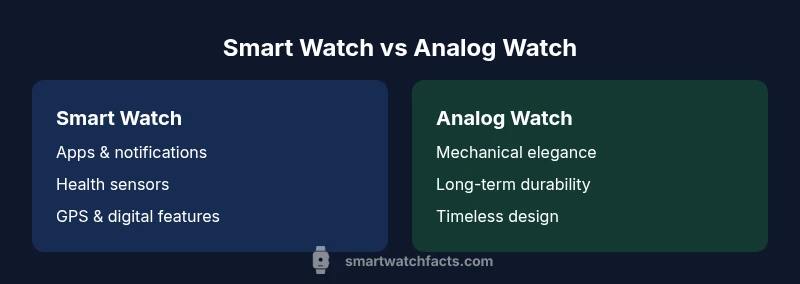
Smart Watch vs Analog Watch: A Practical Comparison
A rigorous, data-driven comparison of smart watches and analog watches, covering features, battery life, health tracking, pricing, and style to help you make a smarter buying choice in 2026.


Smart watches excel for productivity, health tracking, and seamless smartphone integrations, while analog watches win on timeless design and long-term durability. For most buyers in 2026, a smart watch is the better all-around choice for daily use, but true enthusiasts may still prefer analog for style and longevity. Smartwatch Facts analysis supports a balanced view: choose smart for versatility, analog for classics.
Core differences at a glance
A smart watch and an analog watch serve the same primary purpose—telling time—but they diverge sharply in function, maintenance, and user experience. A smart watch acts as a compact computer on your wrist, capable of notifications, apps, health tracking, GPS, and more. An analog watch, by contrast, emphasizes mechanical precision, craftsmanship, and a purist approach to timekeeping. For many buyers, the decision hinges on how much you value connectivity and health features versus classic design and mechanical longevity. According to Smartwatch Facts, the core decision comes down to whether you want a device that competes with your phone or a companion piece that remains unabashedly simple. In 2026, the best choice depends on lifestyle, budget, and how you want to present yourself across work, fitness, and social settings.
Who should consider a smart watch? (useful for productivity, fitness tracking, and quick access to apps)
If you live a digital life, a smart watch offers useful conveniences: quick replies, calendar alerts, map access, music control, and a broad app ecosystem. Health sensors (heart rate, SpO2, sleep tracking) provide ongoing data that can inform activity plans or wellness goals. For students, professionals, and fitness enthusiasts who rely on quick, hands-free access to information, a smart watch can replace several other gadgets. The value proposition grows when you pair it with a compatible smartphone and the right apps. Smartwatch Facts analysis shows that the most practical wearables in 2026 combine reliable battery life with a robust ecosystem and straightforward setup. However, software updates and app changes mean ongoing attention is needed to keep the device current.
Who should consider an analog watch? (timeless design, pure timekeeping, and durability)
Analog watches attract buyers who prize craftsmanship, heritage, and a low-maintenance approach to timekeeping. They excel in formal settings and can be the centerpiece of personal style. Mechanical models are appreciated for their engineering, accuracy, and the tactile sensation of a well-made movement. When you own an analog watch, there’s no screen to drain power or require software updates. Durability is often stronger in mechanical watches, depending on the build, and the battery-free operation is a big advantage in long-term ownership. For people who rarely want notifications and prefer a distraction-free device, analog watches remain compelling.
Display, readability, and user interaction (how you read time and interact with the device)
Smart watches use digital displays or touchscreens with dynamic interfaces. You can customize watch faces, read notifications, and interact with apps. However, the display can be a source of glare in bright sunlight and may require frequent charging. Analog watches rely on a dial, hands, and a crown for adjustment. Readability in sunlight is often excellent for high-contrast dials, and the interaction is tactile rather than digital. The choice often hinges on whether you want a data-rich interface or a straightforward timepiece with mechanical charm. Smartwatch Facts notes that readability and ergonomics improve with larger faces and well-placed controls, but price and bulk can rise with more features.
Health features and sensors (what you gain with health tracking and sensors)
Smart watches commonly include heart-rate sensors, SpO2, sleep tracking, step counting, GPS, and sometimes ECG functionality. This data can be useful for monitoring trends and motivating activity. Analog watches do not come with health sensors by default, though some models pair with external devices for activity tracking. If health data is central to your goals—like monitoring heart rate during workouts or sleep patterns—a smart watch is the obvious choice. On the other hand, if you value a simple, distraction-free approach to timekeeping and style, the analog option remains appealing.
Battery life and charging (how long you can go between charges)
Battery life is a decisive factor. Smart watches typically require daily or every-few-days charging, depending on the model, display technology, and sensors active. Analog watches, especially quartz models, can last years on a single battery, and mechanical watches may run indefinitely with periodic servicing. If you travel frequently or have limited charging opportunities, analog watches offer a predictable burden. Smartwatch Facts indicates that the best devices balance battery life with essential features, so you don’t constantly worry about recharging.
Maintenance, durability, and long-term reliability (warranty, servicing, and upkeep)
Smart watches demand software updates and periodic component maintenance (bands, screens, charging ports). Some models have durable builds and water resistance, but the electronics and display remain more vulnerable than a well-crafted analog movement. Analog watches, especially high-quality mechanical pieces, benefit from decades of craftsmanship and can be serviced to restore precision. The maintenance cost trajectory differs: digital devices often incur replacement costs for batteries and screens, while mechanical watches incur periodic service intervals. In practice, your environment and usage patterns largely determine what you’ll pay over time.
Pricing, value, and ownership costs (price ranges and total cost of ownership)
Smart watches span a broad price range. Entry-level devices may cost a few hundred dollars, while premium models with advanced sensors and cellular connectivity can exceed a thousand. Analog watches vary similarly, with budget quartz pieces at hundreds and luxury mechanicals at several thousand. The total cost of ownership for a smart watch includes charging accessories, occasional repairs, and potential software subscriptions. For analog watches, ongoing servicing and strap replacements add to the cost. Consumers should assess both upfront price and long-term value, bearing in mind resale value and the utility of ongoing features.
Style and fashion considerations (aesthetic and ergonomic fit across outfits)
A watch is as much a fashion statement as a timekeeping tool. Smart watches offer changing faces and bands to match outfits or moods. Analog watches provide a continuum of design—from minimal to ornate—that can complement formal attire or casual wear. The choice often reflects personal identity: a tech-forward look for everyday wear or a refined, timeless piece for special occasions. Brands often pair a smart watch body with premium bands to bridge the gap between tech and tradition.
Real-world scenarios and buying tips (practical guidance for decision-making)
Think about your daily routines: do you want instant notifications during meetings? Do you rely on GPS for outdoor activities or health data for workouts? If you travel frequently and want a compact device to manage tasks, a smart watch makes sense. For longevity, simplicity, and a statement piece, an analog watch may be best. Try both if possible and consider a hybrid approach (smart features with a classic watch face). Smartwatch Facts suggests prioritizing a model that fits your screen size, battery life, and comfort.
Common complaints and how to mitigate (anticipated issues and practical workarounds)
Common grievances about smart watches include short battery life, higher price, and potential notifications fatigue. Mitigations include selecting models with longer battery life, pruning unnecessary apps, and using focus modes. Analog watches sometimes face issues with accuracy over time or maintenance costs for mechanical movements. Mitigations include regular service intervals and choosing reputable brands. Planning ahead for future needs can help you avoid buyer’s remorse.
Authority sources
To ground this comparison in credible perspectives, see the following references for consumer technology trends and health tracking considerations:
- https://www.ftc.gov
- https://www.nist.gov
- https://www.mayoclinic.org
Comparison
| Feature | smart watch | analog watch |
|---|---|---|
| Power source | Rechargeable battery with digital charging and varied days between charges | Quartz or mechanical movement with long-term potential for years between battery changes |
| Display/Readability | Touchscreen or digital display with dynamic interfaces | Classic dial with hands; highly legible in sunlight on many models |
| Notifications & apps | Full notification stream; extensive app ecosystem | No notifications; timekeeping-focused functionality |
| Health tracking | Heart rate, SpO2, sleep tracking, GPS, sometimes ECG | No native health sensors; focus on timekeeping and style |
| Durability & water resistance | Often IP-rated; water resistance varies by model | Durable cases; water resistance depends on construction |
| Customization | Extensive faces, bands, and widgets; software customization | Limited customization; emphasis on the watch face and strap |
| Pricing range | $150-800+ depending on features | $50-500 for typical quartz to mid-range mechanicals |
| Best for | Tech enthusiasts, health tracking, and productivity | Purists seeking timeless design and long-term value |
Strengths
- Broad feature set for productivity and health tracking
- Strong integration with smartphones and apps
- High customization options (faces, bands)
- Regular software updates and feature additions
Weaknesses
- Higher upfront cost and ongoing charging needs
- Privacy concerns due to sensors and data collection
- Reliance on software updates; potential obsolescence
- Analog watches offer longer mechanical longevity in some cases
Smart watch generally offers greater daily utility; analog watch excels in timeless design and longevity.
Choose a smart watch if you value health data, apps, and smartphone integration. Pick an analog watch if you prioritize classic style, durability, and longer-term value with less digital distraction.
People Also Ask
What is the core difference between a smart watch and an analog watch?
A smart watch adds digital features, health sensors, and app support, while an analog watch focuses on traditional timekeeping and craftsmanship. The choice reflects whether you need connectivity or classic, mechanical simplicity.
The key difference is smart watches add apps and sensors, while analog watches focus on traditional timekeeping. Choose based on whether you want features or timeless design.
Can I use a smart watch and an analog watch together?
Yes. Some users wear both: a smart watch for notifications and health data, and an analog watch for style and formal occasions. This combo can cover both sets of needs.
Yes, you can wear both. Use the smart watch for practicality and the analog for style during formal events.
Are analog watches more durable than smart watches?
Durability depends on build quality. Mechanical analog watches can last decades with proper servicing, while some smart watches are built rugged but rely on fragile screens and batteries that require replacement.
Durability varies by model. Some analogs last generations with care; smart watches depend on battery and display durability.
Do analog watches have health tracking features?
Analog watches typically do not include native health sensors. If health data is important, you’d rely on a smart watch or connect an external sensor.
They usually don’t have built-in health sensors; you’ll need a smart watch for health data.
What should I consider about water resistance?
Water resistance varies by model. Most smart watches offer some water resistance but check ATM ratings, while analog watches range from splash-proof to deeper-water ratings depending on construction.
Check the water resistance rating for the specific model. It varies widely.
Which lasts longer in value, a smart watch or an analog watch?
Analog watches often hold their value through craft and scarcity, while smart watches depreciate with new generations. Your preference for tech updates vs timeless design will guide this.
Analog watches can hold value better over time; smart watches depreciate as models advance.
Key Points
- Identify your priority: features and connectivity vs timeless design
- Evaluate battery life impact on daily routines
- Consider health tracking importance in your lifestyle
- Balance upfront cost with long-term ownership costs