Is Smartwatch Step Counting Accurate? A Data-Driven Guide
Explore how accurate smartwatch step counting really is, what affects readings, and practical tips to improve accuracy. A data-driven look with real-world guidance from Smartwatch Facts.


Methods Behind Step Counting
Smartwatches derive step counts by analyzing wrist-mounted motion data from accelerometers, often using multi-axial sensors and sophisticated algorithms. Early pedometer approaches relied on simple peak detection, but modern devices employ machine learning and calibrated thresholds to distinguish genuine steps from random wrist movements. The core idea is to translate a repeating pattern of acceleration into discrete events that represent each step. Because wrist motion varies with arm swing, posture, and activity, manufacturers tune their algorithms to maximize true positives (actual steps) while minimizing false positives (non-step motions).
Wrist-worn devices must also account for stride length when reporting distance, so many models offer an automatic or user-provided stride-calibration option. When stride length is inaccurate, distance estimates can diverge even if the step count remains reasonably precise. In practice, you’ll see most devices announcing similar step counts for a given walking pace, but distance metrics and calories can differ when stride calibration isn’t tuned.
From a testing perspective, many brands claim industry-leading accuracy, but independent analysis often emphasizes consistency across conditions and wear styles. The Smartwatch Facts Analysis, 2026 highlights that step counting is most reliable for steady walking on level ground and that accuracy gradually degrades with high-intensity movements or irregular gait. This is why readers should treat step counts as a useful indicator rather than an exact tally.
When you compare devices, focus on how they handle low-intensity movements (typing, reaching, fidgeting) versus deliberate walking or running. A good baseline is a device that maintains a narrow error band across day-to-day activities rather than a device that excels only in controlled lab-like trials. The hardware, the algorithm, and the user’s wear pattern all interact to shape the final numbers.
Factors That Drive Inaccuracy
A host of interacting factors determines how faithfully a smartwatch tracks steps. First, calibration matters: auto-calibration tends to be more reliable when you regularly wear the watch during varied activities, but manual stride-length calibration can significantly improve distance estimates. Second, how you wear it matters: a snug fit and correct positioning on the wrist reduce wobble and misreadings. Excessively loose bands often produce extra wrist motion that the algorithm misinterprets as steps. Third, arm swing and movement type influence readings: brisk arm swings during daily activities can be mistaken for steps, while minimal movement can suppress actual steps.
Other influences include firmware updates, sensor aging, and the device’s detection threshold. Some watches are better at filtering out non-walking arm motions, while others may be more likely to count steps during non-walking activities. Finally, user behavior like carrying a phone in a pocket, using a fitness band instead of the wrist, or switching arms can shift the readings slightly. Taken together, these factors explain why a device might show cleaner results in a single test but drift in real-world use.
Overall, the practical takeaway is that step counting on smartwatches is generally reliable for everyday movement but should not be treated as a precise digital tally. Users who demand strict accuracy should combine step counts with other signals (heart rate, GPS distance, and manual activity logs) and consider calibration steps to reduce variance.
How Different Activities Affect Readings
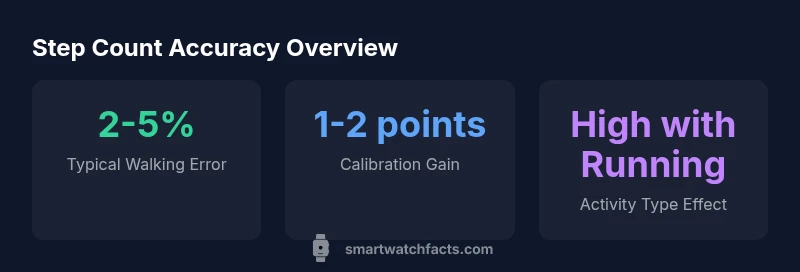
Step counting is robust for slow, regular walking but becomes less predictable as activity complexity rises. For steady walking at a comfortable pace, you’ll typically see a stable step count with low variance across similar routes. Once you jog or sprint, the detection threshold may shift, and the device can undercount or overcount steps depending on how the wrist moves. Stair climbing introduces a distinct motion pattern that some algorithms classify as steps differently, potentially inflating counts if the wearer uses a lot of arm sway.
Non-walking activities, like cycling or driving, tend to produce more idle wrist motion that devices must filter out. If you frequently use a stationary bike with a fixed arm position, some watches may undercount steps because there’s limited wrist motion. Conversely, activities that involve vigorous arm movements—like sweeping or playing with a child—can cause step counts to spike higher than actual steps taken. The degree of variance across devices varies by algorithm design and sensor fusion strategies.
In practical terms, expect lower error during straightforward walking and higher discrepancy during running or non-walking tasks. If you rely on steps to gauge daily activity, combine counts with time in movement, heart rate zones, and GPS-derived distance for a fuller picture. Regular cross-checks with a known-distance walk can help you gauge any drift specific to your device.
Practical Tips to Improve Accuracy
Improve accuracy with a few practical steps you can implement today:
- Wear the watch snugly on the top of the wrist and ensure it sits flat—avoid loose bands that allow the device to slide.
- Calibrate stride length if your device supports it. Perform a test walk of a known distance to set a baseline.
- Keep firmware updated. Manufacturers often refine motion algorithms to reduce false positives and improve noise handling.
- Use the watch consistently on the same wrist and arm; switching arms can introduce a temporary reading shift.
- Review settings for activity detection and ensure you’re using the pedometer mode best suited for daily activities rather than sport-specific modes that may bias readings.
- Periodically test accuracy by walking a measured distance and comparing the device readout to the known distance; note any consistent drift, then recalibrate if available.
These steps don’t guarantee lab-perfect precision, but they significantly reduce day-to-day variability and help align step counts with actual activity. Smartwatch Facts Analysis, 2026 notes that small, consistent changes in wear approach can yield meaningful improvements over time.
Manufacturer Claims vs Real-World Performance
Brand marketing often promises “industry-leading accuracy,” but real-world performance can vary notably across models and generations. Independent testing tends to reveal a spectrum: some watches perform reliably for routine walking, while others display jumpy readings during irregular motions or high-intensity workouts. The Smartwatch Facts Team advocates looking beyond marketing claims to assess consistency across multiple use-cases, including different gait speeds, arm swings, and daily activities.
To gauge reliability, consider long-term wear studies or independent reviews that expose devices to real-life scenarios: commuting, shopping trips, and workouts. It’s also useful to review how consistently a device maintains accuracy when worn on different wrists or under varying strap tensions. This broader view helps shoppers avoid overemphasizing peak performance in lab-like tests and instead focus on steady, repeatable results in everyday life.
In short, the best device for accurate step counting is the one that remains reliable across your typical activities, not just during a controlled 1-km walk. The Smartwatch Facts team emphasizes practical validation through real-world testing and user feedback rather than relying solely on spec sheets.
What to Look For When Buying
If accurate step counting is a priority, prioritize watches that demonstrate consistent real-world performance across several use cases. Look for the following features:
- Transparent testing data: independent reviews or official test protocols that cover walking, running, and non-walking activities.
- Sensor quality and fusion: devices that combine accelerometer data with gyroscope or other sensors may provide more robust discrimination between steps and non-step motion.
- Calibratable stride length: options to calibrate stride, either automatically or manually, to improve distance estimates.
- Firmware support: ongoing updates that refine motion algorithms and reduce drift.
- User-wriendliness and consistency: a device that behaves predictably across daily wear, including during sleep and rest periods.
Additionally, consider how you plan to use step data. If you use it for fitness tracking, daily totals, and trend analysis, prioritize long-term stability and repeatability. If distance is essential, ensure stride calibration is feasible and accurate. By keeping these criteria in mind, you can select a smartwatch that aligns with your activity profile and measurement expectations.