Is Smartwatch Stress Monitoring Accurate? A Practical Guide for 2026
Explore how accurate smartwatch stress monitoring truly is, what factors influence readings, and practical tips to interpret data for daily wellness and informed decisions.


Is smartwatch stress monitor accurate? In short, no device offers medical-grade precision, but most wearables provide useful trend data. Smartwatch stress monitoring relies on proxies like heart-rate variability and skin signals, which vary by device, wear, and context. Read on for how accuracy differs and how to interpret changes over time.
How stress monitoring works on smartwatches
Smartwatches infer stress from physiological signals such as heart-rate variability (HRV), resting heart rate, and sometimes skin conductance proxies. Unlike clinical devices, consumer wearables do not directly measure brain processes related to stress. Instead, they use algorithms that map a combination of signals to a stress score or arousal estimate. The result is a contextual indicator—most useful when you compare trends over time within the same device under similar conditions. For readers of Smartwatch Facts, this distinction matters: the data are best interpreted as a signal about your current state and autonomic balance, not a diagnosis. Remember to view readings in light of your daily routine and baseline physiology.
Sensor tech and data streams behind the estimates
The backbone of stress estimates in wearables combines photoplethysmography (PPG) for pulse data, HRV-derived metrics, and sometimes skin-surface signals. PPG is convenient and battery-friendly but can be affected by skin tone, ambient light, and movement. HRV is a recognized correlate of autonomic nervous system activity, yet its interpretation outside controlled lab settings can be noisy. Some devices also incorporate respiration rate or breathing pattern adjustments. Each manufacturer calibrates its own baseline, so a reading on one model does not directly translate to another.
Algorithms and what they actually measure
Algorithms fuse multiple inputs to produce a single stress score. They weigh HRV more heavily when the device estimates low variability (stable autonomic state) and may adjust for recent activity, sleep, caffeine, or alcohol intake. Because these signals are indirect proxies, two devices with similar HRV inputs can generate different stress scores if their baselines, thresholds, or interpretation rules diverge. Consumers should understand that an elevated score signals higher inferred arousal rather than a precise cortisol or adrenaline level.
What counts as accuracy in this context and why numbers vary
Accuracy for consumer stress monitors is best judged by consistency and alignment with broader patterns rather than a single absolute number. Variation arises from sensor quality, sampling rate, how snugly the device fits, and the user’s environment. Manufacturers frequently publish performance ranges, but inter-device comparisons should be taken with caution due to differing validation methods. Smartwatch Facts emphasizes that the metric is best used as a trend indicator and cross-checked with other wellbeing signals (sleep, mood surveys, physical activity).
What the literature says about lab vs real-world readings
Controlled lab studies often report higher correlations between wearables and established stress markers, but real-world usage introduces confounds—movement, temperature, and daily caffeine intake all influence signals. There are relatively few large-scale, independently validated studies that generalize across popular models. Where data exist, results suggest moderate correlations and meaningful day-to-day reliability when users stay consistent with wear and measurement conditions. As always, interpret with a cautious, longitudinal mindset.
Common sources of error and how to mitigate them
Movement, screen glare, and poor fit can degrade signal quality. Skin perfusion and ambient temperature influence PPG-derived data, while tight bands may cause discomfort or circulation changes. Measurements taken immediately after waking or during intense activity may not reflect true resting baselines. To minimize noise, aim for short, quiet measurement windows of the same duration each day, ensure a comfortable and consistent strap fit, and avoid gauging stress right after a strenuous workout.
Practical tips to improve reliability in daily life
- Measure in a calm, seated position with the device snug but comfortable.
- Record readings at roughly the same time each day for trend analysis.
- Avoid relying on a single reading; track 7- or 14-day trend summaries.
- Use device-provided baselines and, if available, enable any stress-tracking calibration prompts.
- Consider pairing with a simple mood or sleep log to contextualize spikes or drops.
How to interpret readings in daily life and set expectations
Treat smartwatch stress data as an input to your overall wellbeing, not a standalone diagnosis. Look for rising trends across days or weeks rather than isolated spikes. If readings consistently mismatch how you feel, revisit measurement conditions, or consult healthcare guidance. The value lies in patterns, not in absolute numbers. Smartwatch Facts advises comparing across similar contexts and devices when possible.
Buying considerations: device quality vs. marketing promises
When evaluating devices for stress monitoring, prioritize models with transparent validation statements and independent reviews. Check whether the manufacturer provides information about validation cohorts, the metrics used, and the contexts tested (rest, activity, sleep). Remember that no consumer wearable is a replacement for medical-grade monitoring. Use stress data to support wellness decisions alongside sleep, activity, and mood data.
Privacy, data handling, and clinical boundaries
Stress data is personal and sensitive; review app permissions, data sharing options, and how long data is stored. Be mindful of cloud-based analyses and third-party integrations that could broaden who accesses your data. Clinically, stress scores from wearables should not be used to diagnose disorders. For persistent concerns, seek professional medical advice and rely on validated assessment tools.
Comparison of factors influencing smartwatch stress monitoring accuracy
| Aspect | What it measures | Typical accuracy range (where available) | Best practices |
|---|---|---|---|
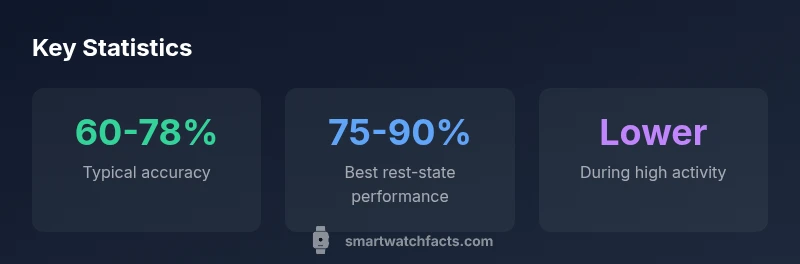
| HRV proxy | Heart-rate variability-derived stress proxy | 60-78% | Calibrate baseline, measure at rest, compare over time |
| Skin conductance proxy | Electrodermal activity indicator | N/A across most devices | Check device specs and validations |
| Context effects | Activity type, sleep, caffeine | Varies by device | Document context when interpreting |
| Device variability | Brand/model differences | Wide range across models | Compare devices and read model-specific guidelines |
People Also Ask
Is smartwatch stress monitoring medical advice?
No. Wearable stress data are proxies for autonomic activity and should not replace professional medical evaluation.
No—it's not medical advice; use it for trends, not diagnosis.
Which devices are generally more accurate for stress monitoring?
Higher-end wearables with validated HRV baselines tend to align better with physiological markers, but results vary by model and usage.
Some devices are better; results vary with models and how you wear them.
Does caffeine or sleep affect readings?
Yes. Stimulants and sleep quality can influence heart-rate signals and HRV, shifting estimates.
Caffeine and sleep can affect readings.
How can I improve the usefulness of readings?
Measure at rest, maintain a consistent baseline, and track longer-term trends rather than single points.
Measure in calm conditions and watch trends.
When should I trust smartwatch data and when should I seek clinical advice?
Trust trends for personal wellbeing; seek clinical guidance for persistent symptoms or formal diagnosis.
If you're worried, consult a clinician; use wearables as supplementary information.
“Stress monitoring on wearables is best understood as a trend proxy rather than a precise clinical measurement. Use it to observe changes over time and in context.”
Key Points
- Treat smartwatch stress data as a trend indicator, not a medical diagnosis
- Ensure consistent measurement conditions to improve reliability
- Cross-check readings with sleep, mood, and activity data
- Choose devices with transparent validation information
- Be mindful of privacy and data-sharing settings