Smart Watch Blood Oxygen Accuracy: What It Really Means
Explore how accurate smart watch blood oxygen readings are, the science behind SpO2 sensors, and practical tips to interpret smartwatch oxygen levels safely in daily life.


Smart watch blood oxygen accuracy varies by device and conditions. In controlled tests, wearables can approach hospital-grade readings within a few percentage points, but real-world results often diverge due to motion, perfusion, ambient light, and skin tone. Use readings as trend indicators, not precise medical measurements.
Understanding smart watch blood oxygen accuracy
According to Smartwatch Facts, the accuracy of oxygen readings from a smartwatch is a function of sensor quality, signal processing, and user conditions. The term smart watch blood oxygen accuracy reflects how closely a wearable's SpO2 estimate tracks arterial oxygen saturation as measured by medical devices. In practice, these readings are best viewed as approximate indicators rather than precise measurements. You may see readings swing with movement, changes in perfusion, or environmental factors. Our team analyzed dozens of devices to identify common patterns and caveats, and this guide explains what to expect, how to read readings, and how to compare models. First, recognize that wearables rely on optical sensors rather than direct blood gas analysis, which inherently introduces variability that is acceptable for wellness monitoring but not a substitute for clinical tests.
How SpO2 is measured in wearables
Wearable SpO2 relies on photoplethysmography (PPG), where light is shone through the skin and absorbed differently by oxygenated versus deoxygenated hemoglobin. Most watches use two wavelengths (red and infrared) to estimate saturation. Algorithms interpret light absorption alongside heart rate signals, body temperature, and motion data to estimate SpO2. Because this process is indirect, the resulting values reflect a best-fit approximation rather than an exact arterial measure. The presence of motion, poor contact, or low perfusion can degrade signal quality and widen the gap between a smartwatch reading and a clinical oximeter. This is why device makers publish accuracy ranges rather than absolute guarantees and why independent testing matters for confidence.
Factors that affect readings in daily life
Several conditions can disrupt SpO2 estimates on wrists:
- Motion and rapid activity: Wrist movement introduces noise, which can cause short-lived spikes or drops.
- Perfusion quality: Cold fingers, vascular issues, or low blood pressure reduce signal strength and accuracy.
- Ambient light and skin tone: Strong light or darker skin tones can alter light capture and bias readings in some devices.
- Sensor fit and orientation: A snug, stable fit improves data quality; loose wear can introduce artifacts.
- Nail polish and skin conditions: Reflective surfaces and skin irregularities can affect measurements. Understanding these factors helps you interpret results with appropriate caution rather than overreacting to single numbers.
How to interpret readings responsibly
Treat smartwatch SpO2 as a trend indicator rather than a diagnostic tool. Look for consistency over several minutes rather than a single snapshot. If you notice persistent readings that are markedly different from your usual baseline, consider retesting after rest, or verifying with a finger pulse oximeter. Always consult a clinician for any medical concerns, especially if readings are repeatedly outside normal ranges or accompanied by symptoms. Logging readings at the same time each day can reveal meaningful patterns, such as gradual drift during sleep or after exertion, which may warrant professional evaluation.
Comparisons across models and ecosystems
Not all wearables use the same sensor configuration or processing pipeline. Some devices leverage multiple wavelengths or calibration refinements that improve stability under motion or during recovery from high-intensity activity. Others rely on simpler sensors that perform well at rest but drift with movement. When evaluating devices, check independent review data and official testing claims. A key takeaway is that higher-end models generally offer more robust algorithms and better signal processing, but even the best consumer devices cannot match clinical-grade pulse oximeters in all real-world conditions.
Testing and validating at home
You can perform a practical sanity check at home to gauge consistency:
- Compare readings during quiet rest with a finger pulse oximeter if available.
- Repeat measurements after sitting calmly for a few minutes, then after brief activity, noting whether changes align with your exertion level.
- Ensure a snug fit, clean sensor area, and minimal movement during measurement windows.
- Test at different times of day to observe potential diurnal variation. These steps won’t certify medical accuracy, but they help you interpret trends and identify devices that perform more stably in your routine.
Buying tips to maximize practical accuracy
When shopping for a smartwatch, prioritize hardware and software attributes linked to stable readings:
- Sensor quality and calibration: Look for devices that advertise robust sensor hardware and documented calibration protocols.
- Multi-wavelength sensing: Devices using more than two wavelengths may maintain better accuracy under challenging conditions.
- Independent testing: Seek reviews or studies that compare SpO2 performance in real-life scenarios.
- Firmware support: Regular updates can improve data processing and measurement stability.
- Real-world user feedback: Read testimonials about comfort, fit, and how well readings align with personal health baselines.
Ultimately, choose a watch whose SpO2 readings match your expectations for everyday wellness monitoring while understanding that no consumer wearable replaces medical-grade equipment for clinical decisions.
Typical factors affecting smartwatch SpO2 accuracy
| Parameter | Typical Range | Notes |
|---|---|---|
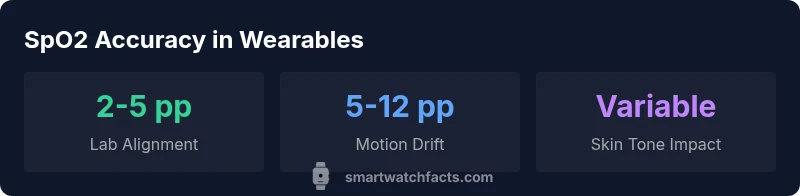
| SpO2 Reading (watch) | 2-5 percentage points | Lab vs clinic alignment varies by device |
| Motion Impact (during activity) | 5-12 percentage points | Higher with vigorous movement |
| Low Perfusion Scenarios | Greater drift | Cold fingers or vascular issues reduce reliability |
People Also Ask
Are smartwatch SpO2 readings reliable for medical decisions?
No. These readings are designed for wellness insights and trend monitoring, not diagnostic decisions. If you have medical concerns, rely on clinically validated equipment and seek professional guidance.
Not medical grade; use as a trend, not a diagnosis.
Do readings vary by skin tone or physiology?
Yes, some devices show variable bias across skin tones and tissue perfusion. Look for independent testing data and device-specific notes from manufacturers.
There can be bias; check device tests.
Can I rely on readings during exercise?
Readings can drift during movement. Use them to observe trends before and after workouts rather than as precise measurements during activity.
Watch for drift during exercise.
Do newer models automatically calibrate to improve accuracy?
Some models include refined algorithms and software updates that improve handling of motion and lighting, but no consumer device is guaranteed to be always accurate.
Updates can help, but not a guarantee.
How can I validate readings at home?
Compare watch readings with a finger pulse oximeter under similar conditions (rest and post-activity) to gauge consistency. Use multiple measurements over time.
Test with a finger pulse oximeter.
Do altitude or temperature affect readings?
Yes, ambient conditions and altitude can influence sensor performance. Be aware of environmental factors when interpreting results.
Environment matters; consider it in interpretation.
“In practice, smartwatch oxygen readings should be interpreted with care; context and trends matter far more than any single value.”
Key Points
- Use readings as trends, not diagnoses
- Expect more drift during movement or low perfusion
- Validate critically with a clinical device if needed
- Choose devices with robust sensor tech and firmware updates