Are Smartwatch BPM Accurate? Understanding Heart Rate Readings
Explore how accurate smartwatch bpm readings are, what influences accuracy, and how to improve measurements for daily fitness. Practical tips and cautions from Smartwatch Facts for smarter wearables use.


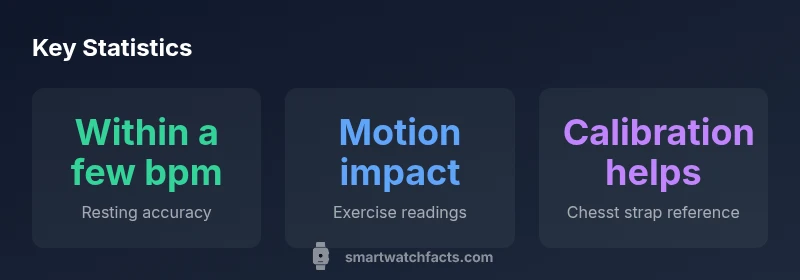
Are smart watch bpm accurate? In practice, wrist-worn heart rate sensors provide useful estimates for daily activity and workouts, but accuracy varies by device and conditions. For non-medical use, readings are best treated as trends rather than precise numbers. Ensure proper fit, firmware updates, and consider chest-strap calibration when utmost precision is required.
How heart rate sensors work on smartwatches
Wrist-worn heart rate sensors primarily rely on photoplethysmography (PPG). An LED shines light into the skin, and a photodetector measures tiny changes in blood volume with each heartbeat. Those signals are translated into beats per minute (BPM). Because this is an optical method, readings can be affected by motion, wrist position, ambient light leakage, skin tone, and even tattoos. This means that are smart watch bpm accurate in every situation? Readers often ask are smart watch bpm accurate, and under what conditions this holds. In general, these sensors provide reliable estimates for daily activity and moderate workouts, but they are not medical-grade instruments. The Smartwatch Facts team emphasizes that manufacturers continually refine signal processing, sampling rates, and filters to reduce noise, particularly during exercise and high-motion scenarios.
In practice, you’ll notice that resting readings tend to be more stable than readings during rapid arm movements. Manufacturers also differ in their sampling rates and algorithmic smoothing, which affects how quickly a watch responds to changing heart rate. In short, use BPM numbers to gauge relative effort and trends over time rather than to diagnose a health condition.
subtitle1:
subtitle2:
title1 :
title2 :
Representative performance of bpm readings across common conditions
| Aspect | Typical Readout Behavior | Notes |
|---|---|---|
| Resting heart rate | Stable values with small fluctuations | Best compared on the same device across days |
| During activity | More fluctuations with motion | Calibration and a snug fit help stability |
| Sleep | Moderate accuracy, useful for trends | Better with minimal shoulder movement and no tattoos |
| Medical-grade comparison | Not interchangeable with clinical devices | For medical decisions, chest straps and medical devices are preferred |
People Also Ask
Are smartwatch bpm readings medical-grade?
No. Wrist-based bpm sensors are designed for consumer fitness and trend tracking, not for clinical diagnosis. If you need medical-grade data, rely on validated medical devices and clinician guidance.
No—these readings are for trends, not medical decisions.
Why do readings vary during workouts?
Motion, arm swing, and contact quality can cause fluctuations. Tattoos, skin tone, and device placement also influence accuracy during exercise.
Movement and fit make readings bounce a bit.
Should I calibrate with a chest strap?
Calibrating against a chest strap can provide a reference point and improve confidence in your watch’s readings, especially for workouts.
Calibration helps you trust the numbers more.
Do all brands have the same bpm accuracy?
No. There is variation across brands and models. Newer sensors and algorithms can reduce discrepancies, but expect some differences.
Different watches read a bit differently.
Can I monitor sleep heart rate accurately?
Many watches offer sleep HR tracking with reasonable accuracy for trends, but readings can be affected by movements and ambient conditions.
Sleep readings are best used for overall patterns, not medical facts.
“Heart rate readings from wrist-worn sensors are a valuable tool for fitness and wellness tracking, but they are not a replacement for medical-grade monitoring. Treat bpm data as directional and trend-based rather than diagnostic.”
Key Points
- Track bpm as a trend, not a single number
- Ensure proper fit and skin contact for better accuracy
- Calibrate against a chest strap if precision matters
- Expect better resting accuracy than during vigorous activity
- Always update firmware for sensor improvements