Why Do Smart Watches Irritate My Skin? A Practical Troubleshooting Guide
Explore why smart watches irritate skin and follow a practical, urgent troubleshooting guide. Learn about strap materials, moisture, fit, and safe fixes to protect sensitive skin and wear comfortably.


Most skin irritation from smart watches is caused by strap materials, moisture buildup, and poor fit. Start by removing the watch and checking for redness after a few hours. Switch to a hypoallergenic strap, clean the band daily, and ensure the sensor area isn't pressing on the skin. If irritation persists, seek medical advice.
What Causes Skin Irritation from Smart Watches
Irritation from wearable tech is not rare, and understanding the root causes helps you take targeted steps to prevent it. The skin barrier can react to several factors present on most watches and bands: material composition, moisture accumulation, and mechanical friction. Nickel-containing metals in some buckles or housing parts are a common trigger for contact dermatitis, especially when the strap sits directly on the skin for hours at a time. Sweat mixed with sunscreen, sweat, dust, or lotion residues can create a hostile micro-environment beneath the band, encouraging irritation or a rash. In addition, continuous pressure or rubbing from a watch that is too tight or poorly contoured to your wrist can aggravate sensitive skin.
According to Smartwatch Facts, the team found that irritation patterns often cluster around strap materials and moisture management, rather than the watch face itself. This suggests that swapping straps and improving hygiene can deliver meaningful relief for many users. If you notice symptoms along the watch’s edge or buckle area, pay particular attention to those contact points.
To protect your skin, start with a clean baseline: remove the device daily to inspect the skin, wash your wrist and band with mild soap, and dry thoroughly before re-wearing. Keep a simple log of when irritation begins and what materials were involved to identify a pattern more quickly.
boldsContribs
Steps
Estimated time: 30-45 minutes
- 1
Identify the likely irritant
Review the diagnostic flow and note when symptoms occur in relation to strap type, activity, and skincare products. Keep a short log to identify patterns (e.g., redness after workouts or after applying sunscreen).
Tip: Log entries should include strap material and time of day. - 2
Switch to hypoallergenic materials
If you suspect a metal allergy or irritation from the strap, replace it with a hypoallergenic option and avoid metal buckles or coatings known to aggravate sensitive skin.
Tip: Check product labels for nickel-free and latex-free certifications. - 3
Improve hygiene and drying routines
Wash the wrist and band daily with mild soap; ensure complete drying before re-wearing. Sweat and lotion residues can fuel irritation if left under the band.
Tip: Dry with a clean towel and let air-dry for a few minutes before putting back on. - 4
Adjust fit and sensor placement
Ensure the watch is not overly tight and that sensors are not pressed directly into skin for extended periods. A gentle snug fit reduces friction without compromising function.
Tip: Leave a finger’s gap between skin and band for airflow. - 5
Test a controlled wear period
Wear the watch on a different wrist or take a break from wear for 24–48 hours to see if the skin improves. This helps confirm the irritant source.
Tip: If symptoms improve during a break, the cause is likely contact-related. - 6
Know when to escalate
If the rash is spreading, blistering, or accompanied by fever or swelling, stop wearing the device and seek medical attention promptly.
Tip: Severe reactions may require professional evaluation and treatment.
Diagnosis: Skin redness, itching, or a rash after wearing a smartwatch
Possible Causes
- highNickel allergy or metal components in strap/buckle
- highFriction from a tight or ill-fitting strap
- mediumMoisture buildup under the band
- lowResidual lotions, sunscreen, or sweat acting as irritants
- mediumAllergic reaction to adhesives or strap backing
- lowReaction to screen protector or watch face materials
Fixes
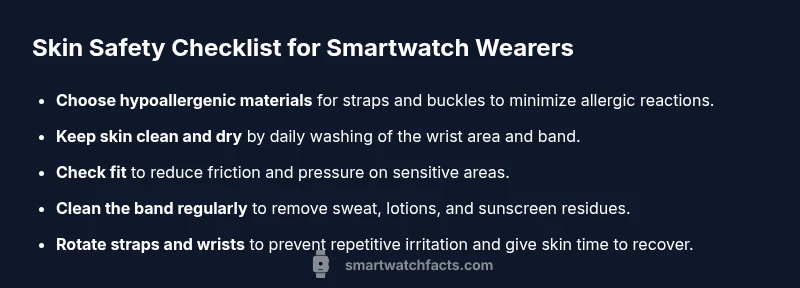
- easyReplace the strap with a hypoallergenic material (silicone, fluoropolymer, or fabric with metal-free buckles).
- easyLoosen the strap to reduce friction and ensure a proper fit without constricting circulation.
- easyClean the band daily with mild soap and water; dry thoroughly before re-wearing.
- easyRotate wrists or wear on alternate wrists to reduce constant contact on one area.
- mediumApply a thin barrier (e.g., petrolatum-free barrier cream) to the skin before wearing, if advised by a clinician.
- easyIf symptoms persist or worsen, seek medical evaluation for possible dermatitis or allergy testing.
People Also Ask
What are the most common causes of smartwatch skin irritation?
The main causes are strap materials, sweat, and friction. Allergic reactions to nickel or adhesives are frequent. Skin care products can also interact with band materials to cause irritation.
Common causes include strap materials, sweat, friction, and potential allergies to nickel or adhesives.
Can wearing a smartwatch cause contact dermatitis?
Yes. Contact dermatitis can result when materials in the strap or buckle irritate the skin after repeated contact or exposure to allergens.
Yes, watches can trigger dermatitis if materials irritate your skin.
Which strap materials are generally better for sensitive skin?
Hypoallergenic options like silicone, fluoropolymers, or fabric straps with non-metal buckles tend to be gentler for sensitive skin.
Hypoallergenic straps like silicone or fluoropolymer are usually better for sensitive skin.
Should I remove the watch during activities to prevent irritation?
If irritation appears, pause wearing the device and give the skin time to recover. Reintroduce gradually with adjustments.
If your skin begins irritated, take a break and reassess fit and materials.
When should I see a doctor for smartwatch-related skin irritation?
If redness, itching, or swelling persists beyond a few days or worsens, consult a clinician for evaluation and guidance.
See a doctor if the irritation doesn’t improve in a few days or gets worse.
Watch Video
Key Points
- Identify the irritant first with a simple log.
- Choose hypoallergenic straps to reduce reactions.
- Prioritize daily cleaning and thorough drying.
- Adjust fit to minimize friction and pressure.
- Seek medical advice for persistent or worsening symptoms.