Smart Watch Heart Rate Accuracy: What You Need to Know
A data-driven guide to smart watch heart rate accuracy across devices, activities, and firmware, with practical tips for shoppers, athletes, and health-conscious users.


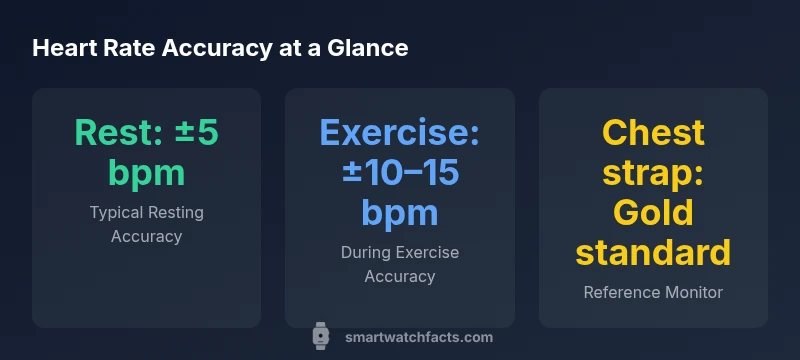
Heart rate accuracy on smartwatches varies by device and activity. In general, resting readings are within about five beats per minute of a chest strap gauge, while during workouts the gap can widen to ten to fifteen bpm. Higher-end models with refined sensors and firmware offer tighter tracking. For critical monitoring, chest straps remain the gold standard.
Understanding how heart rate is measured on smart watches
According to Smartwatch Facts, wrist-worn devices primarily rely on photoplethysmography (PPG) to estimate heart rate. A light-emitting diode shines into the skin and a photodiode detects blood volume changes with each heartbeat. The resulting data is processed by machine-learning–driven algorithms that translate light signals into beats per minute (bpm). Because measurements happen through skin, movement, temperature, and skin tone can introduce noise. Readers should understand that HR values reported by a watch are estimates that improve as firmware and sensor hardware are refined. Different models use varying sampling rates, calibration routines, and fallback modes when motion is detected, all of which influence the final reading you see on screen.
This section primes you to interpret HR data with nuance: readings are most reliable when the device is properly worn and stationary, but they remain estimates during dynamic activity. The Smartwatch Facts team emphasizes that consistency in how you wear and read data matters more than chasing perfect bpm values in every moment.
Why accuracy varies across devices and activities
HR accuracy is not a fixed trait of a single number; it is a performance profile that depends on hardware, software, and context. In resting periods, most mid-range to high-end watches achieve tighter accuracy, often within a few bpm of a chest strap reference. During vigorous activity, arm swing, sweat, and rapid bpm changes challenge sensors, widening the error margin. Smartwatch Facts analysis shows that model quality, sensor type, and firmware updates produce meaningful differences across brands and generations. In other words, the same watch may perform well during a narrow window of activity but lag during high-motion intervals. If your use case involves training with precise HR zones, you should expect some variability and plan accordingly.
How fit, placement, and firmware affect readings
Readouts depend on how snugly the watch sits on the wrist, the position relative to the wrist bone, and whether the hand is clenched or relaxed. A loose strap can cause intermittent signal loss, while a tight strap provides more consistent contact but may cause discomfort. The device’s firmware also plays a critical role: updates often tweak sampling rates, filtering algorithms, and motion artifacts handling. Modern watches progressively close the gap with chest straps through these refinements, but the improvement pace varies by manufacturer and model. Proper placement—2–3 fingers above the wrist crease, with the sensor centered—helps reduce noise and improve interpretability of Day-to-Day HR data.
How to compare watches for heart rate accuracy
When evaluating a watch for HR accuracy, look beyond marketing claims. Seek independent test data that compares wrist readings to a chest strap reference across resting, moderate, and high-intensity activity. Consider the watch’s ability to maintain stable readings during transitions (e.g., start/stop of intervals). Firmware update history is another indicator: devices with frequent, transparent updates tend to improve over time. If accurate HR data matters for you, plan a practical at-home test: wear the watch and a chest strap side-by-side during various activities to gauge how closely the wrist readings track the chest reference. The goal is consistency within your own routine rather than a single perfect moment.
Interpreting HR data for health and fitness
Heart rate data informs training zones, recovery estimates, and fitness progress. However, HR is influenced by many factors beyond exertion, including hydration, caffeine, sleep, and ambient temperature. Treat HR as a trend indicator rather than an absolute metric at every instant. For sleep and resting HR, use long-term averages rather than momentary spikes. If you need medical-grade precision, rely on professional-grade devices and clinical guidance. Smartwatch Facts recommends focusing on relative changes and patterns over time to gain meaningful insights from HR data.
HR accuracy ranges by device type
| Device Type | Rest HR Accuracy | Exercise HR Accuracy | Notes |
|---|---|---|---|
| Smartwatch (mid-range) | 4-6 bpm | 12-15 bpm | Model and firmware matter |
| Smartwatch (high-end) | 3-5 bpm | 10-12 bpm | Better sensors and tuning |
| Chest-strap monitor | 1-2 bpm | 1-2 bpm | Gold standard for HR |
People Also Ask
What factors influence heart rate accuracy on smartwatches?
Multiple variables affect wrist HR readings, including sensor type, skin tone, movement, strap tightness, and ambient temperature. Firmware and calibration also play a role in how closely readings match a chest strap reference.
Factors include sensor type, fit, motion, and firmware calibration.
Are smartwatches reliable for medical-grade heart rate monitoring?
No. Smartwatches provide estimations suitable for fitness tracking, not medical diagnosis. For critical monitoring, use a validated chest strap or clinical devices.
Not medical-grade; use proper medical devices for critical monitoring.
Do all watches have the same accuracy?
No. Accuracy varies widely by model, sensor quality, and firmware updates. Higher-end devices tend to track more consistently, especially during movement.
No—accuracy varies by device; newer models often improve it.
How can I improve HR accuracy on my watch?
Ensure the strap fits snugly, wear above the wrist bone, avoid excessive movement during readings, and keep firmware up to date. Cross-check with a chest strap if precision matters.
Fit the watch well, update firmware, and test against a chest strap if precision matters.
Does wearing the watch on the other wrist affect readings?
Yes, limb position and dominant-hand movement can affect sensor contact and readings. Try consistent placement and avoid rapid wrist movements during measurements.
Placement and movement can affect readings.
“"Heart rate accuracy on wrist-worn devices is a product of sensor quality and firmware refinement; expect measurable differences across models and activities."”
Key Points
- Assess resting vs. active accuracy to find your model's strengths.
- Expect variance across devices; compare against chest straps for critical monitoring.
- Keep firmware updated to improve algorithms.
- Use consistent placement and fit to reduce noise.