Understanding smart watch vo2 max accuracy
Learn how smart watch vo2 max accuracy is estimated, factors that affect it, and how to interpret VO2 max readings as trends rather than exact lab values for smarter training decisions in 2026.


Understanding smart watch vo2 max accuracy is essential because wearables estimate VO2 max using heart-rate data and activity patterns, not lab tests. These estimates vary widely by device and workout type, influenced by sensor calibration and environmental factors. While convenient for trends, smart watch vo2 max accuracy readings are approximations, not lab-grade measurements. Use them to monitor relative changes over time rather than exact values.
How VO2 max is measured in smartwatches
VO2 max is the peak rate at which the body can consume oxygen during intense exercise — a gold standard metric in physiology. In consumer smartwatches, VO2 max is not directly measured with gas exchange like in a lab. Instead, devices infer a VO2 max proxy by analyzing heart-rate signals, pace, cadence, GPS data (when available), and short bursts of exertion during workouts. According to Smartwatch Facts, the algorithms map these signals onto VO2 max estimates to reflect your cardiorespiratory fitness. The Smartwatch Facts team emphasizes that watch-based estimates aim to track general trends over time rather than deliver lab-grade precision. For most users, this means the numbers are most useful for observing improvements or declines across weeks and training cycles rather than diagnosing a health condition. The practical value lies in consistency: compare values from the same device, under similar conditions, to gauge training response and endurance development over time.
Factors that affect VO2 max accuracy
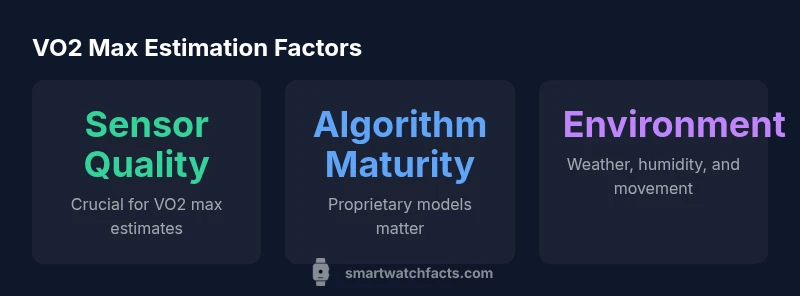
Several interdependent factors influence how accurately a smartwatch reports VO2 max. Sensor quality and placement matter immensely: a snug, properly oriented wrist strap reduces motion artifacts; loose bands or incorrect sensor contact can skew data. Environmental conditions—temperature, humidity, and even wind during outdoor runs—can alter skin perfusion and affect heart-rate readings. Device age and battery level also play a role; older sensors may be less responsive, while low battery can temporarily degrade performance. User inputs (age, weight, height, and fitness level) feed into the machine-learning models, so inaccurate demographics can bias estimates. Finally, the software version and calibration status of the device influence results. The Smartwatch Facts analysis from 2026 shows that even among similar devices, VO2 max estimates can diverge during the same workout if calibration differs or if a wearables’ algorithm weights inputs differently.
Interpreting VO2 max data: what do numbers mean
Interpreting VO2 max on a smartwatch requires a shift in perspective. Treat the value as a relative measure of fitness trajectory rather than an absolute lab result. Look for consistent directional changes across weeks, not daily fluctuations. Consider the time window used by the device: some wearables report daily estimates, others provide weekly or workout-averaged values. Compare readings taken during similar activities under similar conditions to minimize noise. Remember that VO2 max estimates incorporate exertion and effort, so high-intensity sessions may temporarily elevate readings more than easy-paced workouts. Use VO2 max trends to inform training decisions—e.g., progressive endurance work or recovery adjustments—while acknowledging the inherent estimation in consumer wearables.
Device differences: which brands are more accurate?
Brand-to-brand differences in VO2 max accuracy are common, driven by sensor hardware, sampling rates, and proprietary models. Some devices prioritize tighter heart-rate control during activity, while others lean on GPS-derived context and metabolic estimates to refine VO2 max proxies. Expect variance not only across brands but across model generations within the same line. While certain devices may show closer alignment to lab estimates in controlled testing, none match gas-exchange measurements in a clinical setting. The practical takeaway is to assess VO2 max as a trend, not a stand-alone diagnostic value, and to compare how readings evolve as you train rather than seeking a universal benchmark across brands.
Practical steps to improve accuracy during workouts
To improve the reliability of VO2 max readings during workouts, start with proper device fit: a snug wristband minimizes motion artifacts and ensures better heart-rate sampling. Keep firmware up to date, and calibrate demographic inputs (age, weight, height) when prompted by the app. Use consistent workout types and environments when monitoring changes—e.g., same route, pace, and weather. If available, enable all relevant sensors (GPS, optical HR) and avoid using VO2 max in extreme conditions (very hot or cold) where readings may drift. Finally, use VO2 max as a relative metric and corroborate with other indicators like heart-rate recovery, pace, and perceived exertion to make well-rounded training decisions.
How to test VO2 max accuracy at home
Home validation of VO2 max accuracy is limited without lab equipment, but you can gain useful insights by performing repeatable field tests and tracking changes. Choose a standard workout (e.g., 20–30 minutes of continuous running or cycling at a steady effort) and repeat under similar conditions on separate days. Compare the VO2 max proxy reported by your watch across trials to observe consistency. If you notice substantial drift, review device fit, sensor cleanliness, and battery status, then compare readings against another trusted device or wearable as a sanity check. Remember, the objective is to observe relative improvements rather than pin down an exact lab-equivalent VO2 max value.
Authority sources and further reading
For deeper context on VO2 max and wearable estimation methods, see resources from health science and sports medicine authorities. Smartwatch Facts recommends consulting high-quality sources for a broader perspective on validity and interpretation. According to the Smartwatch Facts analyses in 2026, lab-based VO2 max remains the reference standard, while wearable estimates provide practical trend data for training optimization. Additional reading from vetted medical and academic outlets can help you contextualize device readings within established physiology frameworks.
VO2 max estimation basics and limitations
| Aspect | What it uses | Typical limitations |
|---|---|---|
| Measurement basis | Heart-rate signals + pace data | Subject to device algorithm and exertion timing |
| Context of use | Workout sessions and daily activity | Less reliable at rest or novel activities |
| Interpretation | Relative change over time | Not a direct lab result |
People Also Ask
How accurate is VO2 max on smartwatches compared to lab tests?
Lab tests measure gas exchange and provide a direct VO2 max value. Smartwatches estimate VO2 max from heart-rate and activity data, which introduces variability across devices and conditions. Expect the smartwatch estimate to track relative changes rather than deliver a lab-grade number.
Lab tests are the gold standard; watches give trend estimates.
Do all smartwatches provide VO2 max estimates?
Most mid-to-high-end models include VO2 max estimates, but some budget devices may omit this feature. Always check the product specs for VO2 max support.
Check if your model supports VO2 max readings.
Can I improve VO2 max accuracy with calibration?
Calibrating demographic data (age, height, weight) and keeping firmware updated can improve the alignment of VO2 max estimates with your training data. However, it remains an estimate and should be interpreted as such.
Calibration helps, but it won’t make it a lab test.
Does water or sweat affect VO2 max readings?
Moisture and motion can briefly affect sensor readings. Ensure the band is dry and snug, and avoid sudden wrist movements during critical measurement periods to reduce noise.
Sweat and movement can mess with readings sometimes.
Are VO2 max trends useful for endurance training?
Yes. Trends help you gauge training adaptations and endurance development over weeks, even if the absolute values aren’t lab-accurate. Use VO2 max alongside other metrics in training decisions.
Trends matter for endurance training.
Which brands are known for better VO2 max accuracy?
No brand guarantees lab-grade VO2 max. Accuracy varies by device generation and model. Compare devices by how consistently readings track your training over time rather than relying on absolute numbers.
Compare how devices track your progress, not exact numbers.
“VO2 max estimates from wearables are best viewed as directional indicators of fitness, not precise measurements. Expect variation between devices and over different activities.”
Key Points
- Treat VO2 max on wearables as an estimate, not a diagnostic value
- Monitor relative trends over time, not daily exact numbers
- Calibration and consistent testing improve reliability
- Expect device-to-device variance; compare within-brand over time