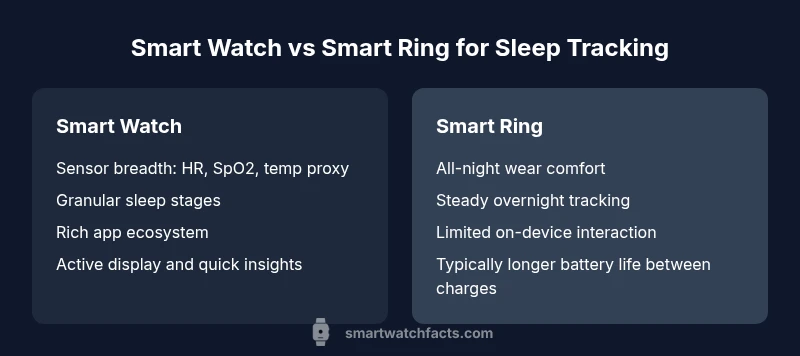
Smart Watch vs Smart Ring for Sleep Tracking: A Practical Comparison
A practical, analytical comparison of smart watches and smart rings for sleep tracking, covering accuracy, comfort, battery life, setup, and when to choose each option.


For sleep tracking, smart watches generally offer broader sensing, longer battery life, and richer app ecosystems, but smart rings excel in comfort and passive overnight tracking. If you prioritize continuous data over the night and want more features, the watch is often better. If you want a discreet device that you barely notice, the ring can deliver similar sleep-stage insights with less fuss.
Sleep-tracking technology in wearables
Sleep tracking combines sensor data with software to estimate when you fall asleep, how long you stay asleep, and how restful your night is. In wearables, two core sensors are most common: accelerometers that measure movement, and photoplethysmography (PPG) sensors that estimate heart rate. Some devices also track skin temperature proxies or oxygen saturation (SpO2) to refine sleep stages. The Smartwatch Facts team notes that sensor fidelity and data processing algorithms strongly influence accuracy, which is why two devices can disagree on the same night. When you consider the keyword smart watch vs smart ring for sleep tracking, you should expect both devices to provide general sleep duration and nocturnal awakenings, with watches often offering more granular sleep-stage estimates and rings leaning toward comfort and overnight wear.
How sleep tracking differs on a watch vs ring
The central difference is placement and hardware emphasis. A watch sits on your wrist and has easy access to a rich sensor suite, including heart rate, skin temperature proxies, and sometimes SpO2. A ring sits on a finger and tends to minimize motion artifacts during the night, sometimes trading off on certain sensors or screen-based features. Both devices rely heavily on accelerometry to infer movement, but the watch's heavier data pipeline and app ecosystem often yield more granular sleep-stage estimates. When comparing smart watch vs smart ring for sleep tracking, consider which data points matter most to you: bedtime consistency, awakenings, or sleep-stage distribution.
Comfort, wearability, and nightly usage
Comfort matters for overnight wear. Rings are typically lighter, less noticeable, and less prone to snag on bedding. Watches, even slim models, can feel bulky after a long night. For lasting night-time wear, both form factors work, but the ring's minimal footprint can encourage consistent wearing, reducing data gaps caused by device removal. In practical terms, choose based on how you sleep: if you toss and turn, a comfortable ring may stay on your finger; if you want quick, glanceable insights in the morning, a watch's display can be handy.
Battery life and charging habits
Battery life expectations differ between form factors. Watches typically require more frequent charging because they perform more tasks and run power-hungry displays and, in some cases, GPS. Rings generally last longer per charge because they perform fewer screen-based tasks and rely on the phone or cloud for heavy processing. The practical impact is straightforward: if you travel often or have irregular charging habits, a ring might deliver more reliable overnight wear. If you want more on-device analytics and reminders, the watch is the stronger companion, with charging scheduled around daily routines.
Sleep stage accuracy and data interpretation
No device is perfect at sleep-stage classification, and differences exist between platforms. Watches often provide more granular staging (light, deep, REM) thanks to combined heart-rate, HRV, and movement data, but ring-based systems can converge on similar results with strong correlation in many users. A common caveat is algorithm transparency: brands guard proprietary methods, so two devices may disagree on the same night. The practical takeaway is to treat sleep-stage percentages as directional indicators rather than precise percentages, and to use trends across weeks rather than a single night to gauge improvements.
Health insights beyond sleep: stress, recovery, and daily patterns
Sleep data feeds broader wellness insights. Many devices connect sleep metrics to stress scores, recovery balance, and training readiness. A watch may push more integrated health data through a single app; a ring might emphasize consistent overnight metrics with simpler insights. Over time, patterns—rather than isolated nights—provide more value. Look for features like recovery scoring, heart-rate variability trends, and resting heart rate baselines to understand how your sleep relates to daily performance and mood.
Setup, syncing, and ecosystem considerations
Alignment with your phone and ecosystem matters. If you own an iPhone, some watch-based platforms offer tighter iOS integration, while Android devices might favor ring ecosystems with strong cloud support. Look for automatic sleep-wake logging, bedtime reminders, and easy data export to health apps. Cross-platform sync can be convenient if you switch devices, but some brands perform best within a single software stack. Decide whether cross-device continuity or a focused, brand-specific experience better suits your needs.
Practical buying scenarios: who should choose what?
If you want the most feature-rich sleep analytics and a broad health dashboard, a modern smartwatch is often the best fit. If you prefer a minimal, comfortable wear that you can forget about at night, a smart ring can deliver reliable sleep data with less disruption. For households with multiple users, consider whether shared apps and data sharing fit your routines, and whether you need family plans or device-level controls. In practice, many sleepers benefit from a hybrid approach: using a watch for daytime health insights and a ring for overnight comfort, or choosing a single device that balances features with wearability.
Common misconceptions and limitations
Many buyers assume rings are as capable as watches for sleep data; in reality, watches usually provide richer context because of larger sensor arrays and a more capable platform. Others worry these devices diagnose medical sleep disorders; they do not—they provide indicators that should prompt professional evaluation when unusual patterns emerge. Battery life, movement artifacts, and skin tone can influence accuracy. Finally, data interpretation depends on the algorithm; two brands may disagree on your sleep stages. Treat these tools as early warning systems rather than medical devices.
Practical tips to improve sleep tracking accuracy
Calibrate for your baseline by wearing the device consistently for at least a week to align with your sleep habits. Maintain a regular bedtime and wake time to improve data coherence. Ensure the device is snug enough to maintain stable sensors without being uncomfortable. Enable relevant features such as SpO2 monitoring, HRV, and temperature proxies if available, and keep firmware updated to benefit from improved algorithms. Finally, avoid toggling modes mid-night, as fluctuations can skew night-long averages.
Budgeting for sleep tracking: subscription vs data ownership
Many platforms offer premium tiers with deeper insights or ad-free experiences. Evaluate whether the extra features justify ongoing costs. For many sleepers, core sleep data is accessible in the free tier; additional data visualization and export options may merit a plan. Regardless of price, prioritize data portability and ownership, making sure you can export or transfer historical data if you switch devices or brands.
Real-world scenarios and user stories
Consider everyday life: a night-shift nurse using a ring for comfort who still checks day-time readiness on a watch; a student who tracks naps and study-related fatigue with a watch; a long-distance runner who values sleep recovery metrics as part of an training plan. Real-world narratives show that these devices complement different lifestyles, and the best choice often comes down to personal comfort, data preferences, and how much you value features over simplicity.
Comparison
| Feature | Smart Watch | Smart Ring |
|---|---|---|
| Sensor Suite | Expansive: HR, SpO2, temp proxy, accelerometer | Compact: HR, accelerometer, ring-specific metrics |
| Comfort & Wearability | Noticeable on the wrist; some models slim | Lightweight and unobtrusive; ideal for all-night wear |
| Sleep Stage Granularity | High granularity with multiple stages | Moderate granularity; strong overnight trends |
| Battery Life & Charging | Typically requires more frequent charging | Longer intervals between charges; discreet charging often possible |
| App Ecosystem & Data Access | Rich health dashboards; export and integrations | Simpler apps; focus on overnight metrics |
| Best For | Power users needing depth and insight | Discreet, comfortable overnight wear |
| Water Resistance | Typically highly water resistant; gym use common | Water resistant; ring care varies by model |
| Cost/Value | Usually higher upfront cost with broader features | Lower up-front cost with fewer sensors |
Strengths
- Both devices provide sleep-tracking data and trends without extra effort
- Watches offer deeper health metrics and real-time insights
- Rings prioritize comfort and continuous overnight wear
- Cross-platform ecosystems enable data export and integration
- With habitual wear, data consistency improves over time
Weaknesses
- Watch wear can be bulky and more noticeable during sleep
- Rings may have limited on-device display and fewer sensors
- Algorithm differences can lead to inconsistent sleep-stage labeling
- Some features require paid subscriptions or specific apps
Smart watch offers richer sleep analytics and broader health insights, making it the better all-around choice; smart ring is best for comfort and discreet overnight wear.
Choose the watch if you want depth and ecosystem integration. If you value unobtrusive wear, the ring is worth considering for overnight sleep tracking.
People Also Ask
What is the main difference between a smart watch and a smart ring for sleep tracking?
The main difference is sensor breadth and user experience. A smartwatch typically offers a richer sensor suite and more on-device features, while a ring emphasizes comfort and uninterrupted overnight wear. Both track sleep duration and cycles, but the watch usually provides deeper analytics and easier data access.
The main difference is breadth of sensors and comfort. The watch gives deeper analytics, while the ring focuses on unobtrusive overnight wear.
Can both devices track sleep stages accurately?
Both can estimate sleep stages using heart rate and movement data, but accuracy varies by brand and algorithm. Watches often provide more granular staging, while rings can reliably track overall sleep quality. Use sleep stages as directional insights rather than precise measurements.
Both estimate stages, but accuracy varies by brand. Use the results as directional trends, not exact percentages.
Is sleep tracking on rings as good as on watches?
Rings are excellent for comfort and overnight consistency, but watches usually offer deeper analytics and more customization options. If data depth is your goal, a watch tends to win; if comfort is paramount, a ring is a strong alternative.
Rings excel in comfort; watches offer deeper data. Choose based on what you value more.
Do I need a subscription to get full sleep insights?
Many platforms offer premium tiers with deeper analytics, but core sleep data is often available in the free tier. Consider whether the added insights, export options, or ad-free experiences justify ongoing costs for your usage pattern.
Premium tiers exist, but core sleep data is usually available for free.
Are these devices good for diagnosing sleep disorders?
No wearable sleep trackers diagnose sleep disorders. They provide indicators and trends that can prompt a professional evaluation if you notice persistent abnormalities or daytime symptoms.
They’re not medical devices; see a doctor if you have persistent sleep concerns.
Which is better for iPhone or Android users?
Both platforms support sleep tracking, but the best experience often depends on the brand’s app ecosystem. Some watches integrate tightly with iOS, while rings may offer platform-agnostic cloud syncing. Check cross-device compatibility before buying.
Platform choice matters; check how the brand supports iOS or Android before buying.
Key Points
- Assess your top priority: depth of data or comfort
- Expect watches to provide broader health context than rings
- Consider your charging habits when choosing between form factors
- Use trends over weeks, not single nights, to judge sleep shifts
- Check app portability and data export options before buying