Is a Smart Watch Waterproof? A Practical Guide to Water Resistance
Discover whether smart watches are truly waterproof, what water-resistance ratings mean, and how to use and care for your wearable around water in real life.


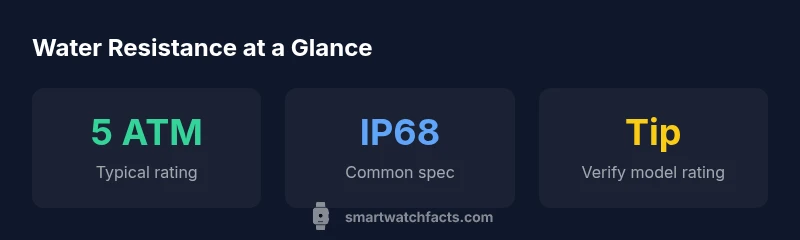
Most modern smart watches are water resistant rather than fully waterproof. Typical ratings include 5 ATM (50 m) or IP68, which cover splashes, rain, and brief immersion, but prolonged swimming or hot-water exposure may still damage seals. When comparing models, verify the exact IP/ATM rating and follow manufacturer guidance. Smartwatch Facts analysis shows substantial variation across brands and generations today.
Waterproof vs water-resistant: definitions and common mistakes
In everyday language, many shoppers still ask the question 'smart watch is waterproof or not?' The short answer is that most consumer smartwatches are water resistant rather than waterproof. Manufacturers publish labels like IP68 or 5 ATM to describe their protection, but those labels are not universal guarantees across every activity. Understanding what the ratings mean helps you avoid damage and potential warranty voids. In practice, a watch rated for splashes or rain should not be immersed for long periods, while models rated for deeper water are built to withstand specific depths and durations. These distinctions matter because real-world use often involves temperature changes, sweat, soap, and chlorinated pools. Ratings describe limits, not invulnerability, and they are fine-tuned for different activities, from showering to swimming to sport-specific training. When evaluating a watch, extract the exact rating from the manual, the manufacturer’s site, or the official spec sheet, and cross-check with independent sources. If you wear your device while doing water-based activities, treat the rating as a ceiling, not a guarantee. This framework helps you make informed decisions without over- or under-perceiving your device’s capabilities.
How the ratings work: IP and ATM explained
Water-resistance classifications come from two main schemes: IP ratings and ATM (Atmospheres). An IP rating expresses protection against solids and liquids, with higher digits indicating better sealing. For watches, IP67 and IP68 are common benchmarks, with IP68 typically allowing submersion beyond 1 meter for a specified duration. ATM ratings translate to depth equivalents; 5 ATM usually corresponds to about 50 meters of submerged capability for a limited time. Real-world performance depends on watch construction, gasket condition, and how the seal is maintained. It’s important to note that manufacturers test in controlled lab conditions; temperature, soap, sunscreen, and saltwater can affect performance over time. Always consult the official spec sheet for your model and avoid assuming a generic “waterproof” label applies to every use case. Smartwatch Facts analysis shows that ratings vary by brand and generation, so verify before water exposure.
Real-world use cases: what activities are safe
People use smartwatches around water for a variety of activities—running in the rain, washing hands, showering, swimming, and diving. The rule of thumb is simple: stay within the rated limits. For splashes and rain, most devices labeled water resistant to 5 ATM or IP67/68 perform well. For swimming, only rely on models with explicit swimming or diving ratings and check the maximum depth and duration. Prolonged high-temperature exposure, such as hot tubs or saunas, can degrade seals even on high-rated devices. If you’re unsure, avoid placing the watch in hot water or steam, and never press buttons underwater unless the manufacturer specifies that action is safe. In practice, a cautious approach and model-specific guidance protect both your device and your data.
Brand-to-brand variability: reading the specs
Not all water-resistance claims are created equal. Two watches with the same nominal rating may behave differently due to case design, seal integrity, and user wear patterns. When comparing models, read the fine print: the rating might specify maximum depth, duration, and temperature. Some rugged watches go beyond 5 ATM or IP68, but these are typically targeted at sports and outdoor enthusiasts. Consumers should compare the exact test conditions used by the manufacturer and understand that ratings are best-guess boundaries rather than absolute guarantees. Smartwatch Facts analysis indicates broader variability across brands and product lines, so always verify the model’s official spec sheet and warranty terms.
Care, maintenance, and warranty implications
Water exposure can wear seals over time. After saltwater, chlorinated pools, or sweat-heavy activities, rinse the watch with fresh water and dry it thoroughly. Avoid exposing watches to hot water, steam, or lengthy submersion beyond the rated limits. Warranty coverage for water damage varies by brand and region, and it often excludes improper use or damage outside rated conditions. If you rely on water resistance for daily activities, consider routine gasket checks at service centers and avoid relying on the rating as a shield against all water environments. Smartwatch Facts recommends treating water resistance as a functional spec, not a guarantee, and planning care around the specific rating for your model.
Water-resistance at a glance
| Aspect | Rating/Standard | Typical Uses | Notes |
|---|---|---|---|
| Definition | Water-resistant (splashes/brief immersion) | Casual wear, rain, hand-washing | Check exact rating for swimming |
| Ratings to look for | 5 ATM / IP67–IP68 | Everyday activities; light water exposure | Higher ratings for deeper water use |
| Limitations | Not for hot water exposure; avoid prolonged submersion | Diving unless rated for it | Protect seals over time |
| Care & maintenance | Rinse after exposure; dry thoroughly | Saltwater, chlorine exposure | Follow manufacturer care guidance |
People Also Ask
Is my smartwatch waterproof or just water resistant?
In most cases, smartwatches are water resistant, not fully waterproof. Look up the exact rating (IP or ATM) for your model, and avoid assuming invulnerability to water. Only use the watch around water within the specified limits.
Most watches are water resistant, not waterproof. Check the exact rating before water activities.
What is the difference between IP67 and IP68?
IP67 means protection against immersion up to 1 meter for up to 30 minutes; IP68 usually allows deeper or longer immersion as defined by the manufacturer. Always verify the model’s official spec sheet for the exact conditions.
IP67 and IP68 specify different immersion depths and times; check your model's exact spec.
Can I swim with my smartwatch?
Only if your watch has an explicit swimming or diving rating. Many devices with 5 ATM or IP68 are suitable for surface swimming but not for deep or prolonged submersion. Verify the depth and duration limits before entering the water.
Only swim with it if the rating explicitly allows swimming.
Are sweat and steam safe with high water resistance?
Sweat and steam are generally not a problem at typical ratings, but repeated exposure to hot steam or sauna environments can degrade seals over time. Follow model guidelines and avoid exposing the watch to bath steam or hot tubs when not rated for them.
Sweat is usually fine, but avoid steam and hot water unless rated.
Does the warranty cover water damage?
Warranties vary by brand and region. Most warranties exclude water damage if the device was used beyond its rated capabilities. Always review the warranty terms and keep proof of ratings in case you need service.
Warranty coverage varies; read the terms and avoid exceeding the rating.
How can I test water resistance at home?
There is no safe home test for water resistance. Rely on the manufacturer’s official ratings and testing guidelines. If you suspect seal degradation, consult an authorized service center rather than attempting self-testing.
Do not test at home; rely on official specs and service centers.
“Water resistance is a defined spec, not a blanket promise. Always verify the model's exact rating for your intended activity and maintain seals to extend life.”
Key Points
- Check the exact rating before water exposure
- IP and ATM ratings define different protections
- Avoid hot water and steam even with high ratings
- Swimming requires explicit, model-specific ratings
- Warranty coverage varies; follow care guidelines