Apple Watch vs Whoop: The Ultimate Smartwatch and Fitness Tracker Showdown
An objective, in-depth comparison of Apple Watch and Whoop, covering features, health metrics, pricing models, ecosystems, and who each device serves best.


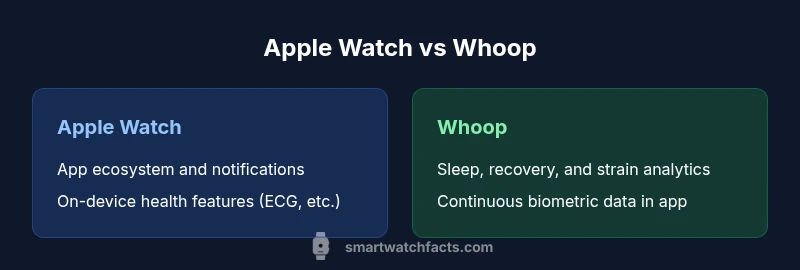
apple smart watch vs whoop: In this head-to-head, Apple Watch dominates as a daily smart device with broad app support and iPhone integration, while Whoop centers on continuous fitness analytics, training load, and recovery without a traditional smartwatch interface. For most users, the choice hinges on whether you want a full-featured wearable or a dedicated training-optimization tool.
Scope and audience in the apple smart watch vs whoop comparison
According to Smartwatch Facts, the apple smart watch vs whoop comparison hinges on two core questions: Do you want a general-purpose wearable that doubles as a digital assistant and phone companion, or do you want a highly focused fitness analytics tool that optimizes training without a traditional watch interface? The Apple Watch excels in everyday usability, third-party app support, and seamless iPhone integration, while Whoop concentrates on continuous biometrics—strain, recovery, and sleep—delivered through a minimal wearable and a subscription-driven data platform. This guide unpacks those differences with an eye toward practical decision-making for shoppers, athletes, and tech enthusiasts alike.
Hardware, software, and ecosystem trade-offs in the apple smart watch vs whoop
The core structural difference is clear: Apple Watch is a full smartwatch with on-device apps, notifications, and optional cellular connectivity; Whoop is a sensor-laden band that pairs with a companion app for deep fitness analytics. Apple’s watchOS ecosystem rewards users who value broad app availability, watch faces, and seamless iPhone syncing. Whoop trades breadth for depth in training data, emphasizing metrics like strain, recovery, and HRV. For Apple users, the synergy with iPhone data, calendars, and smart home devices adds tangible convenience; for Whoop users, the value lies in a data-driven approach to training cycles and rest periods, independent of app ecosystems.
Fitness analytics depths: what each device promises the apple smart watch vs whoop
When evaluating apple smart watch vs whoop, consider the depth of metrics each system emphasizes. Apple Watches provide GPS-enabled activity tracking, multi-sport workouts, and third-party fitness apps that support a broad array of activities. They also offer on-device features like ECG, pulse oximetry, and fall detection, packaged within a general-purpose wearable. Whoop, in contrast, lightens on display features but intensifies data streams—continuous HR, HRV calculations, sleep performance, and a calculated “strain” score that aggregates training load. If your goal is to quantify effort and recovery without a traditional smartwatch interface, Whoop’s approach can be particularly appealing; if you want a versatile device with apps and notifications, Apple Watch wins in usability.
Health features and measurement quality in the apple smart watch vs whoop landscape
Health feature parity exists, but focus differs. Apple Watch integrates widely with patient-facing features like ECG and cycle tracking in some markets, offering medical-grade sensors alongside a robust app ecosystem. Whoop emphasizes metrics that matter to performance, including sleep stages and recovery scores, but it does not provide a traditional health dashboard in the form of medical-grade readings. In practice, Apple Watch offers broader health-oriented capabilities that appeal to a general audience, while Whoop delivers specialized, longitudinal fitness analytics that can guide training decisions even without a full-fledged smartwatch interface.
Use-case patterns: who should buy the apple smart watch vs whoop
For the everyday user who wants calendars, messaging, payments, and a broad range of apps, the Apple Watch is typically the better starting point. It serves well for people deeply embedded in the Apple ecosystem and who value convenience in a single device. For athletes and performance-focused individuals, Whoop’s data-centric design—especially around sleep quality, strain, and recovery—often provides more actionable insights, assuming you’re comfortable with subscription pricing. Your selection should align with whether your primary need is smartwatch functionality or data-driven fitness optimization.
Price models, ownership costs, and total value in the apple smart watch vs whoop debate
Cost considerations differ markedly between the two. Apple Watch involves an upfront device purchase with optional accessories and a potential cellular plan, and its value compounds through broad utility and ecosystem compatibility. Whoop typically costs less upfront but includes ongoing subscription fees for access to advanced analytics and coaching features. If long-term cost is critical, the Apple Watch’s multi-functional value can justify the higher initial price, whereas Whoop’s ongoing fees may be acceptable for users who place the highest value on training optimization and sleep analytics.
Real-world setup, daily use, and maintenance experience in the apple smart watch vs whoop
From installation to daily wear, the Apple Watch offers quick pairing with iPhone, a familiar app experience, and immediate access to notifications and services. Whoop requires a pairing process but then operates largely as a plug-in analytics device, with data visualization delivered via its app. In daily wear, Apple Watch tends to demand more charging frequency, whereas Whoop emphasizes longer wear with less on-device interaction. Consider your tolerance for charging interruptions and whether you prefer an always-on display or a minimalist sensor-led approach.
Decision framework: matching your priorities to the apple smart watch vs whoop strengths
If you prioritize broad app support, phone integration, and smart features, favor the Apple Watch. If your primary aim is optimizing training, sleep, and recovery through continuous biometric data, favor Whoop. In mixed-use scenarios—where you want a smart device plus robust fitness insights—consider a hybrid approach or staged budgeting to test each system before committing long-term.
Convertible strategies: getting the most value from either option over time in the apple smart watch vs whoop journey
To maximize value, start with a clear use case: daily productivity and communication versus performance analytics. Take advantage of trial periods, return policies, and ecosystem features to explore how deeply each platform fits your routines. Track your own metrics for 4–6 weeks, then reassess whether the ongoing costs, feature set, and data quality align with your goals and budget.
Comparison
| Feature | Apple Watch | Whoop Strap 4.x+ |
|---|---|---|
| Primary purpose | General smartwatch with apps, notifications, and iPhone integration | Dedicated fitness analytics with training load, sleep, and recovery (no traditional on-device display) |
| Metrics emphasis | Broad health, activity, and lifestyle metrics; app ecosystem | Intense focus on strain, recovery, HRV, sleep, and performance analytics |
| Ecosystem and app support | watchOS, App Store, cellular options; strong third-party ecosystem | Companion app with subscription-driven insights; limited smartwatch capabilities |
| Display and interaction | Always-on color display; interactive watch faces | Minimalist interface; relies on companion app for insights |
| Battery and charging | Typically daily charging; fast top-ups available | Multi-day wear possible, depends on usage and sensors |
| Price model | Up-front device cost; optional accessories and cellular plan | Lower upfront cost but ongoing subscription for insights |
Strengths
- Clear ecosystem trade-offs help buyers align with their needs
- Highlights the value of features beyond fitness tracking
- Illustrates budget implications and ownership costs
- Extensive third-party support for apps and accessories
- Comprehensive notifications and productivity features
Weaknesses
- Can overwhelm first-time buyers with feature breadth
- Subscription-based data in Whoop may not suit everyone
- Higher upfront cost for Apple Watch compared to basic trackers
- Some health features require region-specific availability
- Whoop reinvests in data analytics rather than standalone smartwatch features
Apple Watch generally wins for all-around utility and iPhone integration; Whoop shines for data-driven training and recovery insights.
If you want a single, versatile device, Apple Watch is the safer default. If your priority is optimizing training and sleep through metrics, Whoop offers deeper analytics. Smartwatch Facts recommends starting with your primary goal—daily usability or athletic performance—then evaluating the ongoing costs and ecosystem fit before committing.
People Also Ask
What is the main difference between Apple Watch and Whoop?
The Apple Watch serves as a general smartwatch with broad app support and iPhone integration, while Whoop focuses on continuous fitness analytics like strain, recovery, and sleep without a traditional smartwatch interface.
Apple Watch is the everyday wearable with apps and notifications; Whoop specializes in training insights and recovery metrics.
Do I need an iPhone to use Apple Watch effectively?
Apple Watch works best with an iPhone for full feature access, including app installations, messages, and health data syncing. Some functions can operate independently, but the experience is significantly smoother on iPhone.
You’ll get the best experience pairing it with an iPhone.
Is Whoop worth the ongoing subscription?
Whoop relies on a monthly or annual subscription for its insights and coaching features. If you value ongoing, data-driven guidance on training and recovery, it can be worth it; otherwise, the upfront cost of a traditional smartwatch may be more predictable.
It’s worth it if you want continuous coaching-style data.
Can Apple Watch track sleep well?
Apple Watch provides sleep tracking with insights and trends, supported by on-device and cloud-based data. While useful for most users, Whoop tends to offer more granular sleep metrics and recovery context.
Apple Watch tracks sleep, but Whoop fills in deeper sleep insights.
Does Whoop have built-in GPS?
Whoop devices generally rely on a paired phone for GPS data; Apple Watch ships with built-in GPS in many models, enabling on-device location tracking during runs and cycles.
Whoop often uses your phone for GPS; Apple Watch has GPS on-device.
Which is better for athletes?
For athletes prioritizing training analytics and recovery, Whoop is compelling. For athletes who need a versatile daily wearable with notifications and app access, Apple Watch may be the better all-around choice.
Athletes: Whoop for analytics, Apple Watch for versatility.
Key Points
- Prioritize your core need: daily smartwatch vs performance analytics
- Apple Watch excels in ecosystem and usability; Whoop excels in training insights
- Balance upfront costs against ongoing subscriptions when evaluating value
- Consider device compatibility with your phone and existing apps
- Test-driven evaluation helps avoid long-term commitment pitfalls